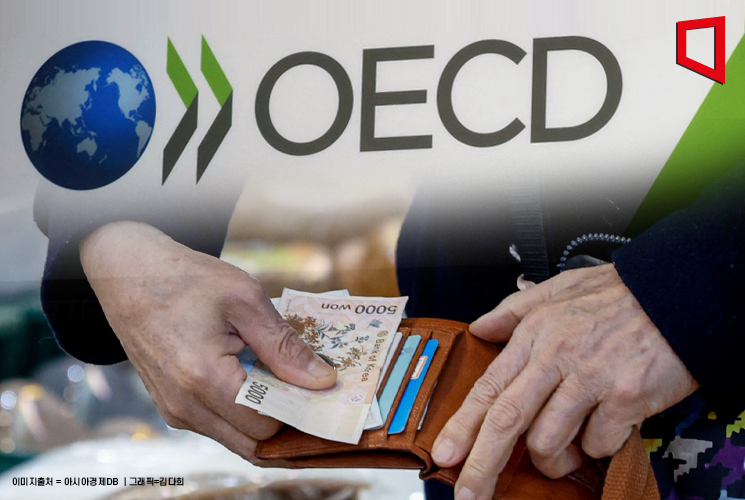
The Organisation for Economic Co-operation and Development (OECD) has revised South Korea's economic growth forecast upward to 2.6%, an increase of 0.4 percentage points from its previous projection. While exports, led by semiconductors, continue to perform well, domestic demand?which had been sluggish due to high interest rates and inflation?is expected to recover in the second half of the year alongside interest rate cuts.
On the 2nd (local time), the OECD announced this revision in its economic outlook report. In February, the OECD had lowered South Korea's growth forecast for this year by 0.1 percentage points to 2.2%, but it has now raised it by 0.4 percentage points within three months.
This suggests that the OECD anticipates a stronger-than-expected recovery trend in the South Korean economy.
The 0.4 percentage point upward revision is the second highest among G20 countries with a per capita income above $20,000, following the United States. Among all 38 OECD member countries, it ranks fourth.
The OECD stated, "The Korean economy is expected to move out of a temporary soft patch and see strengthened growth." It evaluated that "while export momentum driven by semiconductor demand recovery continues, domestic demand, which had been weak due to high interest rates and inflation, will recover in the second half of the year along with interest rate cuts."
Additionally, the economic growth forecast for next year was set at 2.2%. This is the highest figure among G20 countries with a per capita income above $20,000, alongside Australia and second only to Saudi Arabia.
Inflation near 3% is expected to gradually stabilize toward the end of the year. The inflation forecast for this year was revised downward by 0.1 percentage points to 2.6%. The forecast for next year is 2.2%, with inflation expected to settle into a stable trend and decline to the policy target level of 2.0%.
Alongside this, the OECD recommended structural reforms in fiscal policy, labor, and pensions to respond to rapid aging. Specifically, it suggested introducing fiscal rules, expanding the inflow of foreign workers, increasing youth employment, and pension reforms considering old-age security and sustainability.
It also proposed innovations in product market regulations, simplification of support for small and medium-sized enterprises, policies to promote work-family balance, and strengthening efforts to address climate change.
© The Asia Business Daily(www.asiae.co.kr). All rights reserved.

















