New York City Instagram Posts Lunchbox Introduction Video
Korean 'Avery' Brings 'Gimbap' for Lunchbox
"Healthy and Delicious" Wraps Seaweed in Foil to Eat
As the global popularity of 'K-Kimbap' soars, especially among the younger generation, a video of packing kimbap lunchboxes posted on New York's official Instagram has become a major sensation.
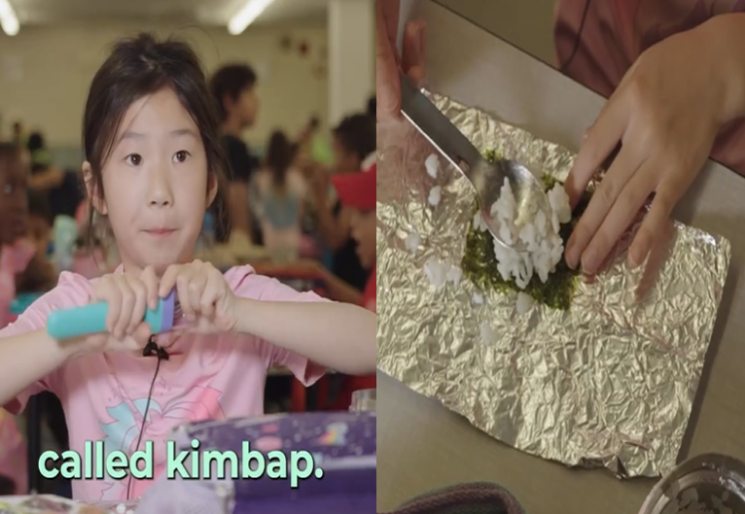 Avery (left) introducing the kimbap lunchbox packed by her mother, and Avery packing kimbap.
 Photo by New York City Official Instagram
Last September, a video titled "Making kimbap in a NYC lunchroom" was uploaded on New York City's social media platform Instagram. The video was part of the "What's in your Lunchbox?" series, which introduces the lunchboxes of children living in New York City. It featured foods eaten by children of various nationalities, including Korean, Indian, and British.
In the video, Avery reveals her lunchbox, saying, "My mom packed rice, seaweed, and foil." The lunchbox contained seasoned gim (seaweed), foil, and rice. Avery spreads the foil on the desk, places the gim and rice on top, rolls it up, and eats it. When asked why she likes kimbap, she confidently replies, "Because it's healthy and delicious."
The video became a huge hit locally. While other videos in the series garnered views of 170,000, 380,000, 630,000, and 900,000, the video related to kimbap recorded an impressive 7.76 million views. Netizens who watched the video responded positively, saying things like, "I remember when I brought kimbap to school, my friends always asked me to share," "Making and eating kimbap after immigrating to the U.S. became a special memory," "I'm glad to see children of various nationalities," and "Korea really has a lot of delicious food."
In contrast, Korean netizens humorously claimed that the kimbap looked too simple. They made lighthearted comments such as, "What if mom only sends rice?", "She should have sent ham too," "No kimchi packed," "Is that really kimbap?" and "I remember my mom dipping it in soy sauce and feeding it to me on the way to school."
Meanwhile, the popularity of kimbap overseas is so intense that a new term, 'Kimbapflation,' has emerged. According to the Korea Customs Service, the export volume of dried gim has sharply increased: ▲2020 (9,808 tons) ▲2021 (12,395 tons) ▲2022 (13,861 tons) ▲2023 (16,771 tons). Last year's export value reached $791 million (approximately 1.03 trillion KRW).
In the first quarter of this year, K-food export value increased by 3.4% compared to the same period last year, setting a new record. The Ministry of Agriculture, Food and Rural Affairs (MAFRA) announced that the provisional K-food export value from January to March was $2.27 billion, up $90 million from $2.18 billion in the same period last year. Exports of frozen kimbap, ramen, and other products showed strong growth, especially in the U.S. Kwon Jae-han, Director of Agricultural Innovation Policy at MAFRA, stated, "Korean agricultural food products are being recognized overseas for their excellent quality and taste alongside the spread of K-content. We will provide multifaceted support, including domestic and international logistics infrastructure and pioneering new markets, to maintain trust as excellent agricultural food products in the international community."
© The Asia Business Daily(www.asiae.co.kr). All rights reserved.

















