Green Umbrella Announces '2024 Child Happiness Index'
Korean children and adolescents generally sleep less and study longer.
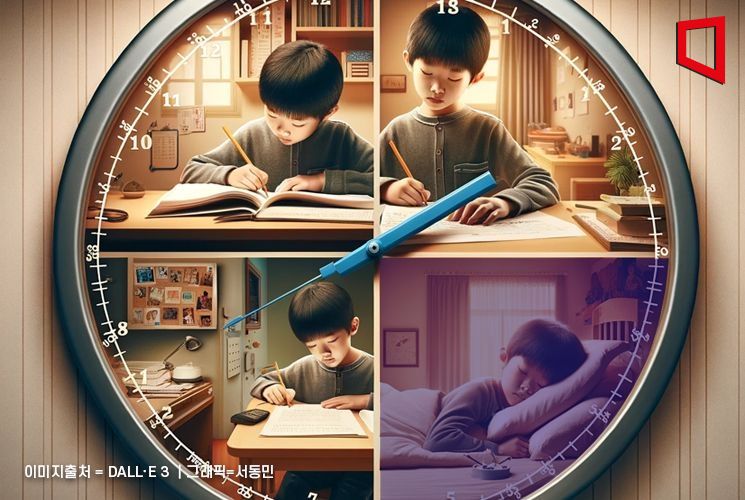
The child welfare organization Green Umbrella announced the "2024 Child Happiness Index," which analyzes the time balance in the daily lives of Korean children and adolescents, on the 2nd.
The Child Happiness Index analyzes a child's day based on four life areas: sleep, study, media, and exercise. It calculates an index representing the balance of daily life compared to the "recommended standard time," which is considered desirable from the perspective of child development and rights. The data was compiled from a self-report survey and time diaries conducted nationwide over four weeks from December 4 to 29 last year, targeting 10,140 children and adolescents from 1st grade elementary to 2nd grade high school.
Green Umbrella expanded the survey sample from about 2,000 to over 10,000 participants and newly included children from 1st to 4th grade elementary school. The survey area was also extended to all 17 provinces nationwide.
The Child Happiness Index scored 45.3 out of 100 points. This result is less than half of the perfect score, despite including lower-grade elementary students who tend to have relatively balanced daily lives due to parental care.
Overall, children's sleep time decreased while study time increased. Children classified as sleep-deprived accounted for 18.8%, and those classified as overstudying accounted for 65.1%. This indicates an increase in children who sleep less but study longer, leading to an imbalanced day compared to the recommended time. This pattern becomes more pronounced with age, showing that older students experience more unbalanced days.
Children whose four life areas corresponded to the recommended times reported a subjective happiness score 1.9 points higher than those who did not. Children with lower happiness scores commonly had difficulty falling asleep at night and felt more pressure from studying and private education burdens.
Among the surveyed children, 13.1% regularly experienced insomnia, with the rates increasing by school level: 9.3% in lower elementary, 11.0% in upper elementary, 15.3% in middle school, and 18.7% in high school. The reasons for difficulty falling asleep included "engaging in media activities such as using a cellphone late at night (29.2%)," "environmental reasons such as noise (24.4%)," "having too many tasks to do (17.0%)," and "worries about tasks for the next day (9.7%)."
Notably, 14.8% of lower elementary and 23.5% of upper elementary students reported that they could not fall asleep due to having many tasks (studying, homework, etc.) and worries about the next day's tasks. This highlights the academic burden on elementary students in Korea. Children whose main family conversations revolve around studying or who experience high achievement pressure from parents tend to suffer more from impulsive suicidal thoughts, depression, and anxiety.
Children experiencing study pressure from parents scored 44.16 on the Child Happiness Index, 1.79 points lower than the 45.95 scored by children without such pressure. Those under study pressure had shorter sleep and leisure times and longer study hours compared to those without pressure.
Additionally, the "study time outside school classes" was 37 minutes longer, indicating that children devote significant time to academics beyond scheduled school lessons. On average, 78.1% of Korean children attend private academies on weekdays, and 57.2% attend on weekends. Among lower elementary students, 84.5% attend private academies on weekdays.
Hwang Young-gi, chairman of Green Umbrella, stated, "The 2024 Child Happiness Index is an important indicator that realistically reflects the situation faced by children in Korea. It shows how crucial it is to ensure balanced living time for children's happiness and to monitor their psychological and emotional well-being. Green Umbrella will gradually specify the content by area so that the Child Happiness Index becomes a representative standard for examining children's lives and serves as a foundation for future child welfare policies in Korea."
© The Asia Business Daily(www.asiae.co.kr). All rights reserved.
![Clutching a Stolen Dior Bag, Saying "I Hate Being Poor but Real"... The Grotesque Con of a "Human Knockoff" [Slate]](https://cwcontent.asiae.co.kr/asiaresize/183/2026021902243444107_1771435474.jpg)
















