Before FOMC announcement 157 yen → after 153 yen
"Appears to be yen purchase by authorities"
Amid the announcement of the Federal Open Market Committee (FOMC), which determines U.S. monetary policy, the yen exchange rate in the New York foreign exchange market experienced sharp fluctuations, raising renewed speculation that Japanese authorities may have intervened in the market. However, it is viewed as a temporary strengthening of the yen, and the trend of yen depreciation is expected to continue long-term as the interest rate gap between the U.S. and Japan remains wide.
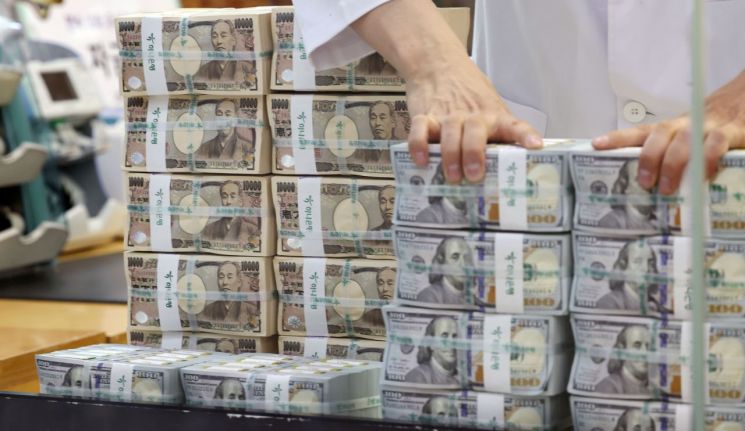
The yen-dollar exchange rate was trading in the high 157 yen range per dollar until 2 p.m. local time on the 1st, just before the FOMC meeting results were announced. Then, around 4 p.m., it dropped to 153 yen per dollar. A decline in the yen-dollar exchange rate means an appreciation of the yen.
Such a large fluctuation in a short period has led to widespread analysis in the market that the Japanese government and the Bank of Japan (BOJ) began purchasing yen. Typically, the U.S. holding interest rates steady is seen as a factor that lowers the yen’s value, but the market showed the opposite movement this time.
A representative from a Japanese bank told the Nihon Keizai Shimbun, "It appears to be yen purchase intervention by the Japanese government and the BOJ." Another bank official said, "During the period when the yen surged sharply, there were large-scale foreign exchange transactions amounting to about 5 trillion yen (approximately 44 trillion won)."
Since the first reports of market intervention by the Japanese government and the BOJ on the 29th of last month, the yen depreciation trend continued, prompting a second intervention. At that time, the yen-dollar exchange rate surpassed the 160 yen level per dollar for the first time in 34 years since April 1990. However, it then plunged more than 4 yen to the low 155 yen range, raising the possibility of intervention by authorities.
Japanese authorities, including the Ministry of Finance, have not yet issued an official statement regarding currency intervention, but the market is highly considering the possibility of intervention in response to the exchange rate fluctuations on this day as well. According to Bloomberg News, Masato Kanda, Financial Vice Minister of Japan’s Ministry of Finance, avoided a direct answer when asked about intervention and said, "We plan to disclose data at the end of this month."
The market is warning that despite authorities’ intervention, the yen’s weakness may persist long-term. Some forecasts suggest that the yen exchange rate, which was around 140 yen per dollar at the beginning of the year, could reach the 170 yen level. The Nihon Keizai Shimbun reported, "The foreign exchange market expects the interest rate gap between the U.S. and Japan will not narrow for the time being," and "selling pressure on the yen remains strong." In particular, it is analyzed that the yen selling trend accelerated further after the BOJ held interest rates steady at the April Monetary Policy Meeting.
Meanwhile, on this day, the BOJ released the minutes of the March Monetary Policy Meeting, where it raised interest rates for the first time in 17 years. The BOJ stated, "We have reached a situation where the 2% price stability target can be achieved," and "a tight financial environment will continue for the time being." However, it explained, "This is not aiming for monetary tightening like the U.S. and Europe, but rather part of efforts to achieve the price stability target." Meeting participants reached a consensus that long-term interest rates are fundamentally determined by the financial markets.
© The Asia Business Daily(www.asiae.co.kr). All rights reserved.