Adjustment of 33 Routes Including Daegwangwi, Gyeonggi-do, Incheon, Gangnam, and Myeongdong
Turnaround Route Adjustments and Transition Promotion... Traffic Volume Reduced by 26-27%
Minimizing Inconvenience and Confusion for Existing Users... Minimizing Congestion When Establishing New Routes
The Seoul Metropolitan Government is set to adjust metropolitan bus routes targeting sections with severe congestion during commuting hours, such as Gangnam and Myeongdong. This decision comes from the assessment that the concentration of metropolitan bus routes in these areas is exacerbating downtown congestion at specific times.
On the 2nd, Seoul announced that it will adjust 33 metropolitan bus routes in the Seoul metropolitan area in collaboration with the Ministry of Land, Infrastructure and Transport’s Metropolitan Area Transport Commission (MADC), Gyeonggi Province, and Incheon City to alleviate congestion at road bus stops in major downtown areas like Gangnam and Myeongdong.
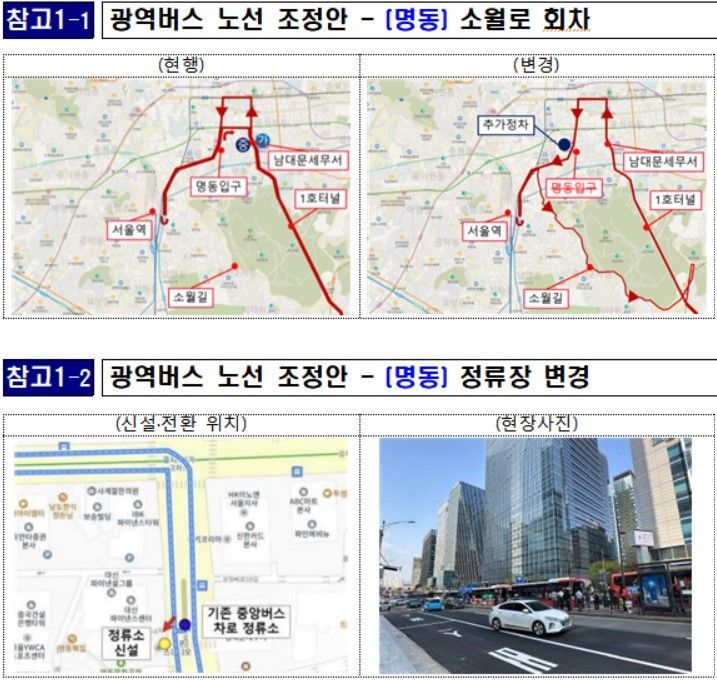
The main adjustments for Myeongdong include ▲turnaround route changes (2 routes: Namsan No.1 Tunnel → Sowol-gil, effective June 29) ▲installation and conversion of curbside stops (11 routes: Namdaemun Tax Office → Myeongdong Cathedral, effective May 16). For Gangnam, measures include ▲reverse-direction operation (5 routes: central bus lane southbound → northbound, effective June 29) ▲conversion of operating lanes (15 routes: central → curbside, effective June 29) to minimize congestion.
Currently, Myeongdong experiences frequent congestion near the 'Myeongdong Entrance' and 'Namdaemun Tax Office (middle)' stops. This is because about 30 metropolitan bus routes from the southern Gyeonggi region, heading to destinations like Seoul Station, pass through the Namsan No.1 Tunnel, stop at Seoul Station and other destinations, then pass Myeongdong Entrance before returning to downtown via the Namsan No.1 Tunnel. Accordingly, the turnaround routes of two lines will be adjusted from the existing Namsan No.1 Tunnel to Sowol-gil at the southern end of Namsan. Sowol-gil is currently served by some Seoul city buses and airport limousines and experiences less congestion than the Namsan No.1 Tunnel during peak hours, which is expected to shorten bus travel times. The effect of reducing congestion at the Namsan No.1 Tunnel through route dispersion will be monitored, and additional route changes will be considered if necessary. As a result, bus traffic at 'Myeongdong Entrance' and 'Namdaemun Tax Office (middle)' is expected to decrease during peak hours from 71 to 61 buses per hour and from 143 to 106 buses per hour, respectively, easing the load on these stops.
In the Gangnam area, where 30% of metropolitan buses are concentrated, many routes are focused on the southbound central bus-only lane on Gangnam-daero. The Shin-sa to Yangjae section, which normally takes about 20 minutes, experiences bus train congestion during the afternoon rush hour, with various buses lined up, sometimes taking up to 60 minutes. To address this, five routes operating in this section will be reversed during afternoon hours to run northbound on the central bus-only lane.
On some sections, buses will operate on curbside lanes instead of the central bus-only lane. Considering that nine routes that turn around at Yangjae and operate back and forth on Gangnam-daero only have passengers alighting on the southbound section, the stops will be switched to curbside starting from the 'Line 2 Gangnam Station (middle)' stop.
Additionally, to reduce the load on the central bus-only lane, six more routes will be adjusted to stop at curbside stops such as 'Raemian Apartment' and 'Financial News' instead of 'Shinbundang Line Gangnam Station (middle)'. Seoul expects that these measures will significantly reduce bus traffic at the main congested stops 'Shinbundang Line Gangnam Station (middle)' and 'Bangbang Intersection (middle)' during peak hours from 198 to 145 buses per hour and from 225 to 193 buses per hour, respectively, thereby easing congestion in the central lane.
Seoul projects that through these route adjustments, bus traffic passing through congested stops in Gangnam and Myeongdong during the evening rush hour will decrease by 26% and 27%, respectively, and travel times will be reduced by 8 minutes (Seoul Station to Soonchunhyang University Hospital) and 12 minutes (Sinsa to Bangbang Intersection), respectively. Yoon Jong-jang, Director of Urban Transportation at Seoul City, stated, "Through cooperative governance with MADC, Gyeonggi Province, Incheon City, and related agencies, we have derived and implemented optimal improvement plans to alleviate metropolitan bus congestion in areas such as Myeongdong Entrance, Namdaemun Tax Office, and Gangnam Station." He added, "We will continue to improve metropolitan transportation through ongoing consultations with related agencies including MADC, Gyeonggi Province, and Incheon City for the convenience of public transit users not only in Seoul but across the metropolitan area."
© The Asia Business Daily(www.asiae.co.kr). All rights reserved.
![Clutching a Stolen Dior Bag, Saying "I Hate Being Poor but Real"... The Grotesque Con of a "Human Knockoff" [Slate]](https://cwcontent.asiae.co.kr/asiaresize/183/2026021902243444107_1771435474.jpg)
















