"Doctors Increased Over 10 Years but Move to Seoul, Not Provinces"
"While Residency Applicants Increase, Pulmonology Applicants Decrease"
There is an argument that the government's plan to increase medical school quotas cannot solve the issues of essential medical care and regional healthcare.
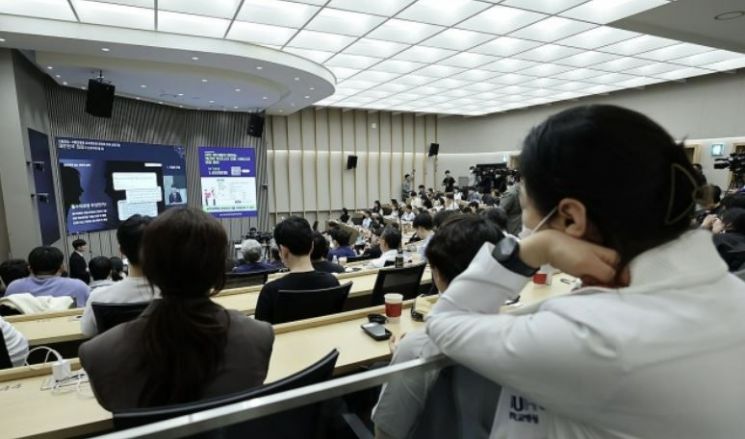 On the afternoon of the 30th, an emergency symposium of the Seoul National University College of Medicine-Seoul National University Hospital Professors' Council Emergency Committee is being held at the CJ CheilJedang Hall of Seoul National University Hospital. [Image source=Yonhap News]
Professor Oh Juhwan of Seoul National University College of Medicine stated this at an emergency symposium held by the Seoul National University College of Medicine-Seoul National University Hospital Faculty Council Emergency Committee on the 30th. Professor Oh said, "About 2,000 doctors retire each year, and the medical school quota is 3,000, so the number of doctors has increased by 1,000 annually," adding, "As the retirement age has gradually been postponed, the number of doctors has increased by 20,000 over the past decade."
He continued, "The increased number of doctors went to Seoul, not to the provinces," and added, "This result shows that even if the medical school quota is increased, doctors do not go to regional areas."
He also argued that increasing the medical school quota cannot solve the problem of essential medical care. He said, "From 2018 to 2022, the number of interns and residents applying continuously increased, naturally increasing the number of specialists, but the application rate for pediatrics and adolescent medicine specialists decreased," adding, "Even if the number of doctors increases, there is no guarantee that current trends will not continue, and simply increasing the medical school quota will not produce the results the government desires."
He explained, "The biggest reason the public supports expanding medical school quotas is probably due to 'three-minute consultations,'" and added, "In reality, doctors will not go to medical sites where there is currently a shortage of personnel."
Concerns about side effects from the increase in the number of doctors were also raised. It is expected that the burden on the health insurance budget will significantly increase due to the rise in the number of doctors. He said, "Korea's current medical expenditure as a percentage of GDP exceeded 9.6% in 2022, which is higher than the OECD average of 9.5%," adding, "If the number of doctors increases according to the government's plan, it is expected to approach 16% of GDP by 2030, but there is no appropriate way to secure funding."
© The Asia Business Daily(www.asiae.co.kr). All rights reserved.

















