Regarding the Public Deliberation Committee's Investigation Results
Opposition: "The Nation's Responsibilities Have Become Clear"
Ruling Party: "Future Generations' Opinions Not Reflected"
The National Assembly's Special Committee on Pension Reform received a report on the results of the pension reform public opinion survey conducted by the Deliberation Committee on the 30th. The ruling and opposition parties clashed over how to incorporate the income guarantee plan, also known as the "pay more, get more" plan, which was supported by the majority of respondents in the public opinion survey, into the framework of pension reform in the National Assembly. They also debated President Yoon Seok-yeol's stance on handling pension reform within the 21st National Assembly and the credibility of the government's submitted fiscal estimates. For now, both parties expressed their intention to strive for an agreement on pension reform during the remaining period of the 21st National Assembly.
On the same day, the Special Committee held a plenary session and received the public opinion results from Kim Sang-gyun, chairman of the Special Committee's Deliberation Committee. From the outset of the discussion, the ruling and opposition parties clashed over the nature of the Deliberation Committee's survey results.
Earlier, the Deliberation Committee announced that after a public opinion survey involving learning and discussion, 56.0% of citizens supported the income guarantee plan (raising the insurance premium rate to 13% while increasing the income replacement rate to 50%). The income guarantee plan, known as the "pay more, get more" plan, was supported by the opposition party. The ruling party reportedly preferred the fiscal stability plan (raising the insurance premium rate to 12% while maintaining the income replacement rate at 40%), which 42.6% of participating citizens agreed with. Trends from three rounds of public opinion surveys showed more citizens supported the fiscal stability argument, but voices in favor of the income guarantee plan grew stronger through the discussion process.
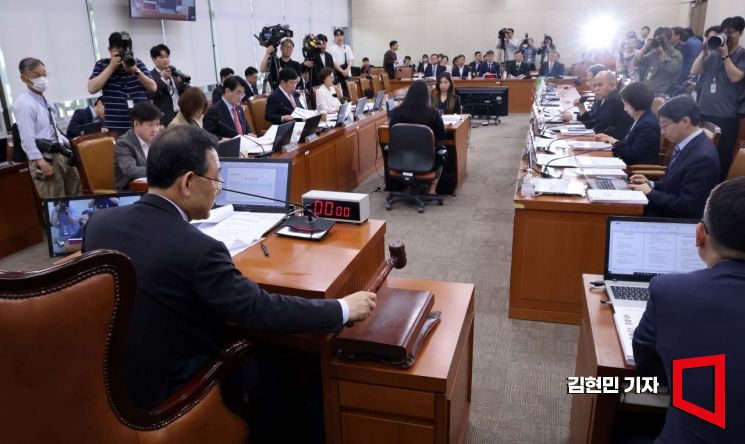 On the 30th, at the plenary meeting of the Special Committee on Pension Reform held at the National Assembly, Chairman Joo Ho-young is striking the gavel. Photo by Hyunmin Kim kimhyun81@
Opposition lawmakers expressed the view that since the public opinion survey confirmed the will of the people, the direction of pension reform should be based on the income guarantee plan. Lee Yong-woo, a Democratic Party lawmaker, evaluated, "The goal of pension reform is to guarantee old-age living," adding, "It is significant that it has become clear what the state must do."
On the other hand, ruling party lawmakers pointed out problems with the public opinion survey and stated that it should be considered only as a reference. Yoon Chang-hyun, a People Power Party lawmaker, raised issues such as the opinions of future generations, including those under their teens, not being reflected in the survey, and the naming of the two plans?one called income guarantee and the other fiscal stability?despite only a 10 percentage point difference in income replacement rates. Yoon criticized, "When you say fiscal stability, it feels like a sacrifice for the country, but when you say income guarantee, it feels like the individual's position is considered."
Joo Ho-young, chairman of the Special Committee from the People Power Party, met with reporters after the committee meeting and said, "Regarding the survey results, the ruling party seems to see it simply as one reference material, while the opposition sees it as the people's will that the National Assembly must resolve somehow," adding, "If the National Assembly is completely bound by the public opinion survey, the Special Committee becomes meaningless, and if it is not bound, then the Deliberation Committee is meaningless. There are many opinions that interpreting the results by both parties is not necessarily a matter of choosing one or the other." He suggested that a compromise solution might be sought instead of a binary choice.
Interpretation of President Yoon's remark, "Let's leave pension reform to the 22nd National Assembly," also became a point of contention.
During the plenary session, President Yoon's remarks were also a topic of debate. Park Sung-jun, chief spokesperson for the Democratic Party, introduced at a briefing after the summit meeting the previous day that President Yoon said, "It is difficult to do it in the 21st National Assembly, so how about discussing and deciding it more in the 22nd National Assembly?" Jin Sung-jun, chairman of the Democratic Party Policy Committee who attended the summit, also explained repeatedly, "President Yoon responded that although Chairman Joo urged to hurry with pension reform, since the 21st National Assembly has little time left, it is difficult to discuss it here and it should be discussed in the 22nd National Assembly."
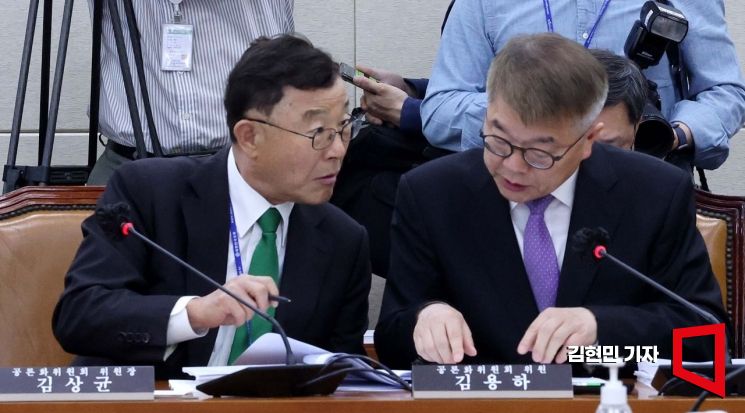 On the 30th, at the plenary meeting of the Special Committee on Pension Reform held at the National Assembly, Chairman Kim Sang-gyun of the Public Deliberation Committee and member Kim Yong-ha are having a conversation. Photo by Hyunmin Kim kimhyun81@
Regarding the intent of the remark, Kim Sung-joo, Democratic Party pension special committee secretary, said, "We are trying our best to reach an agreement on pension reform during the remaining period of the 21st National Assembly, but the president's lack of will and saying it will be done in the 22nd Assembly is quite discouraging," demanding an explanation from the government. In response, Lee Ki-il, first vice minister of the Ministry of Health and Welfare, said, "(The timing of pension reform) is a matter for the National Assembly's Special Committee to discuss and decide. The government will also actively cooperate and participate," adding, "(President Yoon's summit remarks) were an expression of willingness that if a sustainable and desirable pension reform plan is produced for the people, the government will actively join." Regarding the mention of the 22nd Assembly, he added, "If sufficient discussion is needed, it can be understood as meaning that discussions can continue in the National Assembly."
.
When lawmaker Kim asked Chairman Joo if there was any discussion with President Yoon about leaving it to the 22nd Assembly, Joo replied, "Not at all." Joo expressed his reform will, saying, "Regarding pension reform, I have consistently stated the position that if there is any meaningful reform in the 21st National Assembly, we should achieve results and move forward," adding, "We should not delay and must take at least one step forward."
The 'Income Guarantee Argument' Increasing Cumulative Deficits... Credibility of Fiscal Estimates Also Contested
The government reported fiscal estimates on the reform plans from the Deliberation Committee on the same day. If the income guarantee plan passes, pension depletion can be delayed somewhat, but the size of cumulative deficits may increase. According to the "Fiscal Estimates on Deliberation Agenda" submitted by the Ministry of Health and Welfare to the Special Committee, under the income guarantee plan, the fund depletion point is projected to be 2061, about six years later than the current system. However, the cumulative deficit size (until 2093) is expected to increase by 1,004 trillion won compared to now. If the mandatory enrollment upper age is raised to 64, which had high support in the Deliberation Committee, the fund depletion point is expected to be 2059, two years earlier, and the cumulative deficit size is expected to increase to 5,676 trillion won.
Regarding the fiscal stability plan, the pension depletion point is projected to be 2062, seven years later than now, and the cumulative deficit size (until 2093) is estimated to decrease by 4,598 trillion won. However, if the mandatory enrollment upper age is raised to 64, the depletion point is brought forward by two years to 2060, and the deficit reduction effect decreases to 833 trillion won.
Democratic Party lawmaker Jung Tae-ho pointed out the concept of cumulative deficit appearing in the estimates and the pension yield rate used in the fiscal estimates. The estimates applied a 4.5% yield rate, but from 1998 to 2023, the yield rate was higher at 5.92%. Jung criticized, "The government seems to have an intention to deliberately give a negative image to the Deliberation Committee's results." Regarding the criticism that the cumulative deficit concept appeared for the first time in this estimate, Vice Minister Lee explained, "It has been continuously discussed."
© The Asia Business Daily(www.asiae.co.kr). All rights reserved.


















