Korea Consumer Agency Announces Zero Food Investigation Results
Non-Alcoholic Beer '0.0' Label... Misleading as Alcohol-Free
A survey found that the calorie and sugar content of zero-sugar soju sold on the market is not significantly different from that of regular soju. Additionally, the '0.0' labeling on non-alcoholic beer was found to have a high potential to mislead consumers.
The Korea Consumer Agency announced on the 1st that these results came from an investigation into the sugar and calorie content of zero foods. The survey targeted five soju brands currently sold on the market: Cheoeumcheoreom, Daesun, Joeunday, Jinro, and Cham. For beer, the brands included Tsingtao, Cass, Kloud, Heineken, and Hite.
In the tests of the five zero-sugar soju brands, no sugar was detected; however, the comparison group of regular soju also contained an average of 0.12g of sugar per 100ml, which is within the level that can be labeled as zero sugar. According to current food labeling standards, a product can be labeled as calorie-free if it contains less than 4 kcal per 100ml, and can emphasize sugar-free labeling if it contains less than 0.5g of sugar per 100g or 100ml.
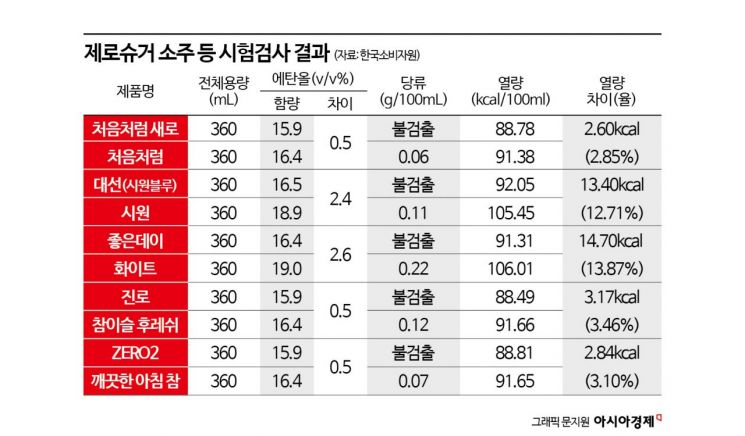
Regarding calorie content, zero-sugar soju was found to have between 2.85% (2.60 kcal) and 13.87% (14.70 kcal) fewer calories per 100ml compared to regular soju. However, since the alcohol content was also lower by at least 0.5 degrees (2.77 kcal) and up to 2.6 degrees (14.38 kcal) per 100ml, and calories vary depending on alcohol content, the difference in sugar had little impact on the calorie content of soju. Nevertheless, 68.6% of consumers who had purchased zero beverages or alcoholic drinks (1,371 out of 2,000 respondents) believed that zero-sugar soju would have significantly fewer calories than regular soju, showing some discrepancy with reality.
The Consumer Agency also pointed out that non-alcoholic beers with less than 1% alcohol content could be mistaken for alcohol-free products. Food labeling standards require that beverages be labeled as 'Alcohol free (for adults)' if the alcohol content is 0%, and as 'Non-alcoholic (for adults)' if the alcohol content is less than 1%. However, survey results showed that 57.2% of consumers (1,144 respondents) did not understand the difference between alcohol-free and non-alcoholic, and 52.3% (1,045 respondents) perceived non-alcoholic labeling as indicating no alcohol at all.
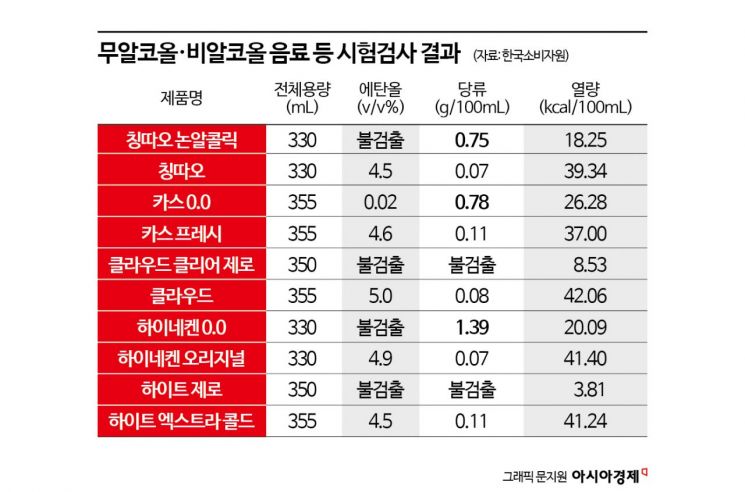
Furthermore, non-alcoholic beers use the '0.0' label, while alcohol-free beers use '0.00'. The Consumer Agency added that 83% of consumers (1,660 respondents) did not know the difference between '0.0' and '0.00', increasing the likelihood that consumers might mistakenly believe non-alcoholic beer contains no alcohol. The agency explained, "In the United States, the label 'Alcohol free' is used on product packaging only when the actual alcohol content is zero, and only then can the '0.0' label be used."
The Consumer Agency urged consumers to carefully check product information when purchasing zero-calorie or zero-sugar food and beverages. This is because only 51.7% of consumers reported that they examine nutritional content and other details before buying zero-labeled products in the survey. A representative from the agency said, "To reduce misunderstandings about the ingredients in zero foods, consumers should check the nutritional information on the back of zero product labels when purchasing."
Based on the survey results, the Consumer Agency recommended that the surveyed businesses improve their zero food labeling. It also plans to consult with related government departments on measures to improve zero-emphasis labeling.
© The Asia Business Daily(www.asiae.co.kr). All rights reserved.


















