Reflected in Former Low Birthrate Response Policy
Results Also Proposed to Government and Seoul City
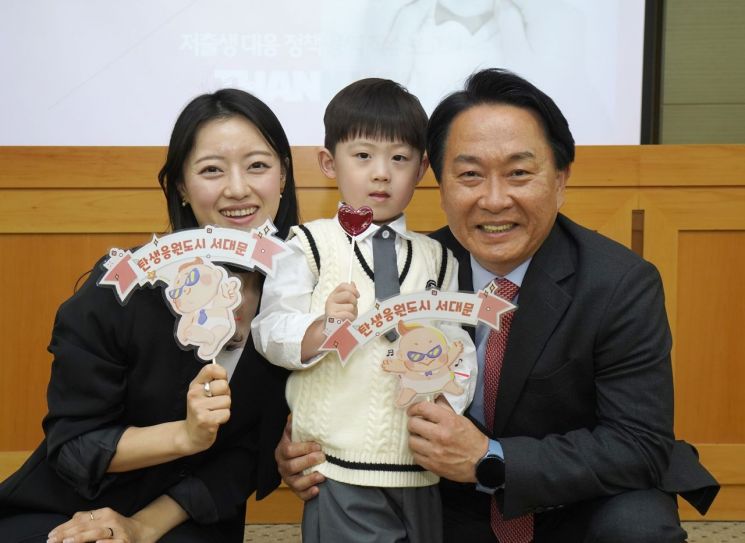 The first child of the Birth Support Group and Lee Seong-heon, Mayor of Seodaemun District. (Photo by Seodaemun District Office)
Seodaemun-gu, Seoul (Mayor Lee Seong-heon) announced on the 30th that it recently held a kickoff meeting for a research project on policy formulation in the district office's large conference room to actively respond to low birth rates and population decline.
According to provisional statistics released by Statistics Korea in February this year, the number of births in Seodaemun-gu was 1,300, and the total fertility rate dropped by 0.04 from the previous year to 0.57. Since 2018, Seodaemun-gu has entered a phase where the number of deaths exceeds the number of births, and in 2022, there were 688 more deaths than births. This represents a population decline at more than twice the speed compared to 302 in 2021 within just one year.
The district explained that to address these issues of population decline and demographic changes, it is seeking the role of the autonomous district and is promoting this policy research project to prepare practical low birth rate response measures applicable to district administration. The results of the policy research project, expected in November this year, will be reflected in Seodaemun-gu's low birth rate response policies next year and proposed to the central government and Seoul Metropolitan Government.
The low birth rate response policy research project in the district is led by Professor Jin Mi-jung of the Seoul National University Industry-Academic Cooperation Foundation, who will carry out the task over the next seven months. Seoul National University will analyze Seodaemun-gu's population structure and household type changes through population analysis, while diagnosing the achievements and limitations of Seodaemun-gu's family policies.
Additionally, surveys and focused group discussions (FGD) will be conducted targeting youth and (expectant) child-rearing households to prepare basic data for childbirth policy promotion and to understand perceptions and policy demands related to marriage and childbirth. Excellent cases of childbirth support infrastructure and services domestically and internationally will be identified, and countries often cited as successful in responding to low birth rates, such as Japan, Singapore, and Hungary, will be analyzed to investigate various policy cases and derive implications.
Based on this, the district plans to propose advanced family policies and population strategies to complete a ‘Seodaemun-gu-only low birth rate response master plan’ from a mid- to long-term perspective.
The kickoff meeting was attended by policy advisory committee members, external experts, heads of related organizations, and department heads. Key proposals included ▲ population analysis of Seodaemun-gu residents, including many foreign international students living in the district ▲ proposals for short- and mid- to long-term projects by sector through analysis of demand for childbirth promotion policies ▲ and the composition of survey questions that can derive characteristics unique to Seodaemun-gu.
At the kickoff meeting, the ‘Seodaemun-gu No. 1 Birth Support Group’ attracted attention. Kim Rana, a public official in charge of the low birth rate research project, attended with her 5-year-old child and spoke about the current childbirth and child-rearing situation she personally experiences as a working mom, a research project official, and an ordinary citizen in her 30s living in this era.
Meanwhile, Seodaemun-gu established the first low birth rate response strategic plan among Seoul's autonomous districts in December last year. To this end, it benchmarked Yeonggwang-gun, Jeollanam-do, which has ranked first in total fertility rate for four consecutive years, analyzed excellent cases overseas and from other local governments, and held three policy advisory committee meetings.
Seodaemun-gu is making continuous efforts from various perspectives to overcome the low birth rate phenomenon, including holding policy briefings proposing joint cooperation across all departments with related department heads.
Mayor Lee Seong-heon said, “Through this policy research, we aim to prepare innovative low birth rate response measures unique to Seodaemun-gu based on verified data such as population analysis and policy demand,” adding, “We will create a sustainable birth support city, Seodaemun-gu, by fostering a child-rearing friendly environment that mothers and fathers can empathize with through effective and meaningful results.”
© The Asia Business Daily(www.asiae.co.kr). All rights reserved.

















