Ruling and Opposition Parties Clash Over 'Abolition' VS 'Implementation'
Party Agreement and Internal Discussions Both Stalled
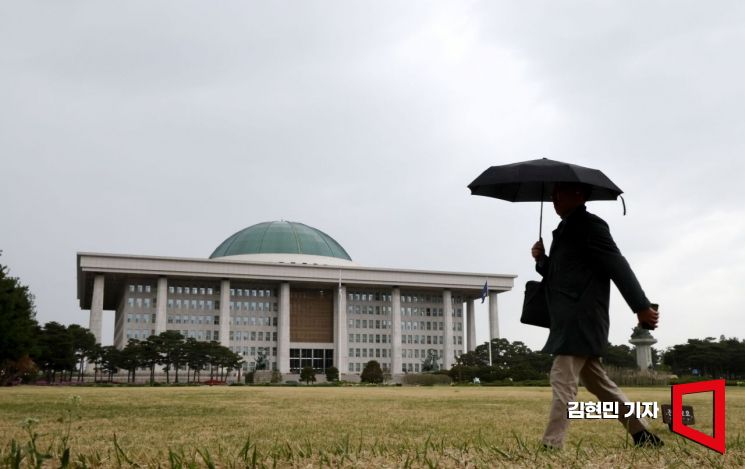 On the 15th, dark clouds gathered heavily over the National Assembly building. With the 22nd general election having concluded on the 10th, attention is focused on how the 21st National Assembly, with just over a month left in its term, will resolve pressing issues such as pension reform and the abolition of the financial investment tax. Photo by Hyunmin Kim kimhyun81@
The implementation of the Financial Investment Income Tax (FIIT) is expected to be finally decided in the 22nd National Assembly. The Ministry of Economy and Finance wants to discuss the FIIT within May, and investors are also advocating for its abolition through legislative petitions, but negotiations between the ruling and opposition parties are not easy.
On the 29th, Yoodongsoo, the Planning and Finance Committee spokesperson of the Democratic Party of Korea, said in a phone interview with Asia Economy, "Taxes are not simply decided; they must be discussed along with the budget bill, so this (FIIT) will be a matter to be discussed in the 22nd National Assembly." He also emphasized that there has been "no decision at all" regarding the 'FIIT postponement plan' raised by some members of the Democratic Party's Planning and Finance Committee.
The People Power Party and the government succeeded in postponing the FIIT, which was scheduled to be implemented in 2023, for two years and are aiming for its abolition. President Yoon Suk-yeol said in January, "Beyond the outdated controversy over tax cuts for the rich, we will push for the abolition of the FIIT, which is scheduled to be introduced next year, for the long-term coexistence of the people, investors, and our stock market." The People Power Party, centered around former Emergency Response Committee Chairman Han Dong-hoon, pledged to abolish the FIIT since the general election, and members of the Planning and Finance Committee have already proposed a bill to abolish the FIIT. If the FIIT abolition bill does not pass in the current opposition-majority situation, the FIIT will be implemented from next year.
A member of the People Power Party's Planning and Finance Committee said in a phone interview, "The Ministry of Economy and Finance expects the FIIT abolition to be addressed in the May extraordinary session of the National Assembly," adding, "However, negotiations between the ruling and opposition party committee spokespersons are necessary, but the situation is somewhat difficult right now." This is because Ryu Seong-geol, the ruling party spokesperson, is not running in the 22nd general election, making active bipartisan agreement difficult.
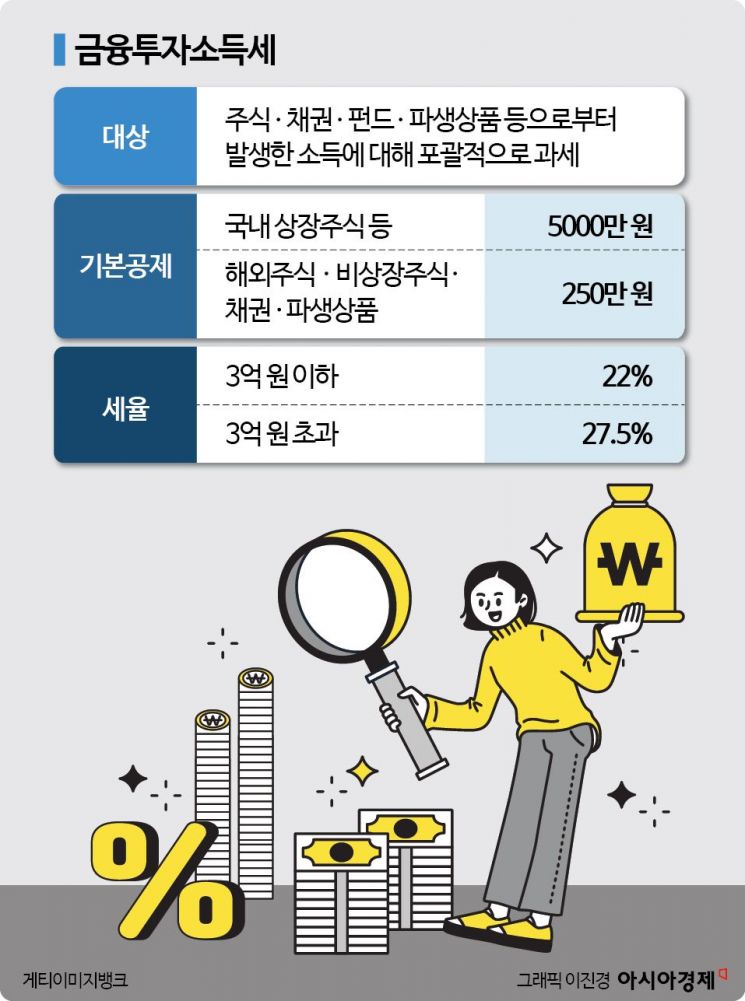
The FIIT is a tax imposed at a rate of 20% on income exceeding a certain amount (KRW 50 million for stocks and KRW 2.5 million for others) from financial investments such as stocks, bonds, funds, and derivatives, regardless of whether the investor is a major shareholder. A 25% tax is imposed on income exceeding KRW 300 million. The government and the ruling party argue that the FIIT should be abolished because it may cause investors to leave the stock market, leading to a decline in stock prices.
The Democratic Party holds the position that about KRW 4 trillion in additional tax revenue is expected if the FIIT is implemented, and the tax applies to only 1% (150,000 people) of all investors, so the FIIT should be implemented. On the 25th, Jin Seong-jun, the Policy Committee Chair of the Democratic Party of Korea, said at a policy coordination meeting, "The Yoon Suk-yeol administration first said to abolish the FIIT, which has not even been implemented, and yesterday a senior government official said that postponement is a reasonable option," adding, "We will ensure that the FIIT is implemented smoothly as scheduled from 2025."
Although the legislative petition to abolish the FIIT by investors surpassed 50,000 signatures within a week, it is not easy for the FIIT discussion to gain momentum. Not only is bipartisan agreement an issue, but internal party discussions are also not actively taking place. A member of the Democratic Party's Planning and Finance Committee said, "There is no discussion among Democratic Party Planning and Finance Committee members regarding the FIIT," adding, "What appears in the media is only from the party's Policy Committee level."
© The Asia Business Daily(www.asiae.co.kr). All rights reserved.
![User Who Sold Erroneously Deposited Bitcoins to Repay Debt and Fund Entertainment... What Did the Supreme Court Decide in 2021? [Legal Issue Check]](https://cwcontent.asiae.co.kr/asiaresize/183/2026020910431234020_1770601391.png)

















