Industrial Production Down 2.1%, Facility Investment Down 6.6%, Retail Sales Up 1.6%
Production Sees Largest Decline in Over 4 Years Since February 2020
Contrasts with Bank of Korea's GDP Flash Estimate Showing 'Surprising Growth'
Industrial production in March turned negative for the first time in five months, marking the largest decline in over four years. Facility investment also decreased by 6.6% compared to the previous month. This contrasts sharply with the Bank of Korea’s preliminary estimate of 1.3% GDP growth for the first quarter, announced on the 25th, which showed a surprising growth trend. The government explained that this was due to a base effect from the favorable economic conditions up to February and differences in the methods of compiling industrial activity trends and GDP, but it seems difficult to dispel concerns about the real economy’s trajectory.
According to the “March 2024 Industrial Activity Trends” released by Statistics Korea on the 30th, total industrial production last month fell by 2.1% from the previous month. After increases of 0.3% in November last year, 0.4% in December, 0.3% in January, and 1.1% in February, the growth trend that lasted four months turned negative for the first time in five months. This is the largest decline in 49 months since February 2020 (-3.2%).
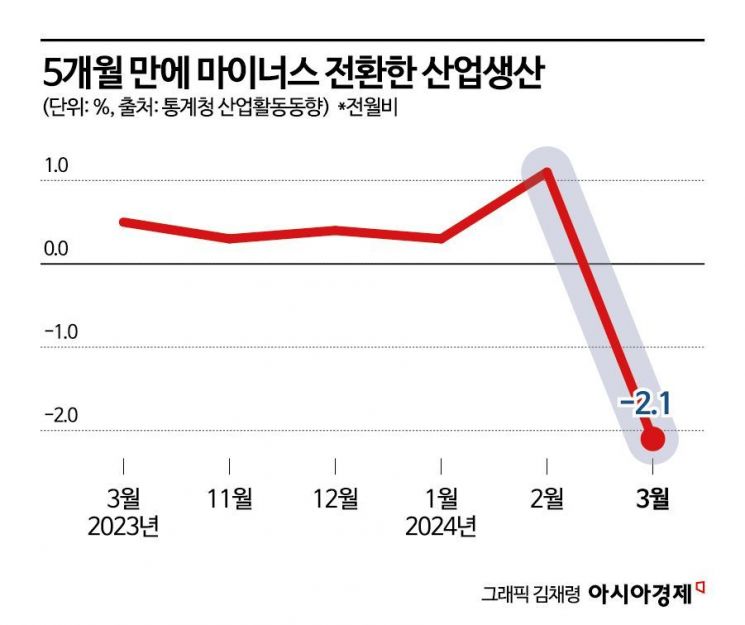
Production declined as mining, manufacturing, and electricity and gas industries (광공업, -3.2%), construction (-8.7%), and services (-0.8%) all decreased. Manufacturing, which accounts for most of 광공업 production, dropped by 3.5%. By sector, production in metal processing, including land metal structures and storage metal tanks, fell by 10.6%, and electronic components decreased by 7.8% due to a decline in IT LCD production. Gong Misook, Economic Trend Statistics Officer at Statistics Korea, explained that this was an “effect of the base impact observed until last month.” It was diagnosed as a temporary adjustment following four consecutive months of production increases. The Ministry of Economy and Finance also stated that “the adjustment in March was due to monthly volatility.”
On a quarterly basis, total industrial production increased by 0.7% compared to the previous quarter. 광공업 production decreased by 0.4% quarter-on-quarter. This differs from the Bank of Korea’s preliminary GDP estimate for the first quarter announced on the 25th, which showed manufacturing increasing by 1.2% quarter-on-quarter. The Ministry of Economy and Finance explained that this difference stems from the different compilation methods of GDP and industrial activity trends. Lee Seunghan, Director of the Comprehensive Policy Division at the Ministry of Economy and Finance, said, “If GDP coverage is 100, the 광공업 indicator in industrial activity trends covers about 84.6%. Industrial activity trends do not encompass about 15% of what GDP covers.” Industrial activity trends conduct sample surveys for companies with fewer than 100 employees, whereas GDP surveys all companies, which accounts for the difference. In the service sector, production increased in transportation and warehousing (1.4%) but decreased in wholesale and retail trade (-3.5%) and restaurants (-4.4%).
Facility Investment Down 6.6%... Retail Sales Turn Positive
Facility investment also decreased by 6.6% compared to the previous month. Machinery investment fell by 7.8% as semiconductor companies reduced equipment purchases in March, and transportation equipment investment shrank by 2.9% due to a decline in passenger car imports. After a sharp increase of 9.6% in February, the trend reversed to a decline. Officer Gong said, “Many indicators showed strong growth in January and February, so March showed a downward adjustment,” adding, “Exports remained strong last month, and the index level itself is not bad, so this is seen as a temporary adjustment.”
Construction performance, which includes building (-9.5%) and civil engineering (-6.0%) works, also decreased by 8.7%. After a significant increase of 12.7% in January, it declined by 1.0% in February and continued the negative trend in March. The Ministry of Economy and Finance explained that the decrease was due to the base effect from the sharp rise at the beginning of the year in both building and civil engineering. For buildings, the completion of large apartment complexes ended in February, and for civil engineering, the progress of large-scale plant projects decreased.
On the other hand, retail sales, which indicate consumption, turned positive after one month, increasing by 1.6% compared to the previous month. Durable goods sales rose by 3.0% due to a significant increase in passenger car sales, and nondurable goods sales increased by 2.4% as cosmetics sales expanded during March’s cosmetics sale events. However, semi-durable goods sales, mainly clothing, decreased by 2.7%.
However, on a quarterly basis, retail sales decreased by 0.2% compared to the previous quarter. This contrasts with the Bank of Korea’s preliminary estimate of a 0.8% increase in private consumption for the first quarter. The Ministry of Economy and Finance explained that the retail sales index only covers goods, whereas the Bank of Korea’s data includes both goods and services and also accounts for consumption occurring overseas, which caused the discrepancy. Director Lee emphasized, “The overall economic trend is better understood through GDP rather than industrial activity trends, which aligns with global standards.”
© The Asia Business Daily(www.asiae.co.kr). All rights reserved.
!["The Woman Who Threw Herself into the Water Clutching a Stolen Dior Bag"...A Grotesque Success Story That Shakes the Korean Psyche [Slate]](https://cwcontent.asiae.co.kr/asiaresize/183/2026021902243444107_1771435474.jpg)
















