Expressing Reflections on Public Transportation Route Reorganization Policy at On-Site Briefing on Municipal Issues
Explaining Efforts and Achievements in Transfer System Reorganization, "We Will Do Our Best in Service Management"
Yoon Byung-tae, mayor of Naju City, apologized for the inconvenience and confusion caused to citizens due to bus transfer issues in some areas following the public transportation route reorganization policy, saying, “I am sorry for causing inconvenience and confusion to the citizens, contrary to the purpose of the reorganization.”
Mayor Yoon made these remarks in response to questions about the city bus route reorganization during a recent major city administration briefing held at the Yeongsangang Garden construction site.
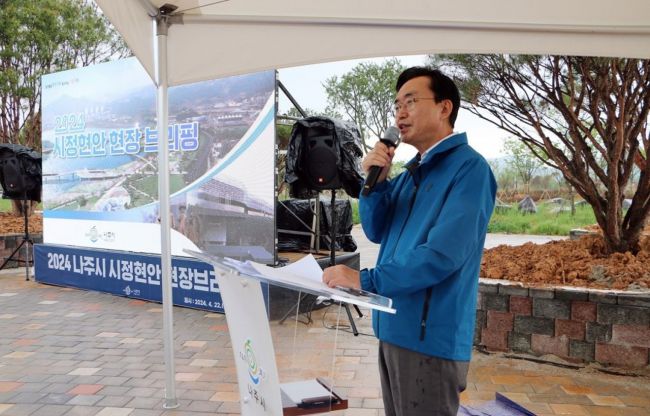
At the Q&A session of the briefing, Mayor Yoon explained the purpose and objectives of the public transportation route reorganization and the efforts made to improve citizen inconvenience in response to a question stating, “Since the reorganization of public transportation routes was implemented in October last year as a key policy of the 8th elected administration, there have been achievements such as express buses and the Bitgaram-dong call bus, but transfer inconveniences have been raised in some areas, and I understand several improvements have been made.”
He also mentioned key achievements such as the increase in users after the introduction of the Naju call bus in Bitgaram-dong, the establishment of a transfer system for village buses in the eastern region, and the improvement of public transportation service quality.
Mayor Yoon first explained the purpose of the route reorganization, saying, “Despite excessive subsidies to transportation companies, the quality of service has been low due to rudeness, failure to stop, and cancellations, causing continuous inconvenience to citizens. We focused on streamlining 223 overlapping routes and implemented a comprehensive route reorganization on October 2 last year.”
Naju City implemented the route reorganization and established new express bus routes on October 2, 2023, aiming to improve passenger convenience through route streamlining and increasing village buses, connecting “metropolitan buses - city buses - village buses.”
After the route reorganization, the city made two improvements on October 25 and December 20 last year based on citizen complaints received through dialogues with residents, extending transfer times and striving to alleviate public transportation inconveniences.
Despite these efforts, transfer system inconveniences between city buses and village buses have continuously been raised in township areas with a high proportion of elderly residents, such as Donggang, Gongsan, Wanggok, Bannam, Dasi, Munpyeong, Seji, and Bonghwang-myeon.
In response, Mayor Yoon held an on-site meeting with residents at the Donggang-myeon Administrative Welfare Center on March 7 to listen to complaints about village bus transfers and announced urgent measures to resolve public transportation transfer inconveniences.
Through this, on March 18, village buses in Donggang, Gongsan, Wanggok, and Bannam-myeon, and on April 15, those in Seji, Bonghwang, Dasi, and Munpyeong areas were changed to direct routes to Yeongsanpo and Naju Terminal without transfers.
Mayor Yoon said, “The village bus direct route reorganization is not a return to the pre-reorganization state but a change to some regional bus routes to resolve transfer inconveniences.”
He added, “Currently, village buses operating in the eastern region, such as Nampyeong, are running with a transfer system applied.”
Mayor Yoon emphasized the main achievement of the route reorganization policy, saying, “We reduced 223 overlapping routes to 60, improving operational efficiency.”
For example, the 100 to 109 bus routes that operated in Donggang, Gongsan, Wanggok, and Bannam areas were significantly reduced from 52 to 9 routes.
In the case of the Bitgaram-dong call bus, the average monthly number of users was about 9,600, approximately four times higher than the existing public bus users (about 2,200).
He also strongly urged the increase of metropolitan buses between Naju and Gwangju, which had caused inconvenience due to unilateral reductions by transportation companies, and improved the situation.
The metropolitan bus 160, which had been reduced from 23 to 10 vehicles, was increased by 8 vehicles, with the number of trips rising to 108 per day and intervals shortened to 15-20 minutes.
For metropolitan bus 999, the number of vehicles increased from 7 to 9, with 52 trips per day and a reduced interval of 23 minutes during rush hours.
Mayor Yoon Byung-tae said, “I once again apologize for causing inconvenience and confusion to citizens contrary to the purpose of the public transportation reorganization,” and added, “We will continue to do our best to manage public transportation services prioritizing passenger convenience, including rational adjustment of bus timetables based on transportation welfare, improvement of bus stop facilities, and enhancement of courtesy.”
Naju = Asia Economy Honam Reporting Headquarters Reporter Kim Yuk-bong baekok@asiae.co.kr
© The Asia Business Daily(www.asiae.co.kr). All rights reserved.
![Clutching a Stolen Dior Bag, Saying "I Hate Being Poor but Real"... The Grotesque Con of a "Human Knockoff" [Slate]](https://cwcontent.asiae.co.kr/asiaresize/183/2026021902243444107_1771435474.jpg)
















