From Tender Offers to Delisting... 3 Cases Last Year and Already 3 This Year
Disclosure Obligations and Stock Price Management Risks Resolved Through Shareholder Simplification
"Active Activism Also a Factor in Market Exodus"
Voluntary delisting initiated by private equity funds (PEFs) through tender offers is on the rise. Including companies currently undergoing the process, there have already been three cases this year, matching the number of voluntary delistings completed last year. Analysts suggest that this trend is becoming more active as the burden on listed companies increases due to 'activism' and 'corporate value-up programs.'

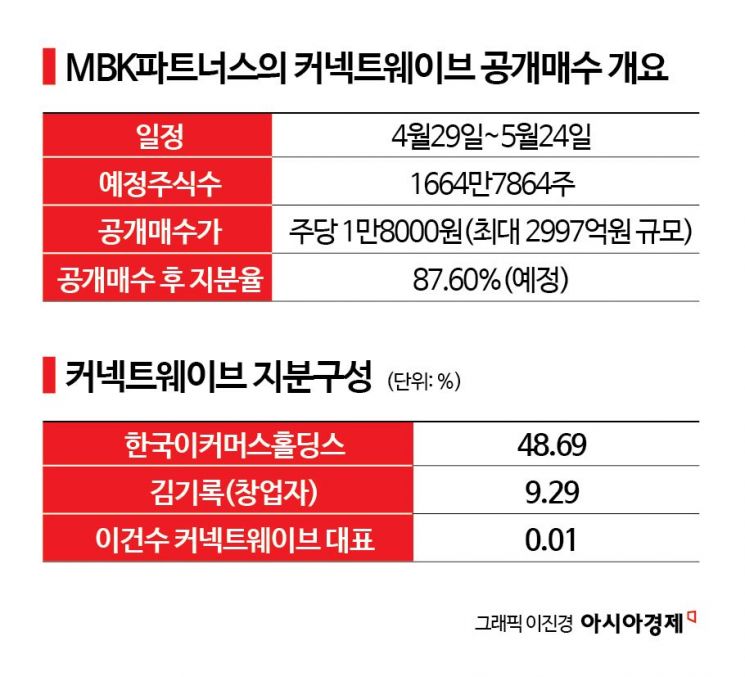
According to the Financial Supervisory Service's electronic disclosure system on the 30th, Korea E-commerce Holdings announced that it will conduct a tender offer for the delisting of Connectwave, a KOSDAQ-listed company, from the 29th until next month 24th. Korea E-commerce Holdings is a corporation established with 100% investment from MBK Partners, a PEF operator. It currently holds 48.69% of Connectwave's shares. The tender offer targets 16,647,864 shares, which is 29.61% of the total potential issued shares, at a price of 18,000 KRW per share. If all shares are acquired, the total amount will be 299.7 billion KRW. After the tender offer, voluntary delisting procedures will be initiated. Connectwave operates the e-commerce platform 'Danawa.'
Simplified Shareholder Structure Enables Swift Decision-Making
The acquisition of the remaining shares through this tender offer aims to achieve the 95% ownership threshold required for voluntary delisting. This strategy is known in English as 'take private.' It involves turning a listed company into a private one. This year, domestic PEF operator Hahn & Company raised its stake in Ssangyong C&E to about 93% through a tender offer, and Hong Kong-based PEF operator Affinity Equity Partners is conducting a tender offer for Lock&Lock shares. In total, three 'take private' cases are currently underway.
Last year, three companies were delisted through the same procedure: Osstem Implant, Lutronic, and SK Rent-a-Car. Among them, Osstem Implant and Lutronic were led by PEFs. SK Rent-a-Car was delisted to become a 100% subsidiary of SK Networks. The reason for employing this strategy is that private companies are easier to manage than listed ones. Seungwoong Kwak, Vice President of UCK Partners, who led Osstem Implant's delisting along with MBK Partners last year, said, "Because the shareholder structure can be simplified, decision-making in private companies is much faster and more efficient than in listed companies," adding, "Delisting itself is not the goal but a means to improve governance." Ultimately, the explanation is that companies leave the stock market to increase corporate value and enhance investment returns through 'value-up.'
Some Influence from 'Activism' and 'Corporate Value-Up Programs'
Another advantage cited is the ability to avoid various disclosure obligations. Listed companies are required to disclose major management decisions and information to the market. An investment banking (IB) industry official said, "The increase in activities by activist funds and minority shareholders has intensified interference in the management of listed companies compared to before, which is one of the reasons for leaving the stock market," adding, "'Corporate value-up programs' are carrot-oriented policies, but if penalties are introduced, they could pose additional risks and thus be perceived as burdensome." According to the Financial Supervisory Service, the number of listed companies and agenda items receiving shareholder proposals at regular general meetings increased from 26 companies (59 cases) in 2020 to 40 companies (93 cases) this year.
Stock price fluctuations can also be a burden. In many cases, PEFs take loans secured by the shares of the companies they acquire. If the stock price falls below the acquisition price, losses may occur. In the worst case, this could lead to a loss of the benefit of the term, known as 'default.' In fact, in the past, IMM Private Equity (PE) faced a loss of benefit of the term on acquisition financing when Able C&C's stock price dropped significantly. The situation has since fully normalized. From the perspective of limited partners (LPs) investing in PEFs, there is little merit in paying fees to private equity funds to invest in shares of listed companies that can be traded directly on the market, which is also a factor encouraging 'privatization.'
© The Asia Business Daily(www.asiae.co.kr). All rights reserved.


















