The number and size of Korean fir (Abies koreana) populations on Yeongchuksan Mountain (1081m) in Yangsan City, Gyeongnam Province, have been confirmed to have decreased.
The Korea National Arboretum announced on the 29th that the number of Korean fir individuals in the Yeongchuksan population decreased from 6 in 2014 to 4 this year, and the average crown size of mature trees shrank by 31.8%.
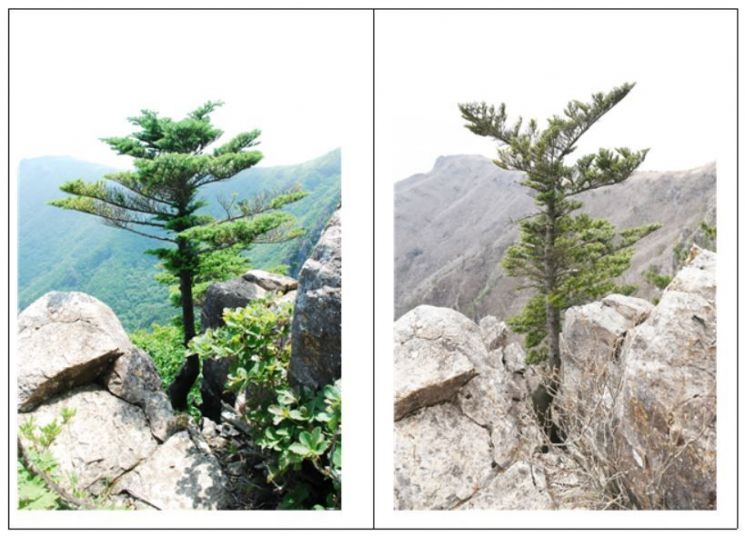 Comparison photos of mature Korean fir trees in June 2014 (left) and April 2024 (right). Although the diameter at breast height (14.0 cm) of this tree did not change over the 10 years, the crown width decreased from 15.9㎡ to 9.1㎡. Climate change-related stress is cited as the cause of this change. Provided by the National Arboretum
In the first survey in 2014, the population consisted of 3 mature trees and 3 young trees, but this year only 3 mature trees and 1 young tree remain. Two young trees have disappeared.
The height and crown size of mature trees also decreased. Over the past 10 years, the average height of mature trees was 4.5m, but this year it was measured at 4.2m. During the same period, the average crown area shrank from 33.0㎡ to 25.1㎡. However, the average diameter at breast height increased from 19.0cm to 21.2cm.
The surviving young individuals showed increases in diameter and height, but their crown width decreased.
The research team at the Korea National Arboretum concluded that the decrease in height and crown width of mature trees is due to the species' stress response and balance adjustment process. However, the cause of mortality among young individuals remains unclear.
Korean fir is a high-altitude conifer species endemic to the Korean Peninsula and is considered a representative climate change-sensitive species.
Yeongchuksan is the driest habitat among Korean fir growing areas and is regarded as the place where changes in Korean fir can occur most rapidly.
While areas such as Sobaeksan, Jirisan, and Deogyusan Mountains, where Korean fir grows, are covered with snow in winter, Yeongchuksan is not.
Shin Hyun-tak, head of the Forest Biodiversity Research Division at the Korea National Arboretum, said, “We will carry out multifaceted activities to measure actual distribution changes and ecosystem impacts of forest species that are sensitive or important to climate change.”
© The Asia Business Daily(www.asiae.co.kr). All rights reserved.

















