FOMC Meeting This Week
Base Interest Rate Expected to Remain Unchanged
Prolonged High Interest Rates
A Major Downside Factor for the Stock Market
Wall Street Analyzes That Strong U.S. Corporate Earnings
Could Lead to a Stock Market Boom
Despite the negative factor of the U.S. interest rate hike timeline being pushed back, there is an analysis that the U.S. stock market can continue to thrive. This is because U.S. companies have shown solid performance despite prolonged high interest rates.
From the 30th (local time) to the 1st of next month, the Federal Open Market Committee (FOMC), which determines the interest rate of the U.S. Federal Reserve (Fed), will be held, and the market is highly likely to keep the current interest rate (annual 5.25~5.5%) unchanged. Earlier this year, there were predictions that the Fed would cut interest rates at least six times within the year, but investors are now anticipating only a single rate cut possibility.
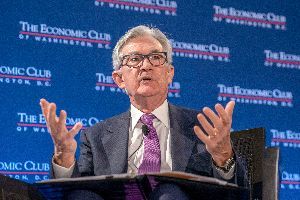
High interest rates are considered a major downside factor for the stock market because they increase companies' interest expenses, squeezing profits. However, Wall Street is optimistic about the possibility of a rebound in the U.S. stock market based on the interim results of U.S. companies' first-quarter earnings.
According to Bloomberg on the 28th, global investment bank (IB) Bank of America (BoA) recently stated that despite the prolonged high interest rates due to the Fed's delay in rate cuts, economic growth is expected to support the U.S. stock market.
Bloomberg reported that despite two years of sustained high interest rates, about 81% of U.S. companies posted better-than-expected results in the first-quarter earnings season, which began in earnest at the end of this month. According to Bloomberg Intelligence, the average earnings of U.S. companies in the first quarter of this year recorded 4.7%, exceeding the estimate (3.8% year-on-year).
S&P 500 companies' earnings are predicted to increase by 8% this year and 14% next year. Andrew Slimmon, portfolio manager at Morgan Stanley, analyzed, “(Despite high interest rates) the market’s anticipation of strong U.S. corporate earnings proves that there is room for stock price growth.”
In particular, despite the unsettling inflation data released on the 26th, the strong performance of major tech stocks such as Alphabet and Microsoft (MS) led the Nasdaq to rise by over 2% in two months, which was interpreted as a sign that the U.S. stock market remains robust.
There has also been analysis that the previously high Treasury yields indicated the strength of the U.S. economy, driving the upward trend of the U.S. stock market. According to BMO Capital Markets, the S&P 500 index yielded an average annual return of about 15% when the U.S. 10-year Treasury yield was above 6% since 1990, whereas when the 10-year Treasury yield was below 4%, the S&P 500 index return was 7.7%. Currently, the U.S. 10-year Treasury yield stands at around 4.6%.
Jared Osmani, manager at Martin Currie Fund, explained, “We need to assess why the scenario of fewer rate cuts this year is possible,” adding, “If it is related to a stronger-than-expected economy, it could support a rally after typical volatility spikes.”
Bloomberg also explained that expectations for strong global economic growth this year were cited as a factor supporting the strength of the U.S. stock market. Earlier, the International Monetary Fund (IMF) revised its economic growth forecast for this year upward from 3.1% in January to 3.2% on the 16th.
© The Asia Business Daily(www.asiae.co.kr). All rights reserved.
![Clutching a Stolen Dior Bag, Saying "I Hate Being Poor but Real"... The Grotesque Con of a "Human Knockoff" [Slate]](https://cwcontent.asiae.co.kr/asiaresize/183/2026021902243444107_1771435474.jpg)
















