Phase 1 Basic Plan Completed Last March... Phase 2 Execution Plan to Begin in May
Establishing Guidelines for Systematic Urban Management and Development... Government Efforts to Reflect in Seoul City Plan
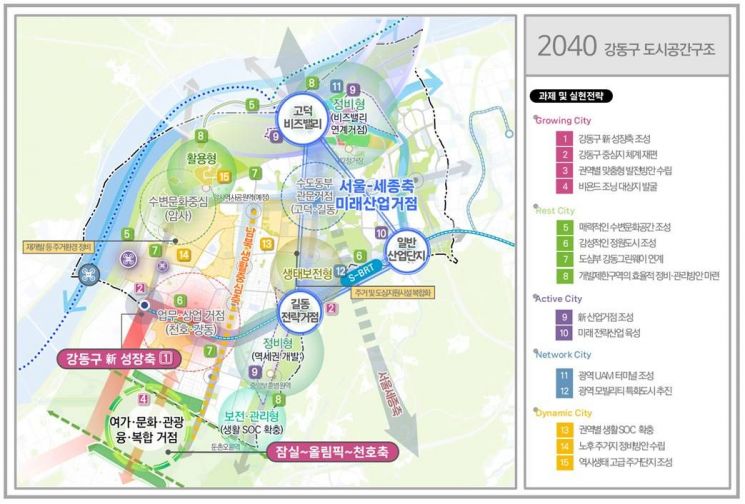
Kangdong-gu (Mayor Lee Soo-hee) announced on the 25th that it completed the 'Kangdong Grand Design Urban Development Master Plan (Phase 1)' last March and is preparing a more concrete implementation plan.
'Kangdong Grand Design' is an urban development planning project that sketches the future of Kangdong in 2040.
Following the completion of the 'Kangdong Grand Design Urban Development Master Plan (Phase 1)' (hereinafter referred to as the ‘Master Plan’), which outlines core goals and strategies, the district plans to establish the 'Kangdong Grand Design Urban Development Implementation Plan (Phase 2)' (hereinafter referred to as the ‘Implementation Plan’) to further specify the plan.
Vision of ‘Grand Kangdong, a city preparing for a better future’... 20 realization strategies and regional development concepts established
Starting with a kickoff meeting in April last year, the district organized a working group composed of experts and public officials and a task force (TF) from related departments, focusing expertise and administrative power. To gather residents' opinions on Kangdong-gu’s development, various channels such as public forums were held to present future urban development plans for Kangdong-gu.
Additionally, to enhance consistency with the ‘2040 Seoul Urban Master Plan,’ consultations were held with related researchers to ensure the plan’s feasibility and execution power.
In particular, at a public forum held in November last year, the vision of ‘Grand Kangdong, a city preparing for a better future’ was finalized, proposing five major promotion goals: ▲ Growing metropolitan center city (Growing city) ▲ Beautiful nature-friendly city (Rest city) ▲ Vibrant industrial hub city (Active city) ▲ Metropolitan ultra-connected city (Network city) ▲ Dynamic everyday city (Dynamic city), along with 20 realization strategies and regional development concepts.
Kangdong’s leap as a central city of the metropolitan area... New growth axis creation and Han River revitalization plan
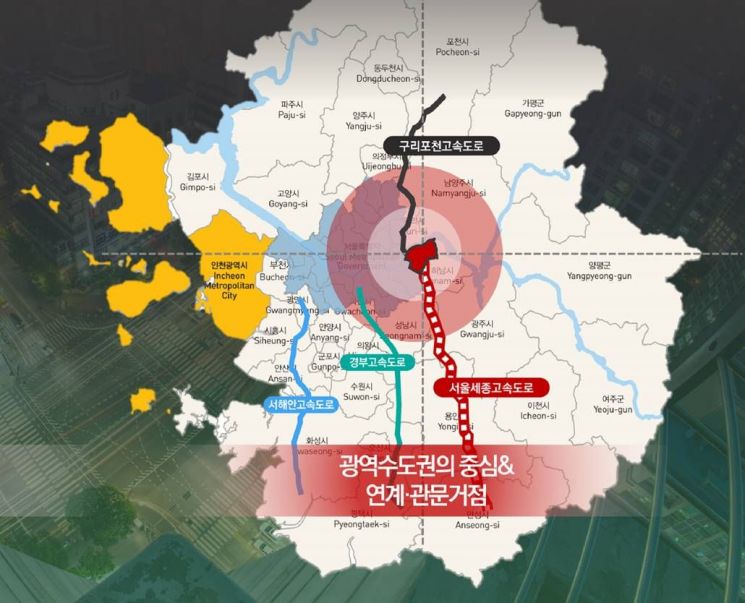
Including Seoul, the metropolitan area is growing into a vast living zone with continuous expansion of the metropolitan transportation network. Once the third phase of new towns in the eastern Gyeonggi area is completed, Kangdong-gu is expected to transform into a major gateway city with a hinterland population of about 2 million. Accordingly, Kangdong-gu has laid the foundation to leap as a central city of the metropolitan area through the 'Kangdong Grand Design Urban Development Master Plan.'
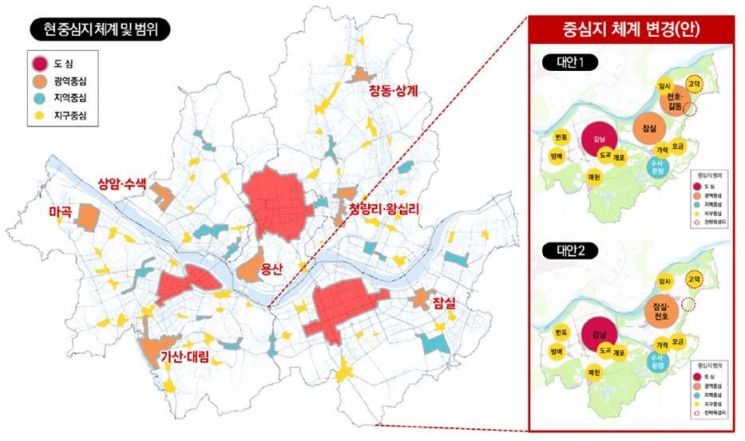
First, to drive Kangdong-gu’s development, the plan proposes the creation of a new growth axis linking the ‘Seoul Future Convergence Innovation Axis’ and the ‘Eastern Gyeonggi Development Axis and Industrial Belt,’ and upgrading the central system by designating strategic development zones such as Cheonho-Gildong metropolitan center and Godeok-Gildong area, establishing customized development plans by region considering location characteristics and local conditions.
Next, to create a beautiful nature-friendly city, the plan includes revitalization measures for Gwangnaru Han River Park linked to the ‘Seoul Great Han River Project,’ landmark space creation plans utilizing Kangdong-gu’s scenic Han River waterfront resources such as the Han River Skywalk, Amsa Green Path, and Han River scenic spots, and presents classification and basic directions for maintenance and management considering the characteristics of development-restricted areas within Kangdong-gu.
Also, to create a vibrant industrial hub city, the plan establishes a basic concept for newly expanding future industrial hubs within Kangdong-gu, fostering strategic industries such as artificial intelligence (AI), information and communication technology (ICT), and architecture-engineering convergence, and develops classification and customized development plans for efficient station area development and management.
Recently, Kangdong-gu made great efforts on transportation issues such as the extension of subway lines 8 and 9, direct connection of line 5, and attracting GTX-D, achieving the significant success of confirming the GTX-D route passing through Kangdong in January. Accordingly, this plan proposes the necessity of developing GTX-D stations and complex transfer centers within Kangdong-gu and improving overall urban mobility services such as upgrading the Bus Rapid Transit (BRT) system, enabling Kangdong-gu to fulfill its role as a metropolitan ultra-connected city in the future.
Furthermore, by establishing a metropolitan urban air mobility (UAM) terminal linking Incheon and Gimpo airports with the eastern metropolitan area, the plan proactively responds to future transportation demand and disperses increasing metropolitan transportation demand to improve accessibility to major hubs.
Along with this, by comprehensively analyzing regional population changes, facility expansion plans, and accessibility by 2030 and further to 2040, the plan provides guidelines for prioritizing supply facilities for living social overhead capital (SOC), carefully analyzes building aging, housing types, and undersized lots to review priority maintenance areas, and establishes maintenance plans for aging residential areas.
Additionally, for low-rise residential areas such as height and landscape districts where redevelopment and reconstruction are difficult, the plan suggests formulating distinctive maintenance plans that preserve the characteristics of the villages.
Development concepts for five regions considering local conditions and circumstances
Kangdong-gu has prepared customized development concepts based on the analysis of current status including population structure changes by region to achieve balanced regional development.
First, the ‘Gangil-Sangil region’ has the vision of ‘a vibrant live-work balanced city where waterfront culture and daily life interact,’ aiming to strengthen accessibility through expansion of metropolitan transportation facilities, promote an innovative industrial complex integrating architecture, engineering, and future knowledge industries, create a waterfront-specialized city flowing with diverse waterfront culture, and specialize residential areas for children, youth, and families.
The ‘Myeongil-Godeok region’ holds the vision of ‘the second Gyeongbu axis gateway hub integrating future residential, commercial, and advanced industries,’ proposing to foster a gateway hub connecting Seoul and the eastern metropolitan area, establish future metropolitan transportation facilities and transfer hubs such as UAM, induce diverse urban support function mixed development in station areas, and create waterfront cultural hubs along the Han River and Godeokcheon stream.
The ‘Amsa region’ envisions ‘a historical ecological cultural hub where the Han River and prehistoric relics breathe with the village,’ aiming to strengthen the historical ecological cultural hub function around the Amsa district center, prepare specialized plans for beautiful and orderly low-rise residential areas, establish systematic management and improvement plans for development-restricted areas along the Han River, expand historically and ecologically specialized streets, and enhance connections with public transportation.
The ‘Cheonho-Seongnae region’ envisions ‘a complex metropolitan hub encompassing southeastern Seoul and the eastern metropolitan area,’ focusing on creating a metropolitan hub linked with the southeastern Seoul urban development axis, preparing sustainable development plans for aging low-rise residential areas, enhancing regional content through improved Han River accessibility and diverse cultural spaces, and expanding metropolitan transportation and cultural and sports facilities.
Lastly, the ‘Gildong-Dunchon region’ envisions ‘a green complex town where nature, residence, and jobs coexist,’ aiming to establish maintenance and management plans tailored to the characteristics of development-restricted areas, promote future transportation means to strengthen public transportation services, create a landmark street along Yangjae-daero, and prepare continuous management and maintenance plans for a favorable residential environment.
Providing grounds for reflecting government and Seoul city plans... Enhancing feasibility through implementation plans
The projects presented in the Master Plan are classified into linked, project-based, and policy-based types to enhance feasibility, with detailed promotion plans to be established through the Implementation Plan. The Implementation Plan will be promptly pursued to increase timeliness, currently under bidding announcement, with commencement planned in May and completion targeted for July next year.
'Kangdong Grand Design' is expected to serve as a systematic urban management and development guideline for Kangdong-gu’s mid- to long-term development and to provide a basis for reflecting in central government and Seoul city plans.
Lee Soo-hee, Mayor of Kangdong-gu, said, “We are putting great effort into the urban development plan for the change and innovation of Kangdong-gu,” and added, “We will faithfully create future urban development strategies based on accurate directions and information so that Kangdong-gu can become the center of the metropolitan area.”
© The Asia Business Daily(www.asiae.co.kr). All rights reserved.



















