When Inflation Occurs, Lower Income Leads to Reduced Real Consumption
BOK Economic Research by Bank of Korea
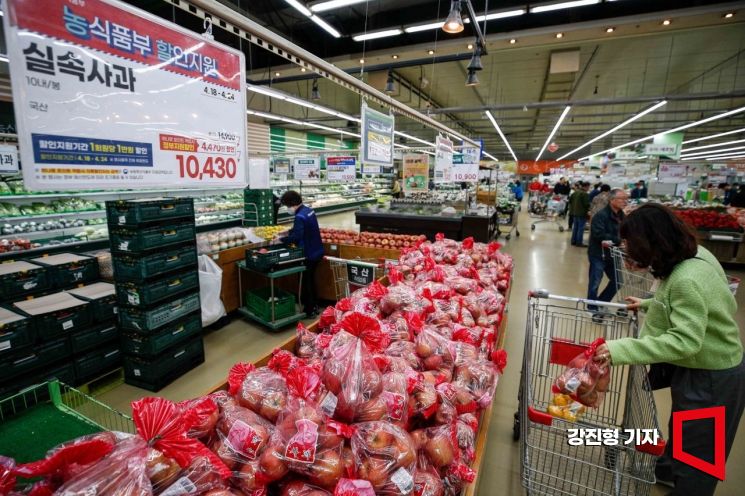 According to the 'March Consumer Price Trends' announced by the National Statistical Office, fruit prices surged 40.9% compared to a year ago. In particular, apple prices rose 88.2%, significantly increasing from the previous month (71%). On the 23rd, a customer visiting Hanaro Mart Yangjae Branch in Seocho-gu, Seoul, is purchasing apples. Photo by Kang Jin-hyung aymsdream@
When inflation (price increase) occurs, it was found that people in lower income brackets tend to reduce their real consumption more significantly.
According to the paper titled "Heterogeneous Inflation Rates and Real Consumption Elasticity by Individual Characteristics," published in the Bank of Korea's BOK Economic Research No. 2024-4 on the 29th, inflation had the effect of reducing both nominal and real consumption of individuals.
The impact of inflation on real consumption varied greatly by income bracket. Inflation was found to significantly reduce the real consumption of people earning less than 60 million KRW annually. In particular, those in the income group earning less than 30 million KRW per year saw their real consumption decrease by more than 1.8 times compared to high-income groups.
The paper estimated inflation rates by individual characteristics such as income, debt, region, and age based on credit card usage data, and through this, estimated real consumption elasticity. It explained that lower-income individuals were more vulnerable to inflation.
For high-income groups earning over 100 million KRW annually, the contraction in consumption due to inflation was relatively small. This is because they had additional liquidity capacity to withstand the increase in consumption expenditure caused by rising price indices.
Co-authors of the paper, Professor Yoo Jae-in and Professor Min Chan-ho from the Department of Financial Engineering at Ajou University, and Professor Jeong Ho-seong from Dongduk Women's University, stated, "The lower the income, the more flexibly real consumption was adjusted in response to price increases. On the other hand, high-income groups are more likely to generate asset-based income during inflationary periods and have higher credit scores based on income, making borrowing easier. Therefore, they have additional liquidity capacity, resulting in less reduction in real consumption."
Perceived inflation also differed according to income and age. The price level perceived by individuals earning less than 100 million KRW annually was higher than that perceived by those earning more than 100 million KRW. This is because lower-income individuals are more affected by essential goods with high price volatility.
Although younger age groups perceived relatively lower inflation, older age groups were more likely to perceive price indices higher than the average. This is because the sectors mainly consumed by older individuals, such as medical services and personal transportation equipment operation, are relatively more affected by insurance premiums and fuel costs.
Additionally, increases in interest rates on unsecured loans and mortgage loans, including housing loans, were found to suppress consumption among borrowers across all brackets. In particular, households with loan balances exceeding 100 million KRW tended to reduce real consumption more than those with less than 100 million KRW in loans. As prices rise, the burden from large loans increases, which is interpreted as leading to reduced consumption.
Professor Yoo emphasized, "Using domestic data, we estimated inflation by individual characteristics and examined the impact of heterogeneous inflation and interest rate changes on real consumption. This will help in understanding changes in individuals' real consumption in response to inflation and interest rate fluctuations."
© The Asia Business Daily(www.asiae.co.kr). All rights reserved.
!["I'd Rather Live as a Glamorous Fake Than as a Poor Real Me"...A Grotesque Success Story Shaking the Korean Psyche [Slate]](https://cwcontent.asiae.co.kr/asiaresize/183/2026021902243444107_1771435474.jpg)

















