Polestar Executives Interviewed by Korean Press
Thomas Ingenlath, CEO of electric vehicle manufacturer Polestar, said, "We are focusing more on the intrinsic value of (cars) that can provide drivers with the joy of driving both physically and emotionally."
He made this remark on the 25th (local time) during a meeting with Korean reporters on the day of the Auto China 2024 press preview event held in Beijing, China, in response to a question about what differentiates Polestar. While electrification transition and advanced information technology (IT)-based digital capabilities and connectivity have emerged as important competitive advantages, he emphasized that they are focusing more on enhancing the core functions and driving performance of cars.
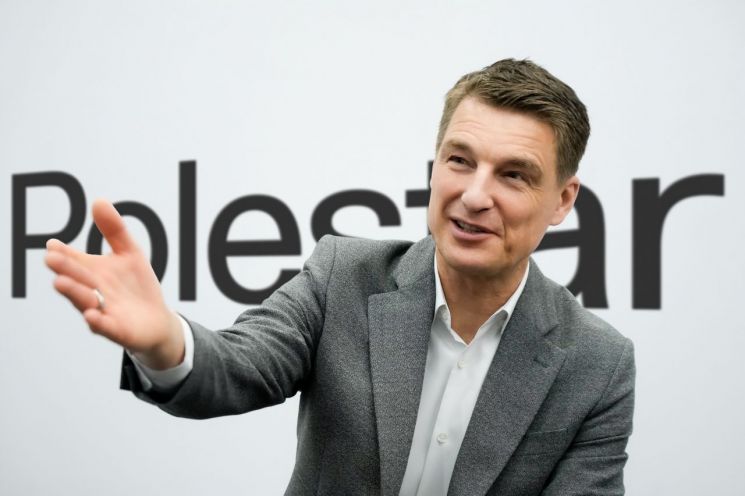
He said, "(Cars) are digital products, but policies must clearly consider them as means to enjoy speed," adding, "Our vision is to combine the latest digital capabilities with the long-accumulated European expertise in manufacturing high-performance cars." He further stated, "Digital capabilities are important, but we also have the ambition to maintain quality and identity as a high-performance car."
Polestar is an electric vehicle-exclusive brand jointly established in 2017 by China's largest private automaker Geely and Sweden's Volvo. It was formerly a term used to refer to Volvo's high-performance models, but after becoming a joint venture, it transformed into a premium electric vehicle brand.
Starting from the second half of next year, Polestar plans to manufacture the coupe-style electric sports utility vehicle (SUV) Polestar 4 domestically. Renault Korea's Busan plant, in which Geely holds a partial stake, has been selected as one of Polestar's global production bases. The company operates as a kind of 'fabless' electric vehicle company that develops vehicles without its own manufacturing facilities. Production is outsourced to global plants of its parent companies, Geely or Volvo.
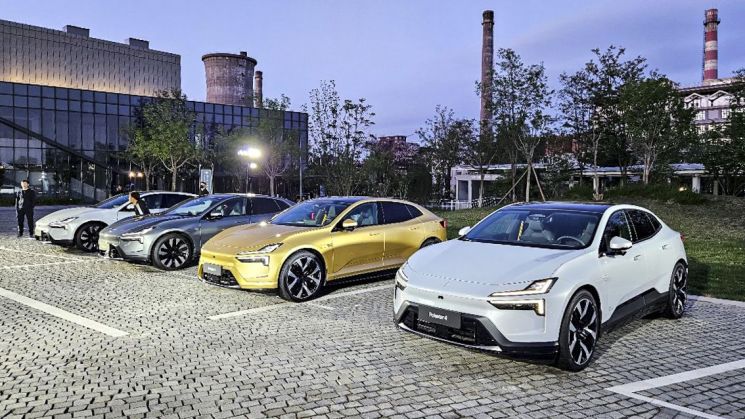 Polestar vehicles exhibited at the Polestar Brand Night held on the 23rd (local time) at a studio in Beijing
[Photo by Korea Automobile Journalists Association]
It was also clearly stated that domestic customers will have no issues using Volvo's service network. There had been concerns that service center usage might become difficult as Volvo, which previously held a 48% stake, sold some shares and now owns about 18%, loosening cooperation between the two brands. Currently, Polestar buyers in Korea use Volvo's service network.
CEO Ingenlath said, "Polestar will continue to collaborate with Volvo in various areas such as existing services, infrastructure, parts, and networks," adding, "The shareholding adjustments and service center impacts are separate matters and will not affect providing services to Korean customers at all." When asked if there are plans to establish a separate service network, he mentioned, "It could be in the form of building dedicated centers in addition to Volvo service centers."
Regarding battery usage, a hot topic in the electric vehicle market, the possibility of relatively inexpensive lithium iron phosphate (LFP) batteries was also left open. The company currently uses ternary (NCM) batteries in all models while positioning itself as a high-performance electric vehicle brand.
He said, "Considering the high performance and fast charging capabilities that the Polestar brand aims for, we are not currently considering equipping LFP batteries," but added, "However, I would not say that there is absolutely no plan for it in the future." He predicted that as battery technology advances, the market will become one where customers choose batteries according to their preferences at certain points in time.
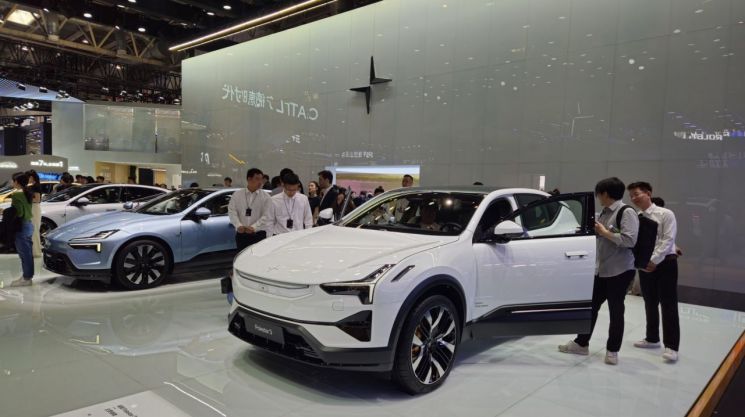 2024 Auto China Polestar Booth [Photo by Korea Automobile Journalists Association] [Image source=Yonhap News]
Regarding the domestic delivery timing of the Polestar 4, he did not provide a specific answer but stated that they will focus more on meeting quality standards rather than the timing. CEO Ingenlath said, "As a premium brand, quality management is the top priority," adding, "It took a lot of time to reach the desired level when producing the Polestar 4 at the Hangzhou plant in China, and it will be the same for Renault Korea's Busan plant." It is interpreted that the Busan plant is also taking a conservative approach since this is its first time producing a pure electric vehicle.
The company also expressed pride in the significance of the Polestar 4's design. The car eliminates the rear window, and a rear camera displays the rear view to the driver. Maximilian Missoni, Head of Design at Polestar, said, "By digitalizing the rear view, it is easier to secure night vision while preserving the coupe line, and removing the rear window also gains additional space," adding, "It captures all three elements of the coupe line: aerodynamics, visibility, and headroom."
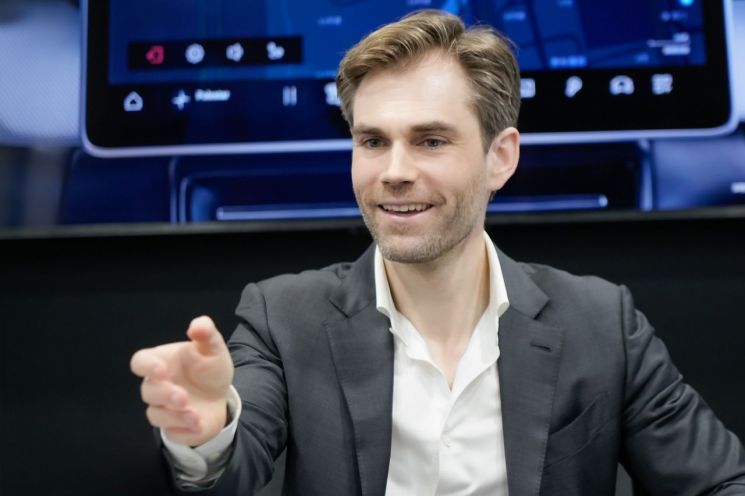
Features also include interior lighting inspired by the colors of planets in the solar system used as indirect lighting, and reclining seats in the second row that can be folded and unfolded. Missoni said about Polestar's design, which resembles Volvo's, "Polestar 2 has Volvo's design DNA, but from Polestar 3 onward, we have independently reflected design, and the 'Dual Blade Headlights' of Polestar 4 represent a step toward a more distinctive design," adding, "You will see completely different designs from Volvo in Polestar 5 and 6."
Regarding Polestar 5, which has only been revealed as a fastback-style concept, Missoni said it applies a self-developed aluminum platform design. He said, "Polestar pursues minimalist design, which resonates with the elegant charm of traditional Korean aesthetics," adding, "Korea is a market sensitive to cultural and social trends with artistic sensibility, and we look forward to seeing how Korean customers will receive it."
© The Asia Business Daily(www.asiae.co.kr). All rights reserved.



















