By 2027, Peak Congestion on Seoul Subway Lines 4, 7, and 9 to Decrease to 150%
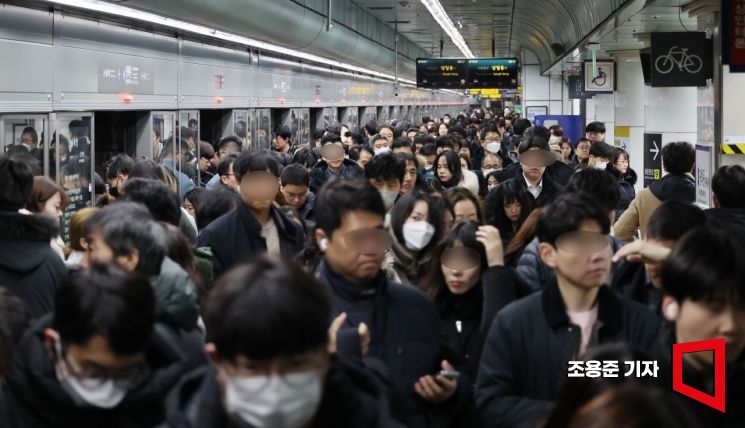 On the 22nd, when a heavy snow warning was issued across Seoul, Seoul Subway Line 5 experienced delays, causing Gwanghwamun Station to be crowded with commuters heading to work. Photo by Jo Yongjun jun21@
The Ministry of Land, Infrastructure and Transport announced on the 28th that it will implement measures such as increasing the number of trains on metropolitan urban railways to reduce public inconvenience caused by high congestion during commuting hours and to prevent safety accidents.This year, a total of 11 billion KRW in national funds will be provided to Seoul and Gimpo cities for urban railway expansion projects, with 6.4 billion KRW allocated to Seoul and 4.6 billion KRW to Gimpo.
For Gimpo City's urban railway, the goal is to increase the number of train sets by 5 by the end of 2026, with national funds temporarily supported over three years (2024?2026). Currently, Gimpo City's urban railway operates at 3-minute intervals during peak congestion hours (7:30 AM to 8:30 AM).
With the 6 train sets that Gimpo City is independently introducing (to be sequentially deployed from June to September 2024) and an additional 5 train sets supported by national funds, the interval between trains can be shortened from the current 3 minutes to 2 minutes and 10 seconds, reducing the interval by 50 seconds. This will increase the transport capacity during the same time period by approximately 40%.
Once the increase in trains is completed by the end of 2026, the maximum congestion rate during commuting hours will be significantly reduced from the current 199% (severe) to 150% (normal), and the average congestion rate during peak hours (7:30 AM to 8:30 AM) will drop from 182% (congested) to 130% (normal).
Additionally, for Seoul's urban railway, national funds will be temporarily supported over four years (2024?2027) with the goal of increasing a total of 8 train sets on the most congested lines among Seoul Lines 1 to 9: Line 4 (3 train sets), Line 7 (1 train set), and Line 9 (4 train sets) by 2027.
For Line 9, which currently experiences the highest congestion, 4 additional train sets will be introduced by 2027. The peak congestion rate, currently at 184% (congested), is expected to decrease to around 159% (caution).
Lines 4 and 7 will also see their maximum congestion rates reduced to below 150% once the train increases are completed by 2027. As a result, it is anticipated that the inconvenience experienced by the public due to crowded trains during commuting hours will be alleviated.
© The Asia Business Daily(www.asiae.co.kr). All rights reserved.

















