'Dokdo = Disputed Area' in Military Mental Strength Training Textbook
Internal Objections Raised Before Publication but Not Accepted
Ministry of National Defense Issues Administrative Sanctions, Not Disciplinary Actions, to Authors
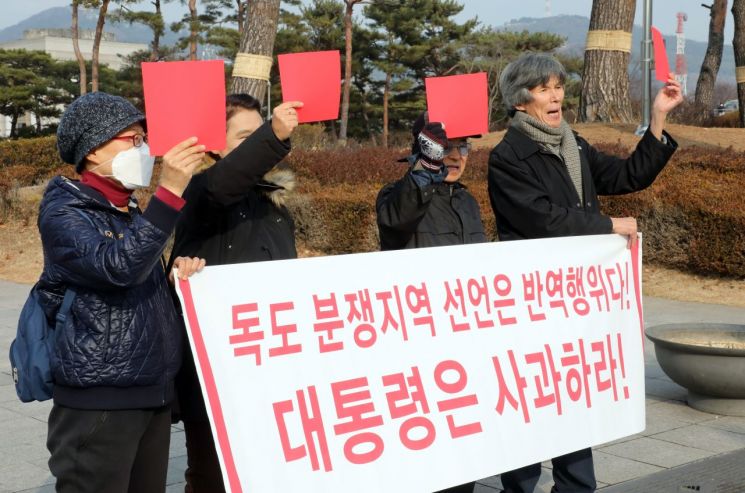 On December 29 last year, members of the Safe Society Citizens' Coalition held a press conference in front of the War Memorial in Yongsan-gu, Seoul, condemning the Ministry of National Defense for describing Dokdo as a region with an ongoing territorial dispute in the mental education materials for soldiers, and demanding the dismissal of Minister of National Defense Shin Won-sik and an apology from the President.
 [Image source=Yonhap News]
It has been revealed that the authors of the Ministry of National Defense's basic mental strength education textbook, which sparked controversy by recognizing Dokdo as a disputed territory, did not accept internal objections regarding the problematic expressions about Dokdo before publication.
However, the Ministry of National Defense stated that since there was no clear violation of laws, it issued relatively mild administrative sanctions such as warnings and cautions to the four individuals involved in writing the textbook.
On the 26th, the Ministry of National Defense announced the results of an audit related to the description of Dokdo in the basic mental strength education textbook. The audit was conducted for more than three months from December last year to early this month.
The basic mental strength education textbook, published by the Ministry of National Defense at the end of last year and distributed to frontline units, included expressions such as "Several major powers including China, Russia, and Japan are sharply confronting each other around the Korean Peninsula," and "These countries project military power overseas for their own interests, and territorial disputes such as Diaoyudao (Japanese name Senkaku Islands), Kuril Islands, and Dokdo are ongoing, so military clashes could occur at any time."
While the Korean government maintains the position that "there is no territorial dispute regarding Dokdo," the Ministry of National Defense described Dokdo as an area where territorial disputes are ongoing, similar to the Senkaku Islands and Kuril Islands. As controversy arose, the Ministry of National Defense recalled all copies of the textbook and launched an audit into the publication process.
The audit revealed that after the draft of the textbook was prepared on April 28 last year, there were two consultations and one review. During the first consultation in May, concerns were raised about the description of Dokdo.
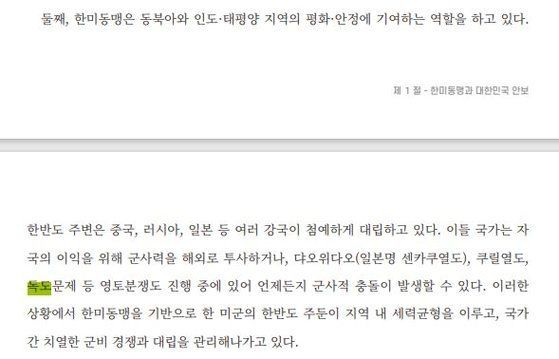 Military personnel mental education textbook describing Dokdo, our inherent territory, as a 'territorial dispute area'
The Ministry of National Defense's Mental Strength Department stated that since Dokdo is not a disputed territory, there was no need for expressions that could be misunderstood as "Dokdo is a disputed area," and the Army's Public Relations Office also submitted opinions that explanations using footnotes were necessary for accurate understanding.
However, all these objections were not accepted. The Ministry of National Defense explained, "It was confirmed that sufficient review was not conducted regarding these consultation and review opinions." No related objections were raised in subsequent consultations and reviews.
Additionally, the textbook contains a map of the Korean Peninsula appearing 11 times, but Dokdo was not marked in any of them. Regarding this issue, it was found that no objections were raised even once during multiple content discussions.
Based on these audit results, the Ministry of National Defense issued warnings to two individuals, including the Army Major General who was the director in charge at the time of publication, and cautions to two others, including the Army Colonel who was the section chief. Warnings and cautions are administrative measures that do not constitute disciplinary actions such as reprimand, salary reduction, suspension, demotion, dismissal, or discharge.
The Ministry of National Defense explained the reasons for not issuing formal disciplinary actions as follows: ▲ there was no clear violation of laws ▲ there was no intentionality in the serious errors ▲ the individuals involved deeply reflected on their actions and expressed remorse.
© The Asia Business Daily(www.asiae.co.kr). All rights reserved.
![Clutching a Stolen Dior Bag, Saying "I Hate Being Poor but Real"... The Grotesque Con of a "Human Knockoff" [Slate]](https://cwcontent.asiae.co.kr/asiaresize/183/2026021902243444107_1771435474.jpg)

















