Hyundai Motor Announces Full Lineup HEV Launch
'Maximized Fuel Efficiency' Compact HEV...Expect Casper HEV
Large 2.5 HEV System Also in Development
HEV System Segmentation by Vehicle Size Underway
Hyundai Motor Company is developing a dedicated HEV system for compact cars to respond to the exploding demand in the hybrid (HEV) market. The goal is to develop powertrains tailored to the size of each vehicle model and establish an HEV lineup across all models. This strategy aims to firmly fill the gap created by the recent slowdown in electric vehicle demand by strengthening the HEV lineup, which has emerged as the mainstream eco-friendly vehicle.
According to Hyundai on the 26th, Seungjo Lee, Head of the Planning and Finance Division, said during the Q1 2024 earnings conference call on the 25th, "Until now, HEVs were only available in mid-to-large sized models, but we are now developing an HEV system that can be installed in compact models," adding, "We plan to equip a system that can install HEVs across the entire lineup."
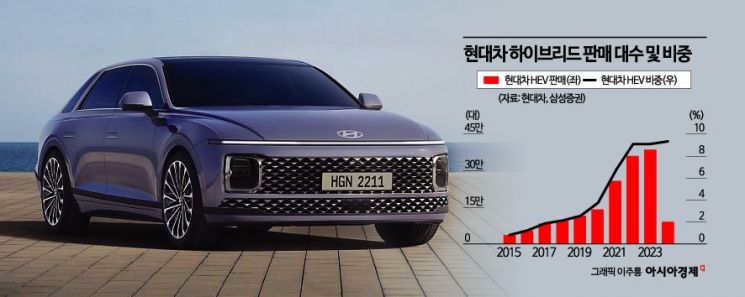
Hyundai is currently reported to be developing a 2.5 HEV system for large sport utility vehicles (SUVs). In addition, the company officially mentioned that it is also developing an HEV powertrain specialized for compact models. With this, Hyundai will have HEV systems tailored to each vehicle model, similar to internal combustion engines.
This is expected to help implement more diverse HEV performance. Currently, most Hyundai HEV systems are based on a 1.6 gasoline engine. Depending on the model, the size of the electric motor or battery is varied to create differences in total output or torque. For example, the compact SUV Tucson HEV and the minivan-sized Staria HEV have different total system combined outputs but are both based on the same 1.6 turbo gasoline engine.
If Hyundai develops a dedicated HEV system for compact cars, it is expected that HEV models will be possible not only for compact models like Kona and Avante HEV but also for light cars like Casper. The launch of a compact HEV with reduced system weight, optimized output, and maximized fuel efficiency is anticipated.
During the conference call, Hyundai also officially mentioned expanding overseas production of HEVs. It announced plans to produce HEV vehicles at the ‘Hyundai Motor Group Meta Plant America (HMGMA),’ an electric vehicle-only plant in the United States scheduled to start operations in October.
Last month, Jose Munoz, Head of North America and Global Chief Operating Officer (COO), said at the New York Auto Show, "We are preparing to increase electric vehicle production and are evaluating whether additional technologies need to be added based on market assessment." While Munoz’s earlier remarks were at the evaluation stage, Hyundai revealed a concrete plan to add HEV production facilities at its Georgia plant in the U.S. The total production volume will be maintained at 300,000 units annually, but production flexibility will be maximized by adjusting the ratio of electric vehicles and HEVs.
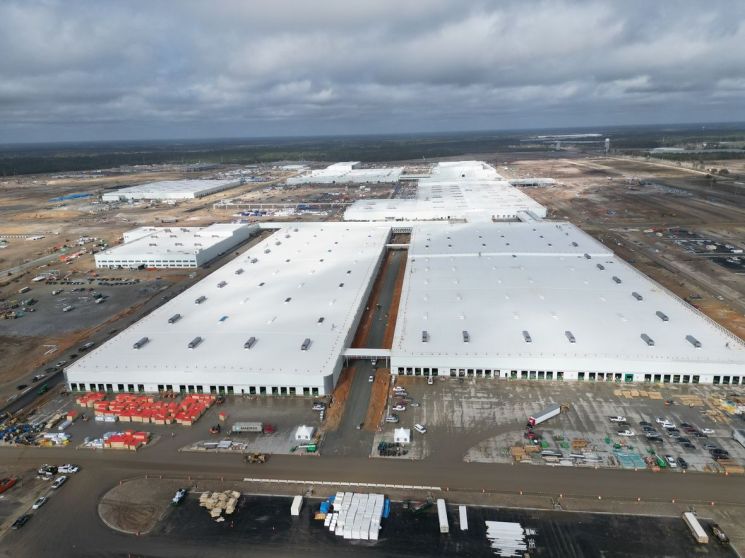 Exterior view of Hyundai Motor Group's electric vehicle-only factory (HMGMA) under construction in Georgia, USA
 [Photo by Yonhap News]
Production flexibility is Hyundai Motor Group’s greatest strength. During the global semiconductor shortage in 2021, this flexible production capability was the reason Hyundai could expand its overseas market share. At that time, Hyundai responded to market demand by breaking down production plans from five-month intervals to weekly and even daily changes.
The strengthening of the HEV lineup and production is related to the sharp decline in electric vehicle demand. To overcome the ‘valley of death’ occurring in the transition from internal combustion engines to electric vehicles, Hyundai has completely revised its strategy to increase HEV production. Hyundai’s global HEV sales target for this year is about 480,000 units, a 28% increase compared to the previous year. The target was raised by 100,000 units compared to last year.
As of Q1 this year, Hyundai’s global HEV sales reached approximately 98,000 units, a 17% growth compared to the same period last year. Particularly, looking at the sales ratio by region, the proportion of HEVs (including PHEVs) in the domestic market accounted for 21% of total sales, a significant increase of 5.7 percentage points compared to the previous year.
Increasing HEV sales also improves profitability. Although electric vehicle profitability still lags behind internal combustion engines, HEVs have reached a similar level. The average selling price is about 15-20% higher than internal combustion engines, and HEV buyers tend to choose the top trim levels more frequently. Lee said, "There are 14,000 unsold Santa Fe HEVs in the domestic market," adding, "The market is demanding more HEVs, and we will make multifaceted efforts to resolve the supply shortage."
© The Asia Business Daily(www.asiae.co.kr). All rights reserved.

![Clutching a Stolen Dior Bag, Saying "I Hate Being Poor but Real"... The Grotesque Con of a "Human Knockoff" [Slate]](https://cwcontent.asiae.co.kr/asiaresize/183/2026021902243444107_1771435474.jpg)
















