Special Committee Holds First Meeting on 25th Without KMA and Residents
"Not True That 2026 Medical School Enrollment Adjustment Is Under Review"
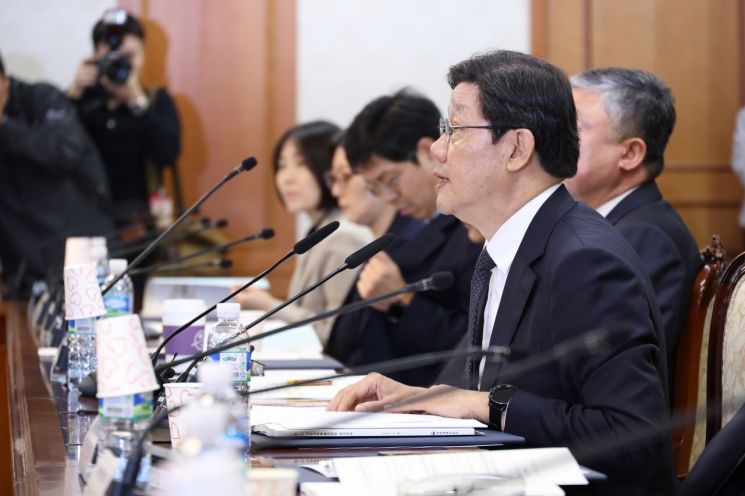 No Yeon-hong, chairman of the Korea Pharmaceutical and Bio-Pharma Manufacturers Association and chairman of the Presidential Commission on Medical Reform, a social consultative body discussing reform, is entering the first meeting of the special committee held on the morning of the 25th at the Government Seoul Office in Jongno-gu, Seoul.
 [Image source=Yonhap News]
Starting from the 25th, medical school professors nationwide, including those from the 'Big 5' hospitals, began submitting their resignations. Amid concerns about potential chaos in the medical field, the Presidential Office stated that "there will be no medical crisis." The Presidential Commission on Medical Reform also launched as scheduled on the same day.
A senior official from the Presidential Office told Asia Economy on the day, "The claim that a medical crisis will occur due to medical school professors submitting their resignations is completely untrue," adding, "Only a small number of professors have submitted their resignations." The official explained, "While the professors' group claims that about 30% of the 12,000 full-time tenured professors across 40 medical schools have resigned, in reality, only about 1.5% have formally submitted their resignation letters. The government is directly checking medical sites, and it has been confirmed that there is no medical crisis."
Government: "Only a Small Number Submitted Resignations"
Additionally, the Presidential Commission on Medical Reform officially launched on the same day without the participation of the Medical Association and the Resident Doctors Association, holding its first meeting at 10 a.m. at the Government Seoul Office in Jongno-gu, Seoul. The commission discussed issues such as reforming the resident training environment, revising the compensation system for essential medical services, managing non-reimbursable and indemnity insurance, improving the medical delivery system to alleviate concentration in large hospitals, and establishing a safety net and compensation system for medical accidents.
According to the Ministry of Health and Welfare, the first meeting covered major agenda items and operational plans for the commission, but no direct discussions on the scale of medical school enrollment expansion took place. Park Min-su, the second vice minister of the Ministry of Health and Welfare, told Asia Economy, "The commission will discuss institutionalizing periodic reviews of medical school quotas, but it will not discuss the quotas themselves."
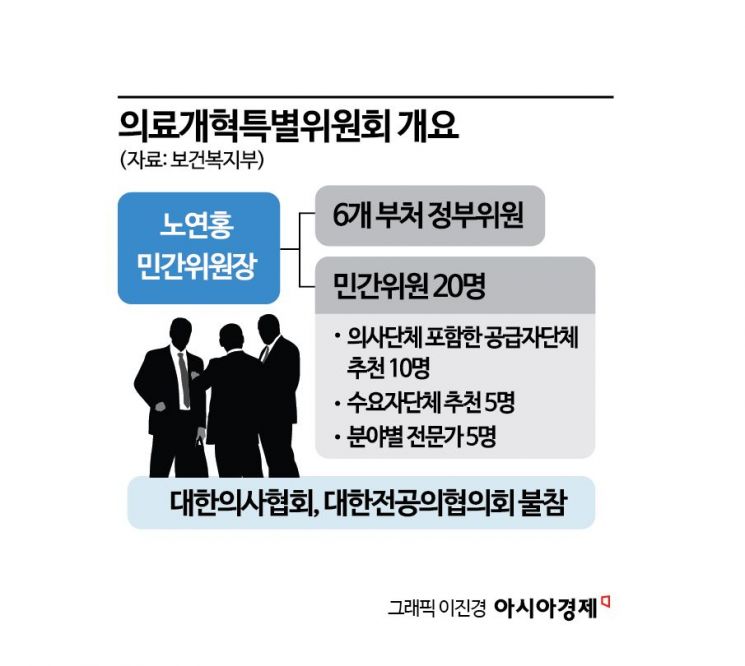
The commission is chaired by Noh Yeon-hong, chairman of the Korea Pharmaceutical and Bio-Pharma Manufacturers Association, and includes 20 civilian members recommended by 10 provider organizations and 5 consumer organizations, as well as 5 experts, along with heads of 6 central government agencies. The term is one year.
However, criticism has arisen that the commission is only half-formed as key stakeholders such as the Korean Medical Association (KMA) and the Korean Intern Resident Association (KIRA) have declared their absence. Chairman Noh stated in his opening remarks, "Medical reform is an urgent task that can no longer be postponed," adding, "We will publicize conflicts and issues and narrow differences through communication among stakeholders."
Chairman Noh: "Medical Reform Is an Urgent Task That Cannot Be Delayed"
Chairman Noh expressed hope that "resident doctors and medical associations, who are the main parties in medical reform, will promptly join the commission as members so that we can work together to improve the structural problems of our country's medical system."
The KMA stated that "discussions should take place in a different type of organization," while KIRA argued, "Considering the composition of the commission, it is an unreasonable negotiation platform from the medical community's perspective." Medical school professors also believe that before the commission convenes, the KMA and KIRA should be called to the negotiation table first. Kim Chang-su, chairman of the National Medical School Professors Association, sharply criticized it as "an organization like the Red Guards during China's Cultural Revolution."
Meanwhile, a Presidential Office official dismissed reports that a plan to adjust the medical school enrollment for the 2026 academic year is being suddenly reviewed, saying, "This is not true," and added, "The enrollment scale for next year will be legally finalized on April 30 and cannot be reversed."
© The Asia Business Daily(www.asiae.co.kr). All rights reserved.

![Clutching a Stolen Dior Bag, Saying "I Hate Being Poor but Real"... The Grotesque Con of a "Human Knockoff" [Slate]](https://cwcontent.asiae.co.kr/asiaresize/183/2026021902243444107_1771435474.jpg)















