Q1 Real Gross Domestic Product (GDP) Growth Rate at 1.3%
Exceeds Market Expectations... Exports and Domestic Demand Grow Together
Bank of Korea Likely to Raise This Year's Growth Forecast from 2.1%
South Korea's economic growth rate in the first quarter significantly exceeded market expectations. With both exports and domestic demand growing simultaneously, the country recorded the highest growth rate in 2 years and 3 months. As the growth trend becomes clearer, the annual growth rate forecast is also expected to rise.
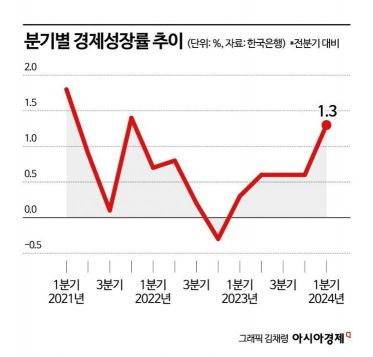
On the 25th, the Bank of Korea announced that the real Gross Domestic Product (GDP) growth rate (preliminary figure) for the first quarter of this year was 1.3% compared to the previous quarter. This figure far surpasses market expectations (0.6~0.8%). It is the highest rate in nine quarters since recording 1.4% in the fourth quarter of 2021. South Korea has recorded positive growth rates for five consecutive quarters, from 0.3% in the first quarter of last year, 0.6% in the second quarter, 0.6% in the third quarter, 0.6% in the fourth quarter, to the first quarter of this year.
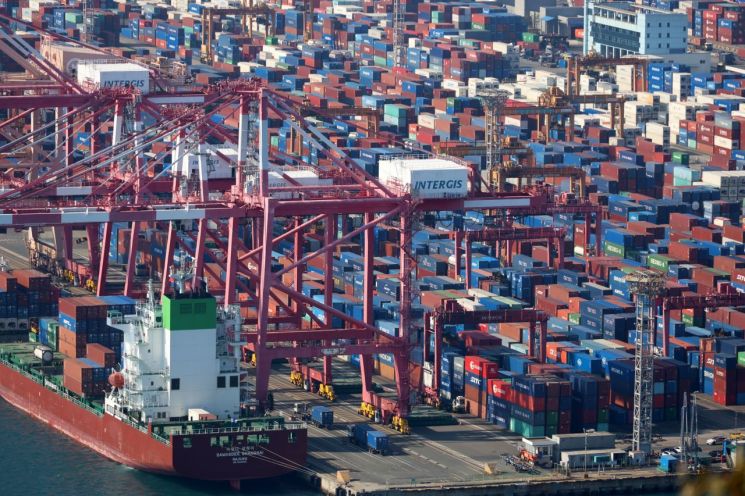
Clear Improvement in Both Exports and Domestic Demand... Private Sector Leads Growth
In the first quarter of this year, not only exports but also domestic demand, including construction investment and private consumption, showed clear improvement. Looking at growth rates by sector, exports increased by 0.9% compared to the previous quarter, mainly driven by IT products such as semiconductors and mobile phones.
Private consumption rose by 0.8% due to improved consumer sentiment, with increases in goods (such as clothing) and services (such as food and accommodation). Government consumption increased by 0.7% due to higher spending on goods, and construction investment grew by 2.7% as both building and civil engineering construction increased. On the other hand, facility investment decreased by 0.8% due to a decline in transportation equipment.
Looking at the contribution to growth by expenditure items in the first quarter, improvements in exports and consumption were evident. The contribution of net exports to the first quarter's economic growth rate was 0.6 percentage points, continuing a positive trend for four consecutive quarters since the second quarter of last year. The contribution of private consumption rose to 0.4 percentage points, compared to just 0.1 percentage points in the third and fourth quarters of last year.
The contribution of construction investment also reversed to 0.4 percentage points from -0.5 percentage points in the fourth quarter of last year. The Bank of Korea explained that construction investment improved due to increased finishing work at some sites, supported by favorable weather conditions in the first quarter of this year.
By sector, the private sector contributed 1.3 percentage points, and the government contributed 0.0 percentage points, indicating that South Korea's economic growth in the first quarter was driven by the private sector.
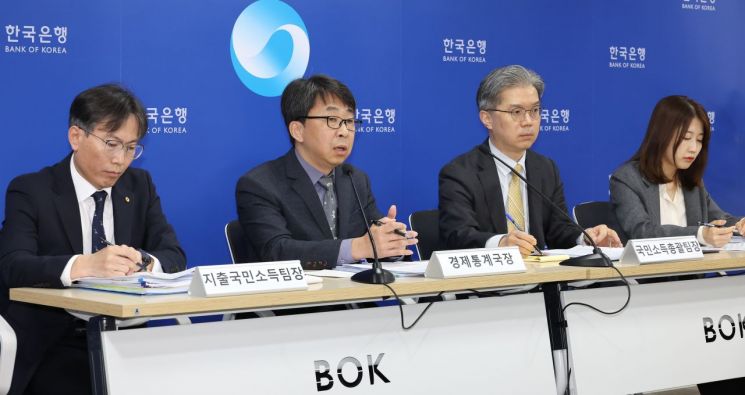
Shin Seung-chul, Director of the Economic Statistics Bureau at the Bank of Korea, said, "Exports remain strong, and domestic demand improved more than expected, leading to a first-quarter growth rate that exceeded previous forecasts. There is a possibility that the overall economic growth rate for this year will surpass initial expectations."
Kwon Hee-jin, a researcher at KB Securities, commented, "With strong export data, the first-quarter growth rate came out as a significant surprise. Currently, export product prices are rising, and volumes are increasing, so the growth trend is expected to continue."
Looking at first-quarter growth rates by industry, manufacturing increased by 1.2%, led by chemical products and transportation equipment. The electricity, gas, and water supply sector grew by 1.8%, driven by water supply, sewage and waste treatment, and raw material recycling. Construction increased by 4.8%, with growth in both building and civil engineering construction. The service sector grew by 0.7%, centered on wholesale and retail trade and accommodation and food services. In contrast, agriculture, forestry, and fisheries declined by 3.1%, mainly due to decreases in crop farming.
Kang Sung-jin, a professor of economics at Korea University, said, "The simultaneous improvement in exports and consumption led to strong growth in the first quarter. Unless major variables arise, the second quarter is expected to maintain a similar trend to the first quarter."
Growth Trend Expected to Continue
The improvement in the Korean economy is expected to continue into the second quarter. This is because exports remain strong, and uncertainties such as international oil prices and exchange rates are likely to improve as the year progresses.
According to the Ministry of Trade, Industry and Energy, South Korea's exports in the first quarter of this year amounted to $163.7 billion, an 8.3% increase compared to the same period last year. This is due to improvements in exports of key items such as semiconductors, smartphones, and automobiles. Even this month, exports reached $35.8 billion by the 20th, an 11.1% increase year-on-year, indicating a continued improvement trend, and exports are expected to drive economic growth in the second quarter as well.
Kang In-soo, a professor in the Department of Economics at Sookmyung Women's University, said, "Exports have been strong this year, leading the growth of our economy. We expect a steady growth trend for the year as a whole."
Domestic demand is also expected to continue improving. This is because the consumer price inflation rate, currently above 3%, is expected to decline in the second half of the year, and there is growing anticipation of interest rate cuts. Director Shin said, "As we move into the second half, conditions such as high exchange rates and high interest rates, which were sources of uncertainty, are likely to ease. We expect the improvement trend to continue in the second half as well."
Annual Economic Growth Forecast Likely to Be Revised Upward
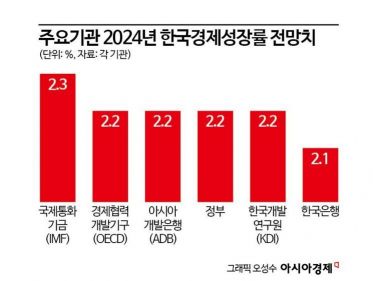
With the clear improvement in the first-quarter economic growth rate, the Bank of Korea's annual economic growth forecast for this year is also expected to be revised upward. In the economic situation assessment report released on the 12th, the Bank of Korea mentioned the possibility that South Korea's economic growth rate this year could exceed the initial forecast of 2.1%, citing rapid export recovery and moderate improvement in private consumption as reasons.
The Bank of Korea's economic growth forecast for this year was slightly lower compared to major domestic and international institutions. The International Monetary Fund (IMF) predicted South Korea's economic growth rate at 2.3% in the World Economic Outlook (WEO) released on the 16th. The Organisation for Economic Co-operation and Development (OECD), the government, and the Korea Development Institute (KDI) all forecast a 2.2% growth rate for this year.
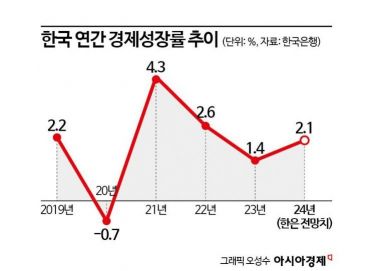
The Bank of Korea is expected to slightly raise its economic growth forecast in the revised economic outlook to be released next month. Director Shin explained, "The first-quarter actual figures exceeded the Bank of Korea's initial forecast. The revised economic outlook next month will reflect the favorable first-quarter results."
Yoon Yeo-sam, a researcher at Meritz Securities, emphasized, "With the first-quarter growth rate rebounding by more than 1%, there is an expectation that this year's growth forecast could be revised upward from the previous 2.1% to around the mid-2% range."
© The Asia Business Daily(www.asiae.co.kr). All rights reserved.



















