'Professor Resignation' Sparks Debate
Government "President Approval" vs Medical Community "Civil Law Validity"
If Resignation Approved, Educational Field Faces Increased Confusion
Reversal of Quotas Causes Ongoing Admission Site Turmoil
Government "President Approval" vs Medical Community "Civil Law Validity"
If Resignation Approved, Educational Field Faces Increased Confusion
Reversal of Quotas Causes Ongoing Admission Site Turmoil
As medical school professors nationwide begin to resign en masse, the government and the medical community are clashing over how to handle the situation. If the resignations spread, the impact on medical school lectures, practical training, and other educational activities is expected to be significant.
According to the medical community on the 25th, medical school professors across the country, including those at the 'Big 5' hospitals, will start resigning from this day depending on the circumstances of their hospitals and departments. Professors affiliated with universities also claim that once they express their intention to resign, the resignation takes effect one month later regardless of the university president’s or appointing authority’s approval. On the other hand, the government maintains that for full-time professors at national universities, resignations cannot be approved without the president’s consent.
Currently, cases of resignation letters being submitted by university vary and are not being compiled at the government level. The Ministry of Education is monitoring individual universities but does not have specific figures, and universities are reluctant to disclose this information.
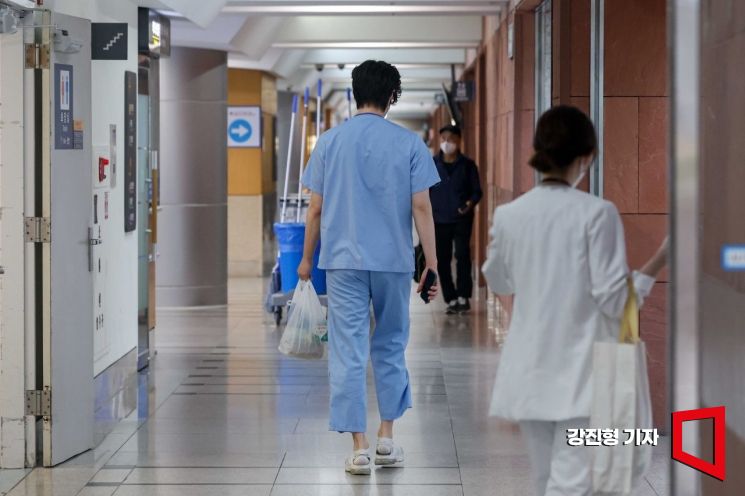
If the resignations of medical school professors continue to spread, medical schools will inevitably be affected in terms of classes and practical training. According to university sources, out of 16 medical schools scheduled to start classes on the 15th of this month, only 8 opened as planned. Even at those that have started, classes are not proceeding properly. Most classes are held online, and attendance rates are not being accurately tracked.
Even if classes have started, students who do not attend may fail due to insufficient attendance days. The education sector views the end of April as the deadline for postponing the start of classes to secure the legally required 1-year class hours (30 weeks) under the Higher Education Act.
A representative from a national university stated, "The current delay in the academic schedule is to secure the number of class days as much as possible without causing any failures due to insufficient attendance."
Confusion in the admissions process is also increasing as the scale and timing of enrollment increases are being reversed by each university. The government has changed its stance to allow each university to autonomously decide the medical school enrollment quota for 2025. Universities must submit their basic admission implementation plans by the 30th of this month.
© The Asia Business Daily(www.asiae.co.kr). All rights reserved.
![Clutching a Stolen Dior Bag, Saying "I Hate Being Poor but Real"... The Grotesque Con of a "Human Knockoff" [Slate]](https://cwcontent.asiae.co.kr/asiaresize/183/2026021902243444107_1771435474.jpg)











