Business Platform ST1 Cargo Unveiled
First OpenAPI Adoption... Considering Driver Health
"First PBV of Group Aiming for SDV"
Customers who use vehicles can directly develop and apply the functions they need. While helping to work more efficiently, it also takes care of the health of those who make a living with vehicles. This is the direction of future mobility presented through Hyundai Motor Group's first purpose-built vehicle (PBV) launched in the market, the Hyundai ST1 (Service Type 1). If you ask what commercial vehicles will look like in the future and why smart vehicles are necessary, you can catch a glimpse of the answer here.
On the 24th, Hyundai Motor released cargo and cargo refrigeration models based on the ST1. Earlier, the company recently unveiled the ST1 in a chassis cab form and named it a 'business platform.' A chassis cab is a vehicle composed only of the chassis (frame) and the passenger cabin (cab), characterized by its versatility depending on the purpose such as transportation or rescue. Hyundai Motor only provides the platform, and the actual usage is determined by the buyer.
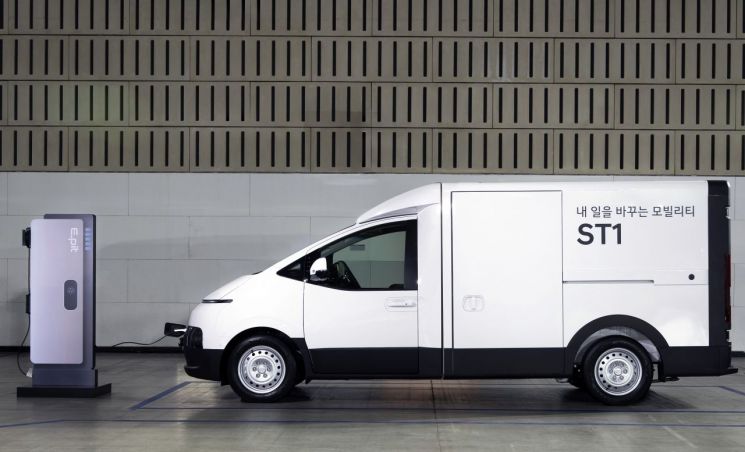
This contrasts with the small commercial vehicle Porter. Porter has a basic model for carrying cargo and some special models like refrigerated or frozen box trucks. Basically, the manufacturer guesses the demand and makes the vehicle, and consumers buy the vehicle they need. On the other hand, the ST1 can be purchased by customers and developed in a customized way according to business or personal use.
At a pre-briefing session held for the press the day before, models such as a police operation vehicle, an emergency rescue vehicle, an electric bike charging vehicle, a mobile smart farm, and a pet care shop?all based on the ST1?were displayed. Jung Yoo-seok, head of Hyundai Motor's domestic business division, said, "ST1 is a new electrified business platform presented by Hyundai Motor that will make mobility enjoyable and business successful with devices and software optimized for customer businesses."
The chassis cab model, which serves as the platform, incorporates plug-and-play technology and introduces the concept of data open API. Plug-and-play is a function that configures separate connectors inside and outside the vehicle, allowing customers to utilize vehicle power or communication data according to their business or purpose in special vehicles. Data open API is a communication method freely usable by customers or partners.
This means that external software developers or users can directly develop and apply the applications they need. It is the first technology applied among all Hyundai Motor models. Through this, customers who purchase the vehicle can easily collect necessary information such as real-time driving data including vehicle location, speed, ignition status, and charge level, as well as driving analysis data. Remote control of air conditioning or locking devices is also possible.
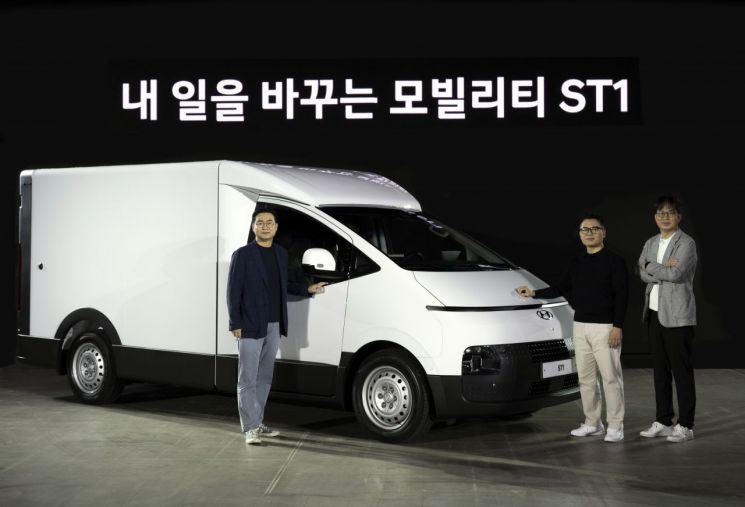 Jung Yuseok, Head of Hyundai Motor Domestic Business Division (from left), Min Sanggi, Head of Hyundai Motor PBV Business Office, and Oh Sehun, Executive Director of Hyundai Motor PBV Development Office, are posing for a commemorative photo at the ST1 media briefing held on the 23rd at Songdo Convensia.
 [Photo by Hyundai Motor Group]
Later, customers can add or remove apps as needed, but initially, Hyundai Motor directly developed a fleet management system (FMS) likely to be frequently used in commercial vehicles. For refrigerated cargo, temperature records must be submitted, and until now, data had to be separately collected, printed, and submitted, but now it can be sent online immediately. The vehicle manufacturer is restricted from accessing the information collected by the customer while using the vehicle.
While developing the ST1 cargo and cargo refrigeration models this time, Hyundai Motor reportedly exchanged opinions frequently with frequently used companies such as CJ Logistics, Hanjin, and Kurly. This was to derive specifications optimized for logistics and delivery operations. They drove prototypes for periods ranging from 1-2 weeks to about two months, pointed out areas to improve and necessary features, and these were reflected in the development process. Considering the vulnerability of the one-box type Porter to driver safety, a semi-bonnet type design with a protruding front hood was adopted. Protective guards were added to frequently scratched bumpers and side garnish parts.
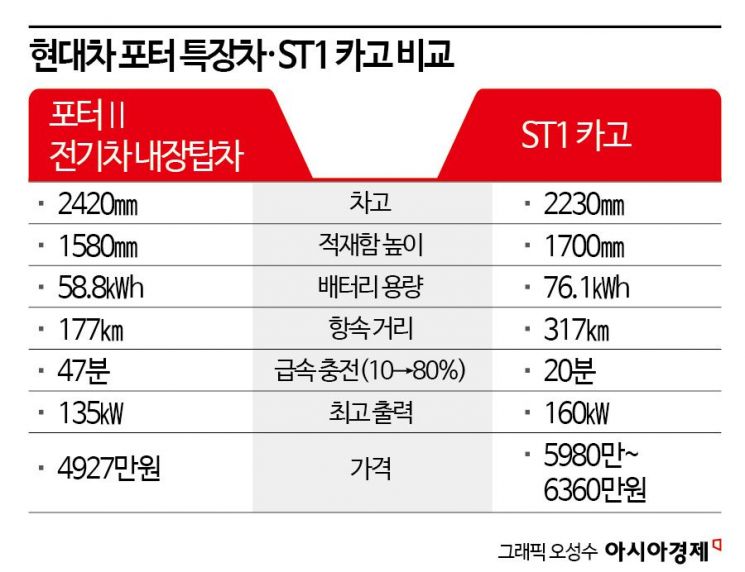
The overall vehicle height was lowered, and an auxiliary step was added behind the cargo bed to make getting on and off easier. The cargo bed is 1700 mm high, making it easy to load and unload cargo without bending the waist much even when inside. There is a swing door on the side and doors that open sideways at the rear. Both are electric, not latch-type.
There are also several convenience features specialized for transport vehicles. The ignition automatically turns on and off without pressing the start button when the driver is seated or buckled up. Sensors are installed above the cargo bed to assist when reversing. This was applied for the first time by Hyundai Motor. When the smart key holder moves far away from the vehicle, the side doors automatically close and lock. A Hyundai Motor official said, "When delivering about 200 packages, the driver gets on and off the vehicle about 100 times. Considering the heavy doors that must be opened and closed manually, physical strain is inevitable, and we aimed to improve this during development."
The battery capacity is 76.1 kWh, allowing a range of 317 km on a single charge. The refrigerated model has a range of 298 km. This covers a day's delivery distance. It goes farther than the Porter electric vehicle with a standard box (177 km) and even the Porter electric vehicle without a cargo bed (211 km). Ultra-fast charging is also possible, charging from 10% to 80% battery capacity in just 20 minutes. This reduces charging stress for delivery drivers.
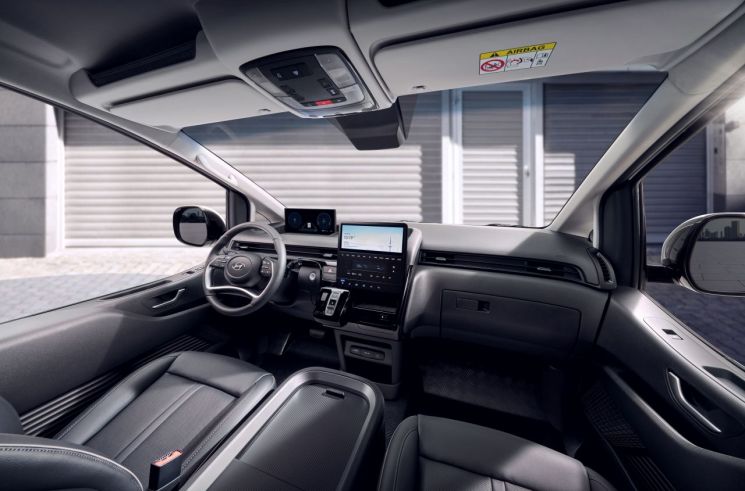
It provides navigation functions reflecting real-time traffic information, nearby charging station search, and estimated battery remaining upon arrival. Convenience features commonly seen in passenger cars such as over-the-air (OTA) software updates, vehicle-to-load (V2L) that supplies electricity from the vehicle battery, smartphone wireless charging, and after-blow are also included. Although the electric vehicle purchase subsidy has not yet been finalized, the company expects it to be similar to the current Porter electric vehicle (national subsidy of 10.5 million KRW).
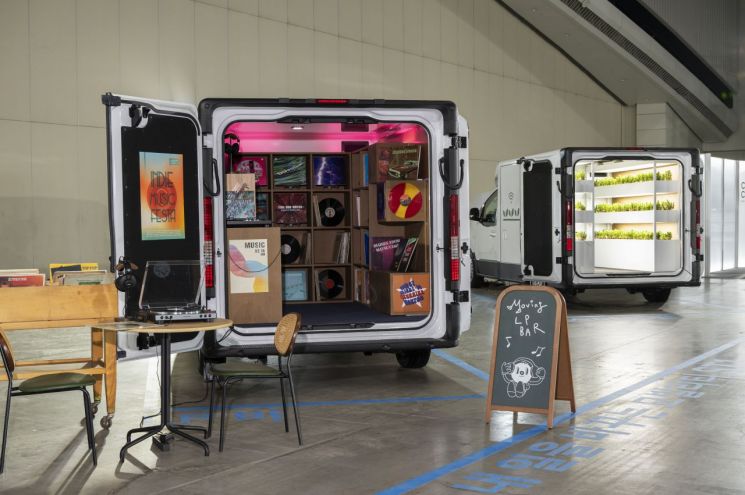
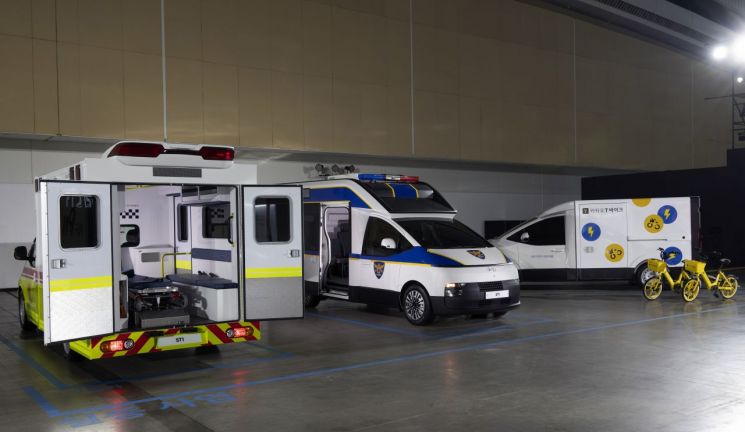 ST1 emergency rescue vehicle, police operation vehicle, electric bike charging vehicle
 Photo by Hyundai Motor Group
© The Asia Business Daily(www.asiae.co.kr). All rights reserved.



















