A multifunctional neural interface that can be used for more than one year has been developed domestically. Neural interfaces implanted through surgery are based on the premise that the maximum amount of information must be obtained from a single surgery. This is why the development of devices that can be used for a long time is necessary. The multifunctional neural interface developed in Korea is expected to bring advancements in brain mapping, brain disease research, and treatment due to its usability for over one year.
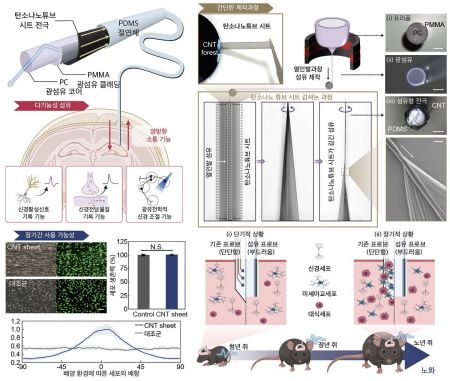 Overview of fiber-type neural interface developed by research teams from KAIST and Hanyang University. Provided by KAIST
KAIST announced on the 24th that a research team led by Professor Seongjun Park from the Department of Bio and Brain Engineering and Professor Changsoon Choi from the Department of Biomedical Engineering at Hanyang University succeeded in developing a multifunctional fiber-type neural interface that can be used for a long time by combining the Thermal Drawing Process (TDP) and carbon nanotube sheets.
TDP refers to the process of applying heat to rapidly draw and extract fibers with the same shape and function from large and complex structures or to process them.
In exploring the brain neural system, implantable interfaces have evolved toward using biocompatible and soft materials to reduce immune responses in biological systems while integrating various functions.
However, previously, the focus was on implementing various functions, making it difficult to create devices that can be used long-term. In particular, carbon-based electrodes showed issues such as complex manufacturing and integration processes and reduced functional performance compared to metal electrodes.
To solve these problems, the research team combined carbon nanotube sheet electrodes with polymer optical fibers. The carbon nanotube sheet electrodes, in which carbon nanotube fibers are aligned in one direction, effectively record neural cell activity, and these are wrapped around polymer optical fibers responsible for light transmission to produce hair-thin multifunctional fibers. The fibers produced through this process demonstrated excellent electrical, optical, and mechanical properties.
 (From left) Woojin Jeon, Ph.D. candidate at KAIST; Jaemyung Lee, Ph.D. candidate at Hanyang University; Yeji Kim, Ph.D. candidate at KAIST; Yunheum Lee, Ph.D. candidate at KAIST; Changsun Choi, Professor at Hanyang University; Seongjun Park, Professor at KAIST. Provided by KAIST
When the brain-machine interface developed by the research team was implanted in an actual rat model, the multifunctional fibers showed excellent electrical neural activity signals and chemical neurotransmitter (dopamine) measurements, and behavioral outputs were possible through optogenetic control.
In particular, the research team explained that by measuring optically evoked neural signals and spontaneously evoked neural signals for over one year after implantation in the rat model, the possibility of ultra-long-term use was confirmed.
Professor Seongjun Park from the Department of Bio and Brain Engineering said, "This research result has the potential to be used as a ‘next-generation neural interface’ due to its multifunctionality and ultra-long-term usability." He added, "The research outcomes are expected to be utilized in understanding detailed mechanisms of brain diseases and in whole brain recording and modulation through future applications in large animals and simultaneous use with magnetic resonance imaging equipment."
Meanwhile, this research was conducted with support from the Ministry of Science and ICT, the Korea Research Foundation’s Nano and Materials Technology Development Project, and the Police Agency’s Future Security Challenge Technology Development Project. The research results were also published in the academic journal Advanced Materials on the 29th of last month.
© The Asia Business Daily(www.asiae.co.kr). All rights reserved.


















