The proportion of elderly population in Gyeonggi Province surpassed 15% last year, entering an 'aged society.' Additionally, 33% of the elderly in the province are unprepared for old age, and 30% have a monthly income of less than 1 million KRW.
Gyeonggi Province recently published the ‘Gyeonggi Province Elderly Statistics 2023,’ analyzing various statistics related to seniors aged 65 and over, including last year's resident registration population status from the Ministry of the Interior and Safety and the province’s social surveys.
According to the statistics, the elderly population aged 65 and over in the province was 2,123,000 last year, accounting for 15.6% of the total population of 13,631,000. The proportion of elderly population increased 1.5 times over nine years from 9.8% in 2013. Notably, it recorded 14.7% in 2022, marking the entry into an aged society. An aged society is defined as when the elderly population accounts for 14% or more of the total population.
Looking at the elderly proportion by city and county, all 31 cities and counties have entered an aged society, with Yeoncheon (31%), Gapyeong (30%), Yangpyeong (29.4%), Yeoju (25.3%), Pocheon (24.3%), Dongducheon (24.1%), and Anseong (20.2%) entering a super-aged society. The area with the lowest aging rate is Hwaseong City at 10.3%.
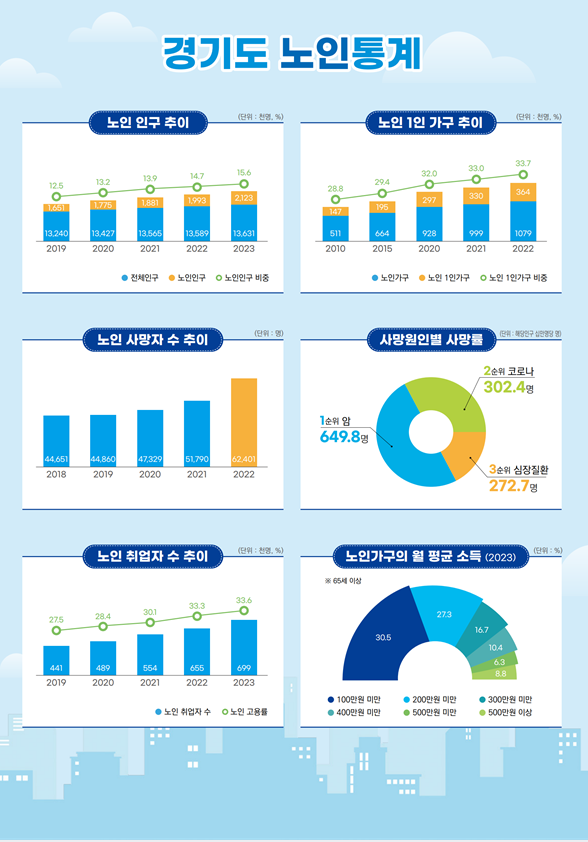
The average monthly income of elderly households in the province was analyzed as 30.5% earning ‘less than 1 million KRW’ and 27.3% earning ‘1 million to less than 2 million KRW,’ meaning 57.8% of all elderly households earn less than 2 million KRW per month. Compared to 2019, before COVID-19, when 69.4% of elderly households earned less than 2 million KRW monthly, the proportion of low-income elderly households has decreased by nearly 10 percentage points.
Regarding preparation for old age, only 66.7% of the elderly responded that they are prepared, an increase from 57.1% in 2019. The methods of preparation for old age were ▲National Pension (69.1%) ▲Savings and installment savings insurance (43.6%) ▲Real estate management (15.3%) in order (multiple responses allowed).
On the other hand, 33.3% of the elderly were unprepared for old age. Among those unprepared, 59.8% said they lacked the ability to prepare, and 35% responded that they plan to rely on their children.
The most burdensome expenses for the elderly’s living costs were medical expenses (41.5%) and food expenses (21.5%). The necessary elderly welfare services identified were ‘household services’ (26.9%) and ‘health checkups and employment assistance’ (16.8%).
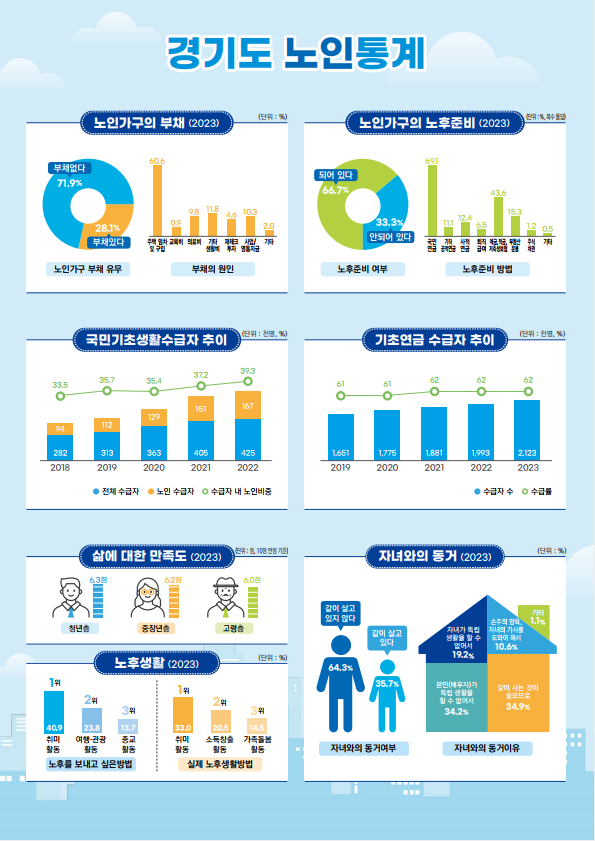
The desired post-retirement activities for the elderly in the province were hobbies (40.9%), travel and tourism (23.8%), and religious activities (13.7%), but actual post-retirement activities were hobbies (33.0%), income-generating activities (20.5%), and family caregiving activities (14.5%).
A Gyeonggi Province official stated, "Elderly issues are problems we will all face in the near future, and aging policies are very important in Gyeonggi Province’s population policies. We will continue to compile related statistics such as elderly statistics to support policy assistance for the province and cities/counties."
Meanwhile, the UN classifies societies as aging when the population aged 65 and over accounts for 7% or more of the total population, aged societies at 14% or more, and super-aged societies when it rises to 20% or more.
© The Asia Business Daily(www.asiae.co.kr). All rights reserved.


















