Korea Institute of Finance 'Household Debt Management in Korea' Policy Symposium
Expansion of DSR Application Scope Including Jeonse and Interim Payment Loans Needed
"Exclusion Needed for Some Groups Such as Youth and Elderly," Also Pointed Out
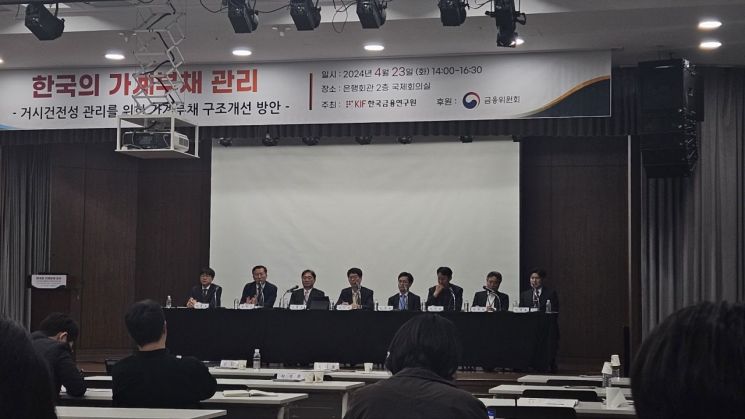 On the 23rd, panelists are discussing at the policy symposium titled "Household Debt Management in Korea: Structural Improvement Measures for Macroprudential Management of Household Debt," held at the Korea Federation of Banks Building in Jung-gu, Seoul. (Photo by Jae-Hyun Park)
There has been a call to expand the scope of the Debt Service Ratio (DSR) application to better manage household debt. This is because household debt interacts with movements in the housing market, making regulation of housing finance important. However, there are also opposing views suggesting that DSR regulations should be relaxed for certain vulnerable groups such as youth and the elderly.
On the 23rd, Park Chun-sung, Head of the Macroeconomic Research Office at the Korea Institute of Finance, emphasized at the policy symposium titled "Management of Household Debt in Korea: Structural Improvement Measures for Household Debt for Macroprudential Management," held at the Bankers' Hall in Jung-gu, Seoul, that "consistent operation of household debt-related regulations based on principles is crucial," and stressed the need to "evaluate the impact of jeonse deposit loans, interim payment loans, and relocation loans, and gradually expand the scope of DSR application."
As of the end of last year, Korea's household debt reached 1,886 trillion won, increasing at an average annual rate of 6.7% since 2010. However, based on new loans in the second quarter of last year, only 26.7% of loan products fall under the DSR regulation. Park pointed out that "limited DSR regulation undermines regulatory consistency across products and fails to achieve the intended policy effects," adding that "it may increase borrowers' repayment burdens and worsen macroprudential stability."
At the symposium, concerns were also raised about the blanket application of DSR regulations. Professor Seok Byung-hoon of the Department of Economics at Ewha Womans University, who participated as a panelist, noted that "the blanket application of DSR regulations could cause side effects."
According to Professor Seok, about 82% of the assets of Korea's elderly population are real estate. If the elderly are subject to DSR regulations, they effectively have no income except for the national pension, making it difficult to cover consumption and expenses. He stated, "If DSR regulations are not relaxed for the elderly, they will have no choice but to sell real estate to cover consumption and expenses," and suggested that "it is necessary to activate private reverse mortgage products or relax DSR regulations specifically for the elderly to liquidate real estate."
Financial authorities said they are internally reviewing the expansion of the DSR application scope. Shin Jin-chang, Director of the Financial Policy Bureau at the Financial Services Commission, said during the panel discussion that "a sudden and significant expansion of DSR application could threaten not only the real economy but also the stability of the financial system," and added, "I believe it should be expanded gradually and consistently with a long-term perspective."
In the same panel discussion, Director Shin pointed out that while the government’s intention is to manage household debt within the nominal GDP growth rate, there are several challenging factors. He expressed concern that the current perception that interest rates in the U.S. and Korea have peaked could stimulate loan demand. He also noted the need to monitor whether policy mortgage supply, implemented to stabilize housing for vulnerable groups, is fueling overall household debt expansion.
Meanwhile, the symposium also addressed the contraction in consumption caused by household debt. Lee Ji-ho, Director of the Research Department at the Bank of Korea, said, "Managing household debt is important not only for financial stability but also from an economic perspective," adding, "The biggest reason for the sluggish recent consumption recovery is high inflation and high interest rates, and households with a high propensity to consume suffer more during periods of high interest rates." He further pointed out, "In addition to high interest rates, household debt has recently reached very high levels, which is suppressing consumption."
© The Asia Business Daily(www.asiae.co.kr). All rights reserved.
![Clutching a Stolen Dior Bag, Saying "I Hate Being Poor but Real"... The Grotesque Con of a "Human Knockoff" [Slate]](https://cwcontent.asiae.co.kr/asiaresize/183/2026021902243444107_1771435474.jpg)
















