On the 23rd, the government once again urged the medical community to "stop collective action and participate in the Medical Reform Special Committee."
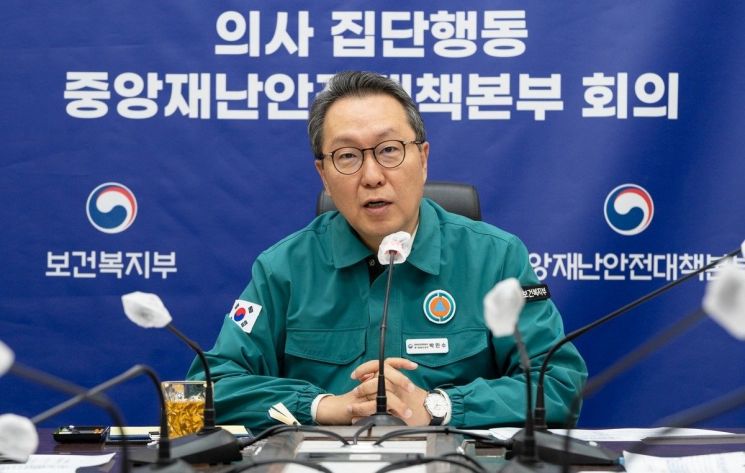
Park Min-su, the 2nd Vice Minister of Health and Welfare, presided over the Central Accident Response Headquarters (CARH) meeting for doctors' collective action on the same day, saying, "We deeply thank the public, patients, and medical staff on the front lines who are enduring heavy workloads while protecting hospitals and patients, and who are yielding advanced general hospitals and emergency rooms for more critical patients despite the inconvenience." He added, "We hope the medical community will stop collective action and participate in the Medical Reform Special Committee, which will be launched this week, to enable progressive and constructive discussions."
At the CARH meeting that day, the government reviewed the operation of the emergency medical system and the status of doctors' collective action.
As of the 22nd, the number of general inpatients at advanced general hospitals was 21,922, a 5.3% decrease compared to the average of the previous week, while the number of patients in intensive care units increased by 2.5% to 2,962.
Among 408 emergency rooms, 394 (97%) operated without reducing beds. There were 15 regional emergency medical institutions displaying messages restricting treatment for some severe and emergency diseases.
The government is expanding the medical cooperation infrastructure and strengthening information sharing between hospitals. From the 24th, the number of medical cooperation hospitals will be expanded from the existing 168 to 189, of which 68 will operate as cancer medical cooperation hospitals to ensure stable treatment for cancer patients.
Additionally, 75 medical institutions, including 38 advanced general hospitals and 37 public medical institutions, received 9.2 billion KRW in emergency medical new recruitment government subsidies for 591 newly hired doctors and 878 nurses. The government plans to continue supporting additional needs as they arise.
© The Asia Business Daily(www.asiae.co.kr). All rights reserved.

















