Ulsan City "Focus on Ecosystem Protection"
Ulsan City announced on the 22nd that the Eurasian otter, a natural monument and a Class I endangered wild species, has been confirmed to inhabit the Haju Island area of the Hoeya River in Mangyang-ri, Onyang-eup, Ulju-gun.
According to Ulsan City, Kang Seong-baek, a resident of the area, discovered the otter while taking a walk along the stream in front of his house and reported it after taking photographs.
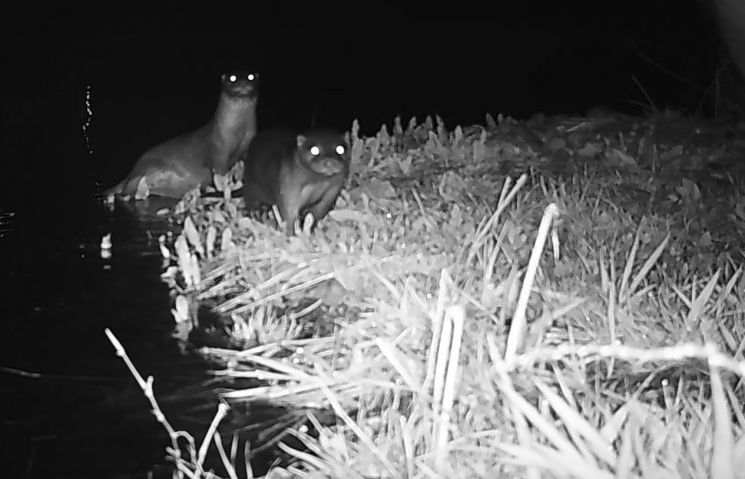
After receiving the report, the city entered the Haju Island (河中島) of the Hoeya River, where the photos were taken on March 13, to check for otter droppings and installed unmanned observation cameras.
On March 15, two otters were captured on camera, followed by separate sightings of two and one otter on March 31. On April 2, three otters were observed together.
Subsequently, the cameras recorded otters moving through the rising river waters, confirming that Haju Island is used as both a feeding ground and resting place.
Wildlife expert Dr. Han Sang-hoon, director of the Korean Peninsula Wildlife Research Institute, stated, “Two cubs have grown to a size similar to their mother and seem to be nearing independence. Being close to the city means there is abundant food, so they hide during the day and are mainly active at night. Maintaining the current habitat environment is crucial for their continued survival.”
An official from Ulsan City said, “We observe local wildlife species and their habitats annually to conserve them, and we are conducting detailed investigations into habitat conditions, including protection efforts. We will do our best to protect and promote the local ecosystem.”
The Eurasian otter is designated and protected as a natural monument and a Class I endangered wild species. It is a large mammal of the Mustelidae family, nocturnal, and adapted to life both in rivers and on land with short legs and webbed feet. It primarily feeds on fish but has developed canines that allow it to eat amphibians and crustaceans as well. Mating occurs from January to February, with a gestation period of 60 to 70 days, and up to four cubs are born at a time.
© The Asia Business Daily(www.asiae.co.kr). All rights reserved.

















