Senior Unsecured Bond Credit Rating Evaluation
IB Division Excels in Profit Generation... Concerns Over Overseas Real Estate
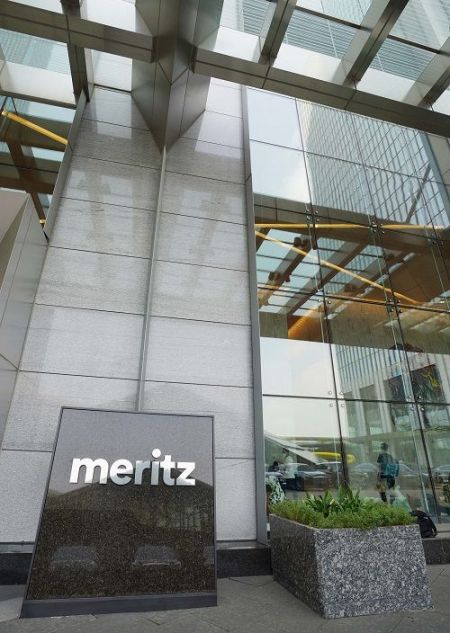
Korea Credit Rating, one of the three major credit rating agencies, maintained Meritz Securities' senior unsecured bond credit rating at 'AA-/Stable' on the 22nd. For subordinated bonds, which have a lower recovery rate than senior bonds, a rating one notch lower of 'A+/Stable' was assigned.
Korea Credit Rating positively evaluated Meritz Securities' strong business competitiveness and profit-generating capability, as well as its sound capital adequacy management. However, concerns remain due to the relatively high quantitative burden of domestic and overseas real estate finance exposure and the asset quality management burden centered on overseas real estate.
Senior analyst Yoon So-jung, who was in charge of the evaluation, stated, "As a large financial investment company with a top-tier market position, it possesses excellent business competitiveness," adding, "Its market share based on operating net income in 2023 was 6.2%, indicating a strong market position." In particular, the differentiated business foundation of the Investment Banking (IB) division and a capital scale exceeding 5 trillion KRW underpin its excellent business competitiveness.
Maintaining high profit-generating capability is also a strength. The average operating net income coverage over the past three years (2021?2023) was 235.0%, reflecting very strong recurring profit generation. Annual profit volatility has also been kept low.
Senior analyst Yoon noted, "In 2023 (operating net income coverage of 223.8%), profitability in the IB division slightly declined due to contraction in the real estate project financing (PF) market, but it maintained robust profitability compared to its peer group."
The quantitative burden of domestic and overseas real estate finance exposure is relatively high. He analyzed, "The risk exposure ratio relative to equity capital rose significantly to 349.8% at the end of 2023 from 239.1% at the end of 2022," attributing this to an increase of about 5 trillion KRW in investments in collective investment securities such as exchange-traded funds (ETFs) compared to the previous year.
There is also a management burden centered on overseas real estate. As of the end of 2023, out of a total risk exposure of approximately 19.7 trillion KRW, domestic and overseas real estate finance exposure (based on valuation for real estate funds) amounted to about 6.7 trillion KRW, comprising 4.8 trillion KRW domestically and 1.9 trillion KRW overseas. The total real estate finance exposure relative to equity capital is about 120%.
Senior analyst Yoon stated, "Although the quantitative burden of domestic exposure is high, considering factors such as region, repayment priority, and loan-to-value (LTV), the qualitative risk level is relatively low. On the other hand, overseas concerns persist regarding commercial real estate (CRE), and given the considerable proportion of development loans, there is an inherent asset quality management burden."
Capital adequacy was assessed as sound. Meritz Securities conducted a paid-in capital increase of 200 billion KRW in 2020 and issued 445 billion KRW of hybrid capital securities in 2021. In 2022, it expanded capital through the issuance of 150 billion KRW in hybrid capital securities and 90 billion KRW in subordinated bonds.
He explained, "Capital adequacy indicators in 2023 declined slightly compared to the previous year due to a larger increase in total risk amount relative to the increase in operating net capital. However, considering the excellent profit-generating ability and risk management stance, sound capital adequacy is expected to be maintained."
Accordingly, future monitoring points include risk management capabilities and financial stability related to contingent liabilities, overseas alternatives, and other high-risk exposures.
© The Asia Business Daily(www.asiae.co.kr). All rights reserved.

















