The court recognized the mandatory nature of the 'distance restriction rule,' which prohibits new store openings within 250 meters between convenience stores of the same brand, and ruled that any terms violating this rule are invalid. This decision puts a stop to the franchise headquarters' cunning contract terms that undermine the 'business area guarantee' created to prevent excessive store openings and protect franchisees' business rights.
The Administrative Division 3 of the Seoul High Court (Presiding Judge Junyoung Jeong, Judges Hyeongjin Kim and Youngwook Park) ruled against the plaintiff in the lawsuit filed by BGF Retail Co., Ltd., which operates the convenience store CU, seeking to cancel a warning disposition issued by the Fair Trade Commission on the 18th (2023Nu45653).
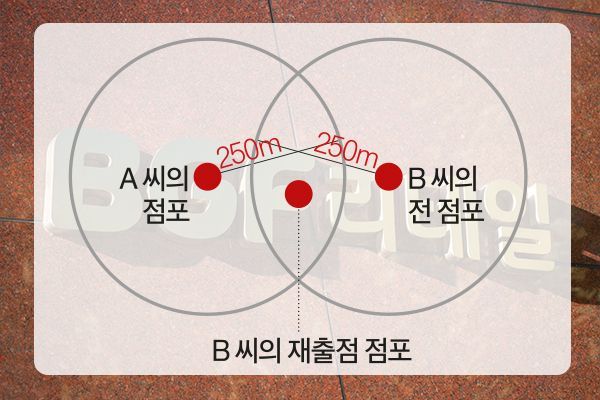
The CU franchise headquarters signed a franchise contract with Mr. A in September 2020 and opened a convenience store in Bucheon-si, Gyeonggi Province. The franchise contract included a clause that the headquarters would not open a new CU store (including directly operated stores) within 250 meters of Mr. A's store, measured by the shortest walking distance. However, exceptions were allowed if the existing franchisee closed and reopened or relocated the store, or if the headquarters obtained the franchisee's consent to open another CU store.
In May 2021, CU approved the existing franchisee, Mr. B, to close a store approximately 278 meters from Mr. A's store and reopen it about 230 meters away. According to online maps, the two stores were about three blocks apart, a distance that takes less than three minutes on foot and less than one minute by bicycle. CU offered Mr. A monetary compensation and requested him to sign a 'consent to opening' within the business area, but Mr. A refused.
Subsequently, Mr. A sent a certified letter to CU demanding the suspension of construction at Mr. B's store, which was under construction for relocation, and urged compliance with the model transaction standards. CU responded to Mr. A stating that the relocation was within the distance restriction stipulated in the franchise contract and finalized the reopening procedures for Mr. B's new store, asserting that Mr. A's consent was not necessary.
In response, the Fair Trade Commission issued a warning in May last year, stating, "CU is warned for relocating an existing franchisee's store from outside to inside the business area during the franchise contract period without justifiable reasons." CU filed a lawsuit challenging this disposition.
During the trial, CU argued that it trusted the Fair Trade Commission's 'Model Transaction Standards for Convenience Store Industry' and that the reopening of Mr. B's store was based on justifiable reasons.
However, the court found no issue with the Fair Trade Commission's warning disposition.
The court stated, "The act of relocating or reopening an existing franchise store can infringe on the business area of stores like Mr. A's and cause serious harm to their business rights. Allowing existing stores to reopen or relocate extremely close to other stores undermines the legislative intent of Article 12-4, Paragraph 1 of the Franchise Business Act, which mandates the establishment of business areas."
It also noted, "The plaintiff, as the franchisor, created and used contract terms that are unfair and contrary to the legitimate interests and reasonable expectations of the contracting party, thereby damaging the order of healthy franchise business transactions and unfairly disadvantaging the franchisee customers." The clause allowing reopening or relocation of existing stores is considered a contract term, and such terms violate the Act on the Regulation of Terms and Conditions.
Article 12-4 of the Franchise Business Act prohibits franchisees from opening directly operated stores or franchises of the same business type within the franchisee's business area, except in cases of 'justifiable reasons.'
The court interpreted this as meaning, "Since the franchisor may use its superior bargaining position to expand harm to franchisees, any act that appears to infringe on business areas is presumed to potentially disrupt fair franchise transactions, and the burden of proving justifiable reasons lies with the franchisor."
CU claimed that it included the clause allowing reopening or relocation within the distance restriction in the franchise contract based on the Fair Trade Commission's 2012 Model Transaction Standards, which permitted such exceptions. However, the court rejected CU's claim, stating, "After the enactment of Article 12-4 of the Franchise Business Act on August 13, 2013, which guarantees franchisees' business areas, the current Franchise Business Act must be followed."
This ruling is expected to curb the convenience store industry's practice of allowing exceptions for store openings within restricted distances through various special agreements, even after the enactment of Article 12-4 protecting business areas. Professor Yonggu Seo of the Department of Business Administration at Sookmyung Women's University said, "The convenience store industry is a 'tilted playing field' where the franchisor's position is overwhelmingly dominant over franchisees. This ruling, which recognizes franchisees' rights, will have a significant impact on the highly competitive convenience store industry, both between different companies and within the same company."
Reporter Suhyun Han, Legal Newspaper
※This article is based on content supplied by Law Times.
© The Asia Business Daily(www.asiae.co.kr). All rights reserved.
![Clutching a Stolen Dior Bag, Saying "I Hate Being Poor but Real"... The Grotesque Con of a "Human Knockoff" [Slate]](https://cwcontent.asiae.co.kr/asiaresize/183/2026021902243444107_1771435474.jpg)
















