Contains 100 Regulatory Improvement Tasks
Including Tourism Complex Facility Standards and Prepaid Electronic Payment Limit Increase
"Prompt Improvements Must Be Achieved"
The Korea Chamber of Commerce and Industry (KCCI) announced on the 22nd that it has submitted a proposal titled '2024 Killer and Livelihood Regulation Improvement Tasks' to the government, requesting the rationalization of unnecessary administrative procedures and the improvement of excessive regulations to enhance corporate vitality and public convenience.
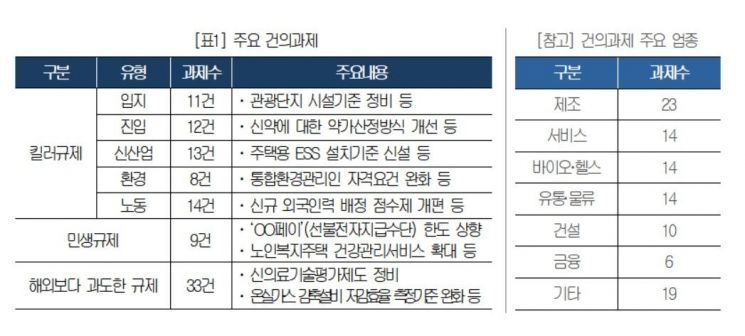 Major proposals included in the "2024 Killer and Livelihood Regulation Improvement Tasks" petition submitted by the Korea Chamber of Commerce and Industry to the government. Table provided by the Korea Chamber of Commerce and Industry.
The proposal includes 100 regulatory improvement tasks identified by KCCI during the first quarter through major companies, local chambers of commerce, and foreign chambers of commerce in Korea, consisting of 58 killer regulations, 9 livelihood regulations, and 33 regulations that are more excessive than those overseas.
In particular, the facility standards for tourist complexes were cited as a representative killer regulation that hinders corporate investment. Currently, the facility standards for tourist complexes are defined for single uses such as tourism and recreation, entertainment, accommodation, and shopping, making it difficult to pursue projects that are combined with various industries, KCCI explained.
Overseas, experiential tourism combined with various industries, such as Universal Studios filming tour and Silicon Valley company visits, or facilities linking shopping, accommodation, and entertainment like Singapore's Marina Bay Sands, have been actively introduced. Therefore, KCCI added that regulations should be newly established to enable the development of tourist complexes that align with these trends.
As a livelihood regulation improvement task, raising the single-charge limit for prepaid electronic payment methods such as '○○Pay' was proposed. Although domestic prepaid electronic payment methods have become daily payment means with the average daily usage amount increasing more than threefold over the past five years, the charge limit has remained at 2 million KRW for 15 years, causing inconvenience to consumers.
Additionally, with the demand for elderly welfare housing such as silver towns expanding due to aging, there was a suggestion to revise standards for the placement of medical personnel and health management to provide basic medical services.
KCCI also requested that when obligations or administrative procedures imposed on companies are more excessive than those overseas, the 'Global Standard Minimum Regulation' be applied to alleviate corporate burdens.
For example, even if a company develops a new medical device and obtains approval from the Ministry of Food and Drug Safety after verifying performance and risk, it must additionally pass a new medical technology assessment to use it commercially in the market.
In this case, the burden of literature and clinical data for safety and efficacy evaluation is excessive, and the evaluation period takes an average of more than 200 days, making it difficult for companies to enter the market quickly. In contrast, major countries such as the United States, the United Kingdom, and Canada generally allow market entry before the new medical technology assessment and permit cost claims as non-reimbursable items.
KCCI also proposed easing the obligation to measure the reduction efficiency of greenhouse gas reduction facilities in advanced industries such as semiconductors and displays to the level of advanced countries.
In Korea, 10% of greenhouse gas reduction facilities in advanced industries are required to measure reduction efficiency annually, but the appropriate level according to the Intergovernmental Panel on Climate Change (IPCC) guidelines is 5%, and the U.S. Environmental Protection Agency (EPA) requires 10% measurement for the first two years and 5% for the following three years, indicating a heavier burden on domestic companies.
Lee Sang-heon, head of KCCI's Regulatory Innovation Team, said, "The government has continuously promoted the improvement of killer and livelihood regulations and recently announced temporary regulatory suspension tasks, continuing bold measures," adding, "We hope that various regulatory difficulties faced by companies and regulations perceived as excessive compared to overseas will be promptly improved."
© The Asia Business Daily(www.asiae.co.kr). All rights reserved.
!["The Woman Who Threw Herself into the Water Clutching a Stolen Dior Bag"...A Grotesque Success Story That Shakes the Korean Psyche [Slate]](https://cwcontent.asiae.co.kr/asiaresize/183/2026021902243444107_1771435474.jpg)
















