AI Improves Quality of Life in Translation, Dining, and Housework
Open Research by Companies Like Meta
Accelerates Development and Enhances Competitiveness
Positive Effects on Productivity Outweigh Job Threats
"Artificial intelligence (AI) and robotics have already become part of our lives. Research on home robots combined with AI is expected to rapidly advance within the next 3 to 5 years."
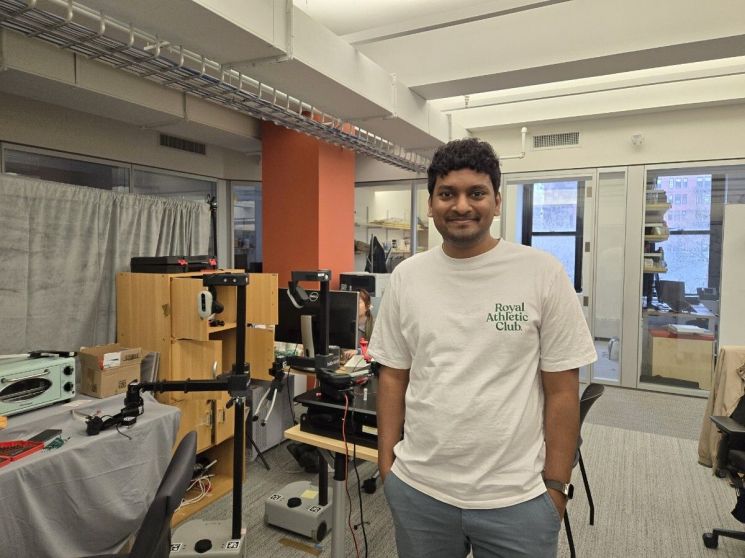 Professor Rele Pinto of the Computer Science Department at New York University is taking photos in a laboratory where robots integrated with artificial intelligence (AI) perform various tasks, following a recent interview conducted at New York University. New York ? Photo by Kwon Haeyoung
Lerrel Pinto, a professor in the Computer Science Department at New York University, recently stated in an interview at NYU, "Although there is still a gap between AI development and product creation, the pace of advancement in physical robots integrated with AI will accelerate sharply, leading to significant progress in everyday life."
Professor Pinto is a young scholar focusing on machine learning for robotics. Last year, he was selected as one of MIT Technology Review's 'Innovators Under 35,' and recently gained attention by founding Fauna Robotics. He is scheduled to participate as a speaker at the Future Enterprise Forum hosted by Asia Economy on the 22nd of next month, where he will introduce trends in AI and robotics technology.
He believes AI will replace various tasks in our daily lives, bringing many changes. He expects AI to greatly improve quality of life in practical areas such as translation and interpretation, restaurant and flight reservations, autonomous driving enhancements, and household chores.
Fauna Robotics, founded by Professor Pinto, is developing robots integrated with AI. One of the main development targets is a general-purpose home robot. They are developing AI robots that operate in unfamiliar environments like humans and enhance their learning ability through trial and error. In his laboratory, AI robots are performing various tasks including household chores. He predicted, "Development of home robots will make significant progress within as soon as three years, but commercialization will take a bit more time."
As AI has recently emerged as a hot topic in the IT industry and companies focus on AI development, Professor Pinto emphasized that collaboration and competition under the keyword 'openness' are important. He cited Meta as a model case, which was the first among big tech companies last year to release the code for the open-source large language model (LLM) LlaMa.
Professor Pinto said, "Many companies do not share their research results, but some, like Meta, have joined the open AI camp. Through open source, everyone can access and develop technology, continuously advancing the field." He added, "Although they may still lag behind OpenAI, the developer of ChatGPT, in competitiveness, many people can participate in development and create high-performance AI, which ultimately accelerates research progress and development speed, providing a significant long-term competitive advantage."
Regarding concerns that AI will threaten human jobs in the future, he viewed the positive effects such as productivity expansion as much greater. Professor Pinto said, "There will be some replaceable jobs, but AI tools are becoming increasingly powerful and useful," and predicted, "Humans can use AI software to boost productivity far beyond current levels." He added, "We cannot entrust everything autonomously to AI, but with AI's help, productivity can be significantly increased compared to before. For example, if developing a specific application took two years, using AI could reduce that to half, one year."
Professor Pinto expects AI to lower information access barriers for socially disadvantaged or vulnerable groups, expanding opportunities. He said, "For groups with limited educational access, AI tools can provide more diverse knowledge and data," and added, "One can learn software engineering much faster through AI tools, and by utilizing AI for code generation, organization, and interaction, the required workload can also be reduced."
He explained that companies need to consider the impact on marginalized groups and develop responsible AI. However, he noted, "The functionality, benefits, and effective use of AI systems depend on the user's understanding and ability to ask the right questions," and "there can be differences in productivity and efficiency outcomes depending on the user." He predicted that information and productivity gaps based on AI utilization skills will widen.
Regarding the advent of the era of Artificial General Intelligence (AGI) that surpasses human capabilities, he said, "The definition of AGI is unclear," and expects it to take considerable time. Professor Pinto stated, "I believe AI will not reach human intelligence levels for a long time," and diagnosed, "Interaction with humans is still insufficient, and product development combining AI with the physical functions required for specific tasks is still underway."
Professor Pinto aims to implement rapidly advancing AI in real life through Fauna Robotics. He emphasized, "The goal of founding Fauna Robotics is to create this type of robot that physically coexists with us in natural human environments, where AI robots can physically assist in the real world, such as tidying the house or moving coffee cups."
© The Asia Business Daily(www.asiae.co.kr). All rights reserved.

















