Research Institutions Including Korea Institute for Industrial Economics and Trade and Five Major Financial Research Institutes Attend
Oh Young-joo "Will Reflect Various Policy Suggestions"
The Ministry of SMEs and Startups and the Financial Services Commission have joined hands to review and discuss the financial difficulties faced by small and medium-sized enterprises (SMEs).
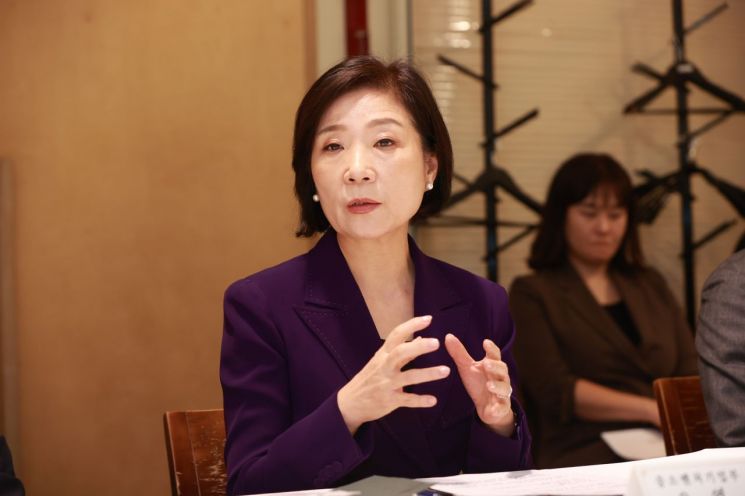
On the 22nd, the Ministry of SMEs and Startups announced that it held the first meeting of the ‘SME Financial Difficulty Review Consultative Body’ jointly with the Financial Services Commission at the Korea Federation of SMEs in Yeouido, Seoul.
The consultative body was established to examine the financial status, loans, and financial conditions of SMEs, respond early to risk factors, and timely prepare necessary financial support tasks on the ground. The first meeting was co-chaired by Minister Oh Young-joo of the Ministry of SMEs and Startups and Chairman Kim Ju-hyun of the Financial Services Commission, with participation from research institutions such as the Korea Institute of Finance, Credit Information원, Korea Institute for SMEs and Startups, and financial research institutes of the five major holding companies.
Minister Oh Young-joo of the Ministry of SMEs and Startups explained, “To resolve the financial difficulties of SMEs, it is necessary for the Ministry of SMEs and Startups, which oversees policies for SMEs and small business owners, and the Financial Services Commission, which is responsible for financial policies, to put their heads together and pool their wisdom.”
Minister Oh added, “Various policy suggestions from the consultative body will be reflected in future policies for SMEs and small business owners. Going forward, the Ministry of SMEs and Startups will actively seek support measures to reduce the repayment burden on small business owners while strengthening the supply of policy finance to create new growth engines for SMEs.”
Chairman Kim Ju-hyun of the Financial Services Commission said, “SMEs hold an absolute share in the industrial ecosystem and employment, making them very important. Recently, SMEs have seen declining sales and rising costs, weakening profitability. Although absolute figures such as delinquency rates remain favorable, continuous attention is necessary.”
Chairman Kim also stated, “The Financial Services Commission has implemented various measures to support sales growth and reduce cost burdens to alleviate the financial difficulties of SMEs. Going forward, through the SME Financial Difficulty Review Consultative Body, we will analyze the financial status and difficulties of SMEs by major industries and prepare effective support measures in a timely manner according to changes in the situation.”
The first presenter of the day, Shin Yong-sang, Director of the Financial Risk Research Center at the Korea Institute of Finance, gave a presentation on ‘Current Status and Implications of Domestic Corporate Credit.’ Director Shin analyzed, “Although corporate sector insolvency is currently assessed as unlikely to spread to systemic risk across the economy, it is necessary to closely monitor trends given the recent rapid increase in corporate debt in Korea, the ongoing high interest rate environment, and the continued stagnation of the domestic market including the real estate market and private consumption.”
Lee Dong-joo, Deputy Director of the Korea Institute for SMEs and Startups, who presented on ‘SME Management Diagnosis and Financial Risk Review,’ expressed the opinion that “During the COVID-19 crisis, policy finance for SMEs and small business owners has faithfully served as a financial safety net for medium- and low-credit policy targets. For this reason, the default rate is inevitably rising, and monitoring and appropriate management are necessary.”
© The Asia Business Daily(www.asiae.co.kr). All rights reserved.

















