Interview with Jeon Jeonghwa, Director of Busan Child Cognitive Development Center
Early Detection and Treatment of Acquired Disabilities, "Critical Period Before Age Three"
“Do you know the golden time for treating developmental disabilities?”
South Korea is currently entering an era with 260,000 people with developmental disabilities. The number of newly registered infants and toddlers with developmental disabilities has shown a steep increase, more than doubling from 1,475 in 2014 to 3,301 in 2021, and the current number of infants and toddlers with developmental disabilities is estimated to be around 70,000.
To hear the vivid voices from the field of a welfare institution specializing in developmental disabilities in honor of Disability Month, we visited Jeonghwa Jeon, director of the Busan Child Cognitive Counseling Center.
Located in Yeonje-gu, Busan, the Busan Child Cognitive Counseling Center was established in 2010 and operates various programs for the treatment and welfare enhancement of people with developmental disabilities, including language, cognitive, and art therapy, special physical education, early education, and daytime activities. Experts in each field strive to realize the dreams of people with disabilities, just like the meaning of the institution’s name prefix “Kkumttang” (land where dreams grow).
Jeonghwa Jeon, who has played a pioneering role in the field of special therapy in Korea, is a German-educated scholar who once majored in German language and literature and dreamed of becoming a humanities scholar. During her studies in Germany, she encountered special education research, which was unfamiliar in Korea at the time, through acquaintances in the local special education field for people with disabilities.
In particular, she experienced Germany’s advanced welfare system for people with disabilities, which supports lifelong customized programs for individuals with disabilities by implementing the “Tagesstruktur” system, known as “daily life organization.” The image of people with developmental disabilities in Germany living happy and healthy lives with support from the state and society, quite different from the situation in Korea, greatly inspired Director Jeon.
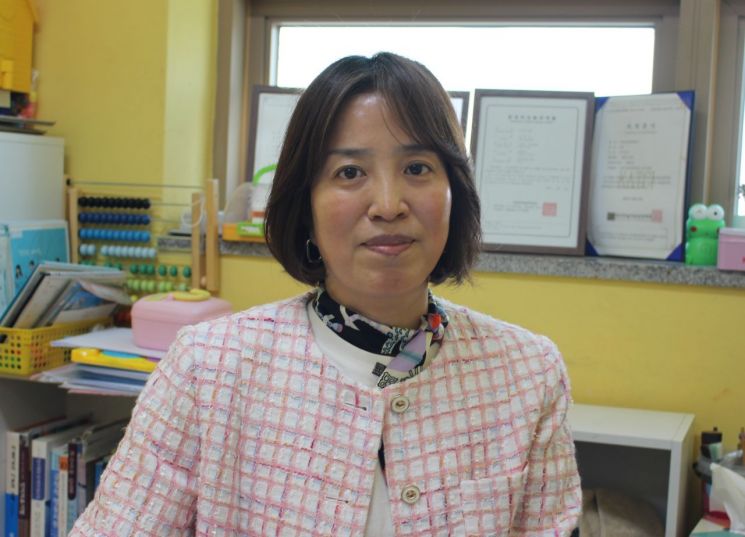
“After finishing my studies abroad, I entered a special education department to pursue a new goal of working with people with disabilities. It felt like giving up a lifelong dream and stepping into unfamiliar territory.”
At that time, special education was not widely spread in Korea, so it was not an easy decision for Director Jeon. After completing her university studies, she began gaining field experience at a welfare center for people with disabilities in Busan. The social awareness and national support were insufficient, and all conditions were poor.
Director Jeon recalls, “The cold gaze of society toward people with developmental disabilities spurred me on even more. It was heartbreaking to see even those disabilities that could be treated being neglected due to a lack of small interest and effort from all of us.”
Determined to confront this reality, she established the Busan Child Cognitive Counseling Center in 2010, an integrated private educational institution offering integrated education and therapy tailored to various types of disabilities, including speech therapy, cognitive therapy, behavioral therapy, and special physical education.
Director Jeon emphasizes, “Professional treatment is necessary depending on the problem behaviors and types of disabilities of people with developmental disabilities. For this, the efforts of experts and the trust of families, including parents, are most important.”
Currently, the Busan Child Cognitive Counseling Center operates various programs such as an “early education program” that screens problem behaviors in children with disabilities or preschool children and guides them to adapt to learning activities; a “therapeutic education program” for language, cognitive, music, art therapy, and special physical education for school-age children and students; and “daytime activities” and “after-school activities” for people with developmental disabilities.
These integrated programs reflect the long field experience and efforts accumulated by Director Jeon. She advises, “Differentiated, customized treatment and activities are needed according to the individual characteristics and symptoms of people with developmental disabilities. Appropriate treatment and activities by life cycle greatly help people with disabilities take one more step into society.”
The center also operates daytime activity programs for adult people with developmental disabilities who have nowhere to go after finishing formal institutions. While preschool children or students can attend special schools operated nationwide, there are few suitable places for adults. Statistics show that only about 25% of all adult people with developmental disabilities use specialized institutions.
Director Jeon said, “If adult people with developmental disabilities stay only at home, they lose social adaptability, and the treatment they have received so far regresses. Although there are practical difficulties, continuously seeking specialized institutions is helpful.”
Daytime activities for adult people with developmental disabilities are operated as government-subsidized projects. Composed of various experiential and therapeutic programs, they make tireless efforts to cultivate social skills and improve adaptability of people with disabilities. However, there are also practical problems in operating programs for adults.
Director Jeon pointed out, “Problem behaviors of adult people with developmental disabilities appear in various ways, and since the degree of violence and sudden behaviors varies by individual, treatment and protection methods must differ.” She expressed regret, saying, “However, the support fund regulations are somewhat rigid, and there are many restrictions in operating customized programs according to individual characteristics.”
She added, “The social gaze that looks directly at people with developmental disabilities is still cold, and there are many restrictions on external experiential activities,” appealing for institutional autonomy to enable flexible program operation.
Many experts emphasize the importance of early detection and treatment of developmental disabilities before the brain development stops at age three. They stress that the golden time must not be missed. Director Jeon strongly stated that developmental disability symptoms detected early can be treated except for congenital disabilities.
Director Jeon warned, “From infancy, children need a lot of parental attention and attachment relationships to feel and express emotions. If they only play at home with TV, smartphones, or computer games, interpersonal problems gradually arise, and neglecting this period can lead to acquired autism over time.”
She also said, “The most prominent example of such autistic tendencies is language. Some children may be slow in acquiring or expressing language, but this can be a phenomenon caused by autism or delayed language development. If a child does not make eye contact, does not socialize with peers, or does not respond when called, I urge parents to immediately seek specialized institutions.”
Director Jeonghwa Jeon says that seeing parents who still cannot accept that their child has a developmental disability makes her feel the painful reality of our society even more. This is why she emphasizes that parental interest, attachment, and continuous warm attention and communication with children can prevent acquired disabilities.
© The Asia Business Daily(www.asiae.co.kr). All rights reserved.
![Clutching a Stolen Dior Bag, Saying "I Hate Being Poor but Real"... The Grotesque Con of a "Human Knockoff" [Slate]](https://cwcontent.asiae.co.kr/asiaresize/183/2026021902243444107_1771435474.jpg)
















