Chungnam Center Rescues 190 Animals Affected by Sticky Traps
Smaller Birds More Vulnerable... Only 42.6% of Rescued Animals Released
There have been frequent cases where innocent wild animals get caught and harmed by sticky traps set to catch rats.
According to the Chungnam Wildlife Rescue Center on the 21st, from 2011 to 2023, the center rescued 190 wild animals affected by sticky traps.
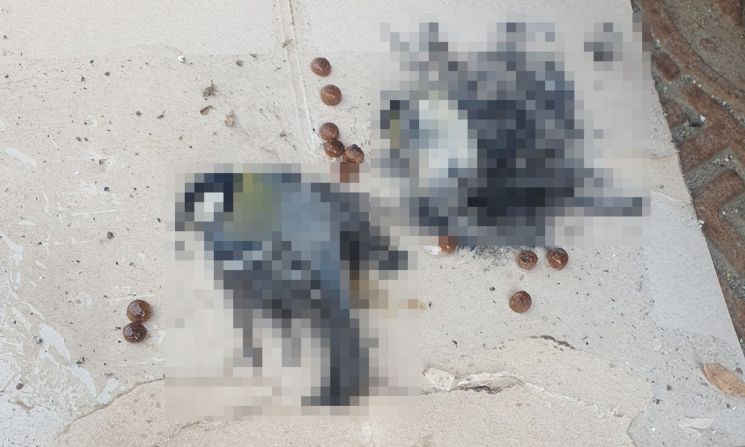 The appearance of great tits stuck to the glue traps installed around a restaurant in Cheonan, Chungnam on the 14th [Photo by Chungnam Wildlife Rescue Center]
Among the affected animals, 109 (57.4%) either died during treatment or are still undergoing treatment, while only 81 (42.6%) have returned to the wild.
The most affected species was the common kestrel, with 45 individuals (23.7%). This is because they suffer secondary accidents while hunting small mammals and birds caught in the sticky traps.
Following were sparrows with 39 individuals (20.5%), swallows and great tits with 13 each (6.8%), redstarts with 9 (4.7%), Eurasian eagle-owls and Korean rat snakes with 4 each (2.1%), and weasels with 3 (1.6%).
Small-bodied birds are particularly vulnerable to sticky traps. They often break bones while struggling to escape. Additionally, the toxicity of the sticky substance irritates their skin and mucous membranes, and the stress from removing contaminated feathers can cause rapid breathing and death.
By season, the most incidents occurred in summer with 113 cases (59.5%), when sticky traps are increased to catch rats and pests. This was followed by spring with 41 cases (21.6%), and autumn and winter with 18 cases each (9.5%).
Kim Bong-gyun, a rehabilitation manager at the Chungnam Wildlife Rescue Center, emphasized in a phone interview with Yonhap News that although sticky trap incidents are fewer in scale compared to other types of accidents, they should be given attention because they can be easily reduced with a little care.
Manager Kim said, "To block rats and pests, it is more effective to install sticky traps indoors rather than outdoors. Moreover, placing sticky traps outdoors can cause harm to third-party wild animals."
He suggested, "Although there are difficulties due to cost and disposal issues, it is preferable to install capture cages rather than sticky traps, as this can reduce the possibility of harm to other animals."
© The Asia Business Daily(www.asiae.co.kr). All rights reserved.
![Clutching a Stolen Dior Bag, Saying "I Hate Being Poor but Real"... The Grotesque Con of a "Human Knockoff" [Slate]](https://cwcontent.asiae.co.kr/asiaresize/183/2026021902243444107_1771435474.jpg)
















