Japanese Court Lawsuit Lost → New Lawsuit in Chinese Court
Korean Court Does Not Recognize State Immunity and Rules Compensation Possible
Descendants of Japanese military 'comfort women' victims in China have initiated a lawsuit against the Japanese government in a Chinese court. They referred to lawsuits and rulings conducted in Korea.
According to the Chinese media Modern Express and the Chinese 'Comfort Women' Issue Research Center on the 21st, the children and grandchildren of 18 Chinese victims, including grandmother Hou Dong'e, filed a lawsuit against the Japanese government at the Shanxi Provincial Higher People's Court between the 8th and 10th of this month. All 18 plaintiffs are deceased.
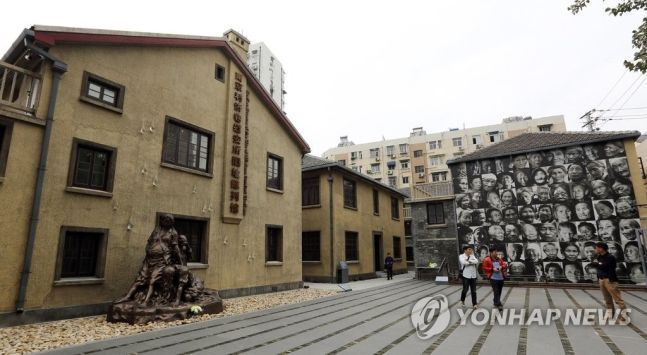 Exhibition Hall of the Former Site of Lijiangyuanso in downtown Nanjing, China
 [Photo by Yonhap News]
This lawsuit is led by Jiang Shuangbing, China's first private investigator of 'comfort women' victims. Jiang first met grandmother Hou Dong'e, who was living in hardship, in 1982 and then began searching for other victims in China.
Over the next 42 years, Jiang met more than 1,000 victims, among whom 139 officially came forward demanding compensation from the Japanese government.
He collected victim data and began filing lawsuits in Japanese courts from 1992. There were a total of nine trials until 2007, and the Supreme Court of Japan ruled that the statute of limitations had expired and that under Japanese law, lawsuits could not be filed against the government. While acknowledging the historical facts, the court ultimately decided not to award compensation.
Regarding the reason for initiating a new lawsuit in Chinese courts, Jiang explained, "I gained insight from the Korean cases. Before Korean volunteers helped Korean 'comfort women' victims start their lawsuits, I had several exchanges with them. The Korean court rulings made me consider filing a lawsuit against the Japanese government in China."
Earlier, the Seoul Central District Court ruled in 2021 in the first trial that the Japanese government must pay 100 million won each to 12 Korean 'comfort women' victims, including the late grandmother Bae Chun-hee, in a damages lawsuit.
At that time, the court rejected Japan's claim of 'state immunity' (an international law principle that a court of one country cannot exercise jurisdiction over another country or its property, also called 'sovereign immunity') and ruled that Korean victims could receive compensation from the Japanese government. This ruling was finalized as Japan did not appeal.
Around the same time, another division of the Seoul Central District Court accepted the state immunity argument in the first trial of a damages lawsuit filed by 16 victims including grandmother Lee Yong-soo, dismissing their claims. However, in November last year, the second trial overturned this decision and ruled that the Japanese government must pay 200 million won each to the victims. This ruling was also finalized.
Last year, Jiang sent the Korean court's compensation ruling to Chinese human rights lawyer Jia Fang and requested her to take on the lawsuit. Lawyer Jia and her colleagues decided to support the case.
In a previous ruling by the Tokyo High Court, the phrase in the 1972 'China-Japan Joint Communique' stating "The Government of the People's Republic of China renounces its demand for war reparations from Japan for the sake of the friendship between the peoples of the two countries" became a point of contention. It was argued that the Chinese government had already relinquished the right to compensation.
However, lawyer Jia plans to argue that the joint communique's content is limited to the 'Chinese state's right to claim compensation' and that under international law and agreements, individual war civilian victims' human rights claims for compensation are not subject to statute of limitations or state immunity restrictions.
Lawyer Jia believes that Chinese courts will not accept Japan's statute of limitations and state immunity arguments.
She stated that the Korean court's compensation ruling is "an expression of national judicial sovereignty" and that "after the legitimate ruling, the Korean court requested the Korean government to disclose the list of Japanese assets in Korea for enforcement, which serves as a reference for Chinese victims."
She added, "If the Japanese government does not acknowledge apology and compensation, our demands during the ruling, enforcement, enforcement rulings, and reconciliation process might more easily prompt their sincere remorse and apology."
Su Zuliang, director of the 'Comfort Women' Issue Research Center and professor at Shanghai Normal University, said, "The significance of this lawsuit is special, and we hope not only the Shanxi Provincial Higher People's Court but courts nationwide will take it seriously. There is still a need to pursue many unresolved issues left by the war, such as victims of biological warfare by the invading Japanese army, forced labor victims, and gas attack victims in the Northeast region."
© The Asia Business Daily(www.asiae.co.kr). All rights reserved.

![Clutching a Stolen Dior Bag, Saying "I Hate Being Poor but Real"... The Grotesque Con of a "Human Knockoff" [Slate]](https://cwcontent.asiae.co.kr/asiaresize/183/2026021902243444107_1771435474.jpg)















