KAMC Issues Appeal to Government
"Difficult to Meet Legal School Days" Pressure
The Korean Association of Medical Colleges (KAMC) urged the government to freeze the medical school admission quota for the 2025 academic year and to promptly resolve the issue, stating that the resignation of residents and the retention of medical students would collapse the medical workforce training system and cause educational losses. KAMC announced this appeal to the government on the 21st after a meeting of deans and heads of medical schools on the 18th. Despite the government's concession to allow each university to autonomously select 50-100% of their medical school quota for the 2025 academic year, medical school deans expressed strong opposition.
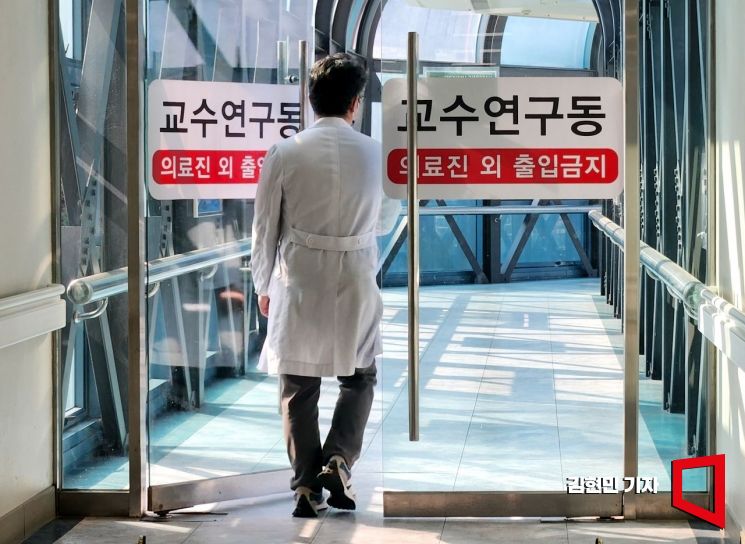 A medical school official is entering the research building at a university hospital in Seoul.
 [Photo by Hyunmin Kim kimhyun81@]
They emphasized, "Considering the return of residents and students and the 2025 academic year admission schedule, please freeze the medical school admission quota for the 2025 academic year," and added, "We hope that a consultative body with the medical community will be promptly formed to discuss the scientific calculation of admission quotas and the establishment of governance to determine future medical workforce supply and demand from the 2026 academic year onward." This essentially maintains their existing stance demanding a complete cancellation.
"KAMC has done its best to normalize the academic schedule of medical schools amid difficult circumstances, but due to repeated delays and cancellations of classes, it will be difficult to meet the legally required number of class days by the end of this month," they stressed, adding, "Although the Ministry of Education is not approving leave of absence applications, if the current situation continues, deans will have no choice but to approve leaves of absence to minimize students' disadvantages such as collective retention and tuition losses."
Furthermore, the government's plan for 'autonomous increase of medical school quotas' was rejected, stating, "While it had the effect of breaking the framework of dialogue confined to numbers, it is not reasonable to rely on university presidents' autonomous decisions on the scale of national medical workforce output amid intense conflicts." They urged, "KAMC has patiently waited for a fundamental change in the government's position, but the time to prevent the collapse of Korean healthcare is running out," and appealed earnestly, "For the future of Korean healthcare, we sincerely appeal for the government's wise decision, which holds the key to resolving this crisis, so that the government and the medical community can cooperate to overcome this difficulty."
Recently, the government, which had been pushing for an increase of 2,000 students, proposed a reduction of up to 1,000. On the 19th, Prime Minister Han Duck-soo said, "Considering the educational conditions of each university, among the 32 universities whose medical school quotas were expanded this year, those that wish will be allowed to autonomously recruit new students within 50% or up to 100% of the increased number for the 2025 academic year only." However, the medical community's response remains cold. Rather, they seem to be pressuring the government by citing the tight timeline after the general election.
© The Asia Business Daily(www.asiae.co.kr). All rights reserved.

















