KCCI '2023 Business Wage Increase Characteristics Analysis'
Large Companies 70 Million KRW, SMEs 43 Million KRW
Polarization Deepens... Performance Bonus Gap Widens
Hourly Wage 25,000 KRW... Rises to Inflation Rate Level

Last year, the monthly wages of regular employees at domestic companies increased by 2.8% compared to the previous year, but performance bonuses decreased by 2.9%.
According to the "2023 Business Wage Increase Characteristics Analysis" released on the 21st by the Korea Employers Federation, which analyzed the raw data from the Ministry of Employment and Labor's Business Labor Survey, the annual total wages of regular employees last year amounted to 47.81 million KRW, a 2.8% increase from the same period the previous year. Regular employees refer to wage workers whose employment contract period is either indefinite or one year or longer. The annual total wage is the amount obtained by converting the average monthly wage per person into an annual figure.
Specifically, fixed wages, which include base salary, regular allowances, and other allowances, were recorded at 41.33 million KRW, up 3.8% from the previous year. On the other hand, special wages, which include performance bonuses and incentives, amounted to 6.48 million KRW, down 2.9% during the same period. Including overtime pay, the annual total wage reached 50.53 million KRW, up 2.8% from the previous year, surpassing 50 million KRW for the first time in history.
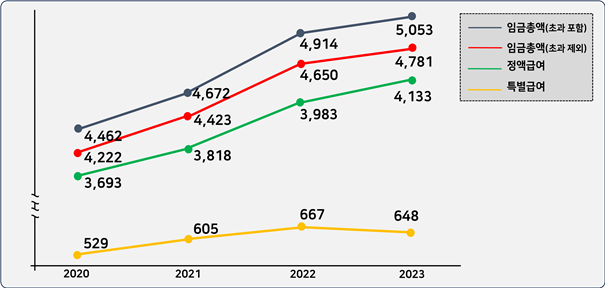 Trends in Total Annual Wages of Regular Employees from 2020 to 2023 (Unit: 10,000 KRW, Provided by Korea Employers Federation)
The 2.8% increase rate in annual total wages fell to about half of the previous year's 5.2%. This is attributed to the special wages, which had increased by 10.4% in 2022, decreasing by 2.9% last year compared to the previous year. However, over the recent three years (2021?2023), the cumulative increase rate of special wages was 22.4%, nearly double the 11.9% increase rate of fixed wages.
The wage gap by business size also widened. Last year, the annual total wages for businesses with 300 or more employees were 69.68 million KRW, up 2.4% from the previous year. In contrast, businesses with fewer than 300 employees saw their annual total wages rise by 2.6% to 42.96 million KRW during the same period. In 2020, the annual total wages of businesses with fewer than 300 employees accounted for 64.2% of those with 300 or more employees, but this ratio shrank to 61.7% in 2023.
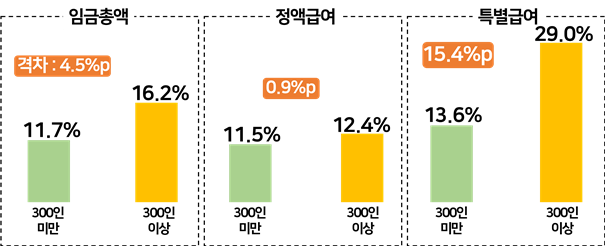 Total Annual Wage Amount and Cumulative Increase Rate of Fixed and Special Allowances by Business Size in 2023 Compared to 2020 (Provided by Korea Employers Federation)
This is interpreted as a widening gap in the payment of special wages such as performance bonuses. Compared to 2020, the increase rate of fixed wages in 2023 was 11.5% for businesses with 300 or more employees and 12.4% for those with fewer than 300 employees, with a difference of less than 1 percentage point. However, the increase rate of special wages was 29.0% for businesses with 300 or more employees, overwhelmingly surpassing the 13.6% for businesses with fewer than 300 employees.
Meanwhile, by industry, the annual total wages were highest in the finance and insurance sector at 87.22 million KRW. This is about three times the size of the lowest sector, accommodation and food services, which stood at 30.29 million KRW.
The hourly wage of all regular employees in 2023 was 25,604 KRW, up 3.6% from the previous year. This was 0.8 percentage points higher than the 2.8% increase rate of annual total wages and matched the inflation rate of 3.6%.
Ha Sang-woo, head of the Economic Research Department at the Korea Employers Federation, stated, "In 2023, wage increase trends slowed somewhat due to deteriorating corporate performance amid the global economic slowdown, but over the past three years, high special wage increases such as performance bonuses in large corporations have driven wage growth. As the dual structure of the Korean labor market deepens, causing various social conflicts, it is necessary to stabilize the excessively high wages of large corporations caused by seniority-based wage systems and labor movements centered on large companies, and to refrain from excessive performance bonus payments to high-wage workers."
© The Asia Business Daily(www.asiae.co.kr). All rights reserved.



















