Despite Animal Abuse Controversy, Some Local Governments Hold Annual Events
Cultural Heritage Administration: "Will Thoroughly Examine Through Academic Research"
As the claim that 'So-ssaum'?a traditional bullfighting event where two bulls butt heads?represents traditional culture clashes strongly with criticisms of animal cruelty, an investigation is being conducted to determine whether So-ssaum holds value as an intangible cultural heritage.
According to academia on the 21st, the Cultural Heritage Administration recently announced a public notice for the 'Basic Academic Survey on So-ssaum as Intangible Cultural Heritage.'
This survey aims to serve as foundational data for discussing whether to designate So-ssaum as a national intangible cultural heritage. Conducted over 210 days from the start date, the investigation will revisit the meaning and history of So-ssaum as a folk game, examining its transmission history and patterns of change.
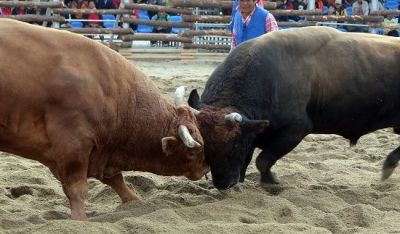
Previously, the Cultural Heritage Administration included So-ssaum among the candidates for new national intangible cultural heritage designations after expert review, but postponed the decision due to opposing opinions. Accordingly, this survey plans to also examine issues surrounding animal cruelty and gambling controversies related to So-ssaum.
Additionally, the possibility of So-ssaum being officially designated as a national intangible cultural heritage item will be reviewed. Intangible cultural heritage refers to intangible cultural assets passed down through generations, including traditional performances and arts, traditional crafts and fine arts, as well as traditional customs related to food, clothing, and shelter.
The Intangible Cultural Heritage Committee, which discusses designation and cancellation of national intangible cultural heritage, gathered last month and agreed that "it is necessary to thoroughly scrutinize problematic aspects related to So-ssaum through academic investigation."
Currently, some local governments such as Cheongdo in Gyeongbuk Province hold So-ssaum annually as part of folk events. Under the 'Act on Traditional Bullfighting Competitions,' ten local governments (Gimhae, Uiryeong, Jinju, Changnyeong, Changwon, Haman, Cheongdo, Dalseong, Wanju, and Boeun) can hold So-ssaum with permission from the Minister of Agriculture, Food and Rural Affairs. However, due to the negative connotations of the word 'fight' implying animal cruelty, the event's name was changed to 'Bull Strength Competition' starting in 2022.
The Korean Folk Encyclopedia of the National Folk Museum states, "Cattle have been used in Korea for about 2,000 years, and So-ssaum likely naturally developed since then," defining it as a "traditional folk game passed down from ancient times." This serves as the basis for local governments' claims that So-ssaum is a legitimate folk game. However, animal protection groups argue that feeding herbivorous bulls carnivorous health tonics such as snake soup and dog soju, subjecting them to harsh training and fights, constitutes animal cruelty and have demanded its abolition.
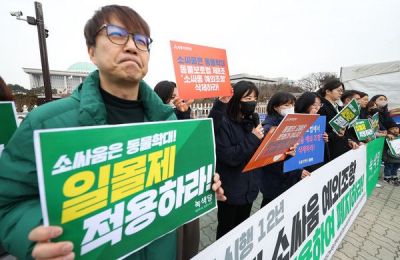 Representatives from the Green Party and Animal Freedom Coalition held a press conference in front of the National Assembly in Yeouido, Seoul, last February, urging the abolition of bullfighting.
 [Image source=Yonhap News]
Considering these circumstances, the Cultural Heritage Administration has proposed including "selection, breeding, and fighting methods of fighting bulls" as tasks to be addressed in the survey, explicitly suggesting the inclusion of animal cruelty aspects. They also requested analysis of how much local residents actually participate in So-ssaum and how people enjoy the So-ssaum culture, along with assessing the degree of gambling involved.
The results of the survey, including the bidding process, are expected to be released as early as the end of this year or early next year. Whether to proceed with the designation survey for national intangible cultural heritage will be decided thereafter.
Meanwhile, starting from the 17th of next month, the legal and administrative system will shift focus from the existing 'Cultural Heritage' to 'National Heritage,' and intangible cultural heritage will be renamed 'intangible heritage,' while national intangible cultural heritage will be renamed 'national intangible heritage.'
© The Asia Business Daily(www.asiae.co.kr). All rights reserved.


















