Causes of Math and Science Study Burden... Repeat Students Likely to Increase in Science Track
In the nationwide joint academic assessment (hereinafter referred to as the academic assessment) held last month, the proportion of high school seniors in the science track was found to have decreased compared to last year. This contrasts with the 'medical school craze' and the 'preference for science track' phenomenon.
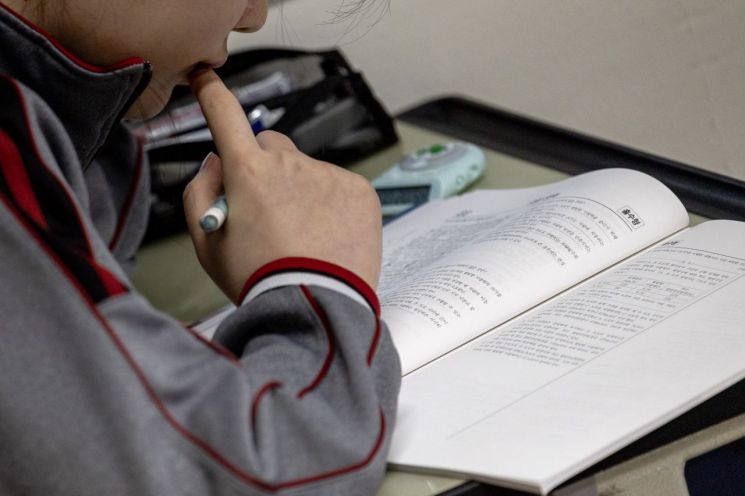
On the 21st, Jongno Academy analyzed the scoring results of the 'March Nationwide Joint Academic Assessment (Hakpyeong)' held on March 28 and found that among high school seniors, 44.9% chose science inquiry in the inquiry section. This is a 2.3 percentage point decrease compared to last year. Since the introduction of the integrated CSAT, which is taken without distinction between humanities and science tracks in Korean and math subjects, the proportion of science inquiry test takers in the March academic assessment increased consecutively for two years from 43.8% in 2022 to 45.3% in 2023 and 47.2% in 2024. This marks the first decrease in science inquiry test takers in three years.
In the Korean language section, the selection rate of 'Language and Media,' which is relatively more chosen by science track students, slightly decreased from 37.6% last year to 37.4% this year. Conversely, the selection rate of 'Speech and Composition,' which is more popular among humanities students, increased from 62.4% to 62.6%.
In the math section, the proportion of students choosing 'Calculus' increased from 43.4% to 43.8%. However, Jongno Academy explained, "Recently, humanities students have been choosing calculus more often, recognizing that it yields higher standard scores," adding, "It is difficult to conclude that the increase in calculus proportion means an increase in science track students."
Lim Seong-ho, CEO of Jongno Academy, analyzed, "Despite the medical school craze and preference for the science track, the decrease in the proportion of science track students among high school seniors seems to be mainly due to the heavy learning burden in math and science." However, unlike high school seniors, repeat test takers (N-su students) are expected to have a higher proportion of science track students than last year. Especially, once the medical school admission quota is finalized next month, the active participation of science track repeaters is expected to make this trend more pronounced.
Reduction in Medical School Expansion Scale... Admission Plans in Uncertainty
The current scale of medical school expansion is expected to be significantly reduced from the originally planned 2,000 students. On the 19th, Prime Minister Han Duck-soo stated, "Considering the educational conditions of each university, among the 32 universities where medical school quotas were expanded this year, those wishing to do so will be allowed to autonomously recruit freshmen within 50% or up to 100% of the increased number for the 2025 academic year only." This fully accepted the requests of the presidents of six non-metropolitan national universities. Depending on the universities' adjustments, the medical school expansion scale for the 2025 academic year, originally 2,000 students, is expected to be reduced to between 1,000 and 1,700 students.
However, despite the government's concession, the medical community's response remains cold. They maintain the stance that no government proposal will be accepted unless it is a complete cancellation.
Therefore, the exact medical school admission quota for next year will only be known at the end of this month. Since the expansion of medical schools affects not only medical school applicants but also the cutoff scores of top universities and departments in a chain reaction, the admission plans of examinees remain uncertain.
© The Asia Business Daily(www.asiae.co.kr). All rights reserved.
![Clutching a Stolen Dior Bag, Saying "I Hate Being Poor but Real"... The Grotesque Con of a "Human Knockoff" [Slate]](https://cwcontent.asiae.co.kr/asiaresize/183/2026021902243444107_1771435474.jpg)











