Ministry of Agriculture, Food and Rural Affairs, Basic Policy for Rural Space Restructuring and Regeneration
A blueprint for a 10-year rural spatial plan has been unveiled to address the crisis of rural disappearance and indiscriminate development, aiming to regenerate rural functions as living spaces, workplaces, and resting places.
The Ministry of Agriculture, Food and Rural Affairs (MAFRA) announced the 'Basic Policy for Rural Spatial Restructuring and Regeneration' containing these details on the 21st.
The Basic Policy for Rural Spatial Planning is established every ten years by MAFRA under the 'Act on Support for Rural Spatial Restructuring and Regeneration,' which came into effect in March this year. It is a strategic plan presenting the future vision and long-term development direction of rural spaces at the national level and serves as a guideline for the 'Basic Plan for Rural Spatial Restructuring and Regeneration' formulated by cities and counties.
MAFRA prepared the draft Basic Policy for Rural Spatial Planning through consultations with local governments and central ministries, and on the 18th, the Rural Spatial Policy Deliberation Committee reviewed, finalized, and announced the policy.
According to the Basic Policy for Rural Spatial Planning, following the new rural paradigm announced by Minister Song Mi-ryeong of MAFRA, the vision is "an open space of opportunity where all citizens can live, work, and rest." It presents three main goals?living space, workplace, and resting place?and six major strategies and tasks including rural spatial restructuring, housing and settlement, living services, economy and jobs, landscape and environment, and community vitality.
Under the Basic Policy for Rural Spatial Planning, the policy framework will completely shift from individual project support led by the central government to a system where local governments and residents take the lead in planning, and the government provides integrated support such as budgeting. The 139 rural cities and counties must establish local government plans by next year in accordance with the Basic Policy for Rural Spatial Planning.
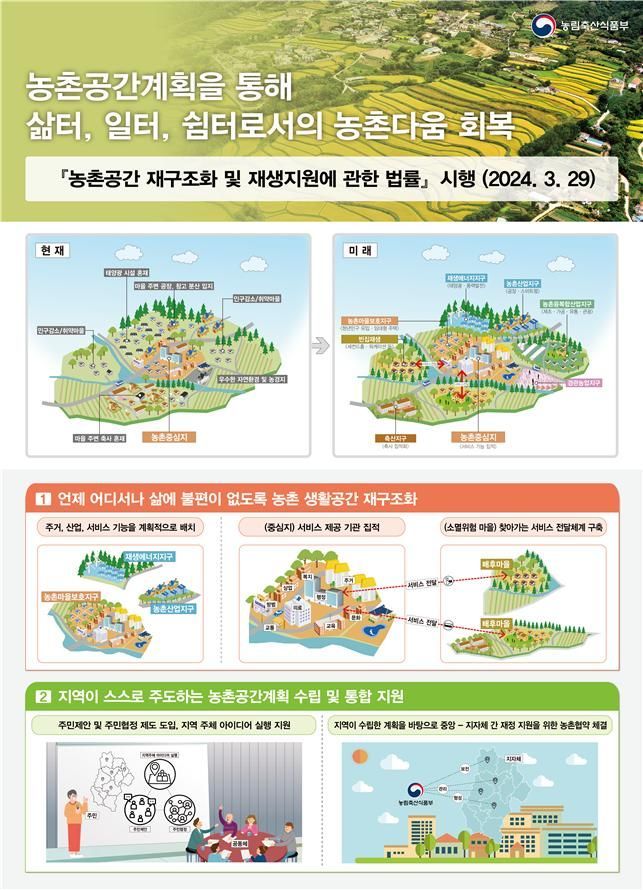
First, rural spaces will be restructured focusing on specialized districts. Cities and counties will designate rural specialized districts by function?such as residential, industrial, livestock, and convergence industries?through rural spatial plans and cluster related facilities. In rural village protection districts, housing and living service infrastructure will be concentrated to improve settlement conditions, while in rural industrial districts and livestock districts, industrial facilities such as enterprises, smart farms, and livestock barns will be clustered to induce synergy effects. The government plans to enhance the utilization of rural specialized districts through deregulation of agricultural and mountainous areas and concentrated project support.
Based on the placement of specialized districts, cities and counties will designate about three 'Rural Regeneration Activation Areas' and establish a 'Basic Plan for Rural Spatial Restructuring and Regeneration' that includes improving settlement conditions and expanding economic and job bases. When cities and counties formulate plans together with residents, the government will sign a 'Rural Agreement' with local governments and provide up to 30 billion KRW in national funding packages over five years.
Efforts will also be made to improve rural housing and settlement conditions. Villages with long-term settlement functions and high potential for population inflow will be designated as rural village protection districts, and new housing sites will be encouraged near eup/myeon centers and complex service facilities to facilitate smooth access to living services such as childcare, education, and culture. The government will support the relocation, clustering, and spatial regeneration of indiscriminate development facilities that harm the settlement environment and establish a systematic maintenance and utilization system for vacant houses and aging residences.
Living service hubs will be fostered, and innovative service delivery models will be expanded. Essential infrastructure investments will be strengthened in eup/myeon centers serving as living area hubs for each city and county, and services will be supplied by systematically connecting 'central areas - basic living hubs - surrounding villages.' Additionally, administrative, welfare, education, and cultural facilities will be integrated into complex clusters to create an environment where residents can access necessary services in one place.
To overcome limitations in rural living service supply such as long distances and low population density, the introduction of service models applying advanced technologies like information and communication technology (ICT) will be expanded, and the living service delivery system will be diversified by enabling residents and local communities to directly participate as service providers.
Alongside this, an industrial ecosystem that converges people, enterprises, and rural resources beyond agriculture will be created. Existing systems will be revised, including easing location regulations, to accommodate new forms of agriculture such as vertical farms. To expand rural-type business startups utilizing unique resources beyond agriculture such as landscape, ecology, and culture, a comprehensive support system for startup stages targeting youth and entrepreneurs will be established. The existing individual enterprise-level rural convergence industries will be advanced, and policy support targets will be expanded to include regional agricultural-related upstream and downstream industries.
Furthermore, landscape agricultural districts and agricultural heritage districts will be used to cluster regional landscape crops and establish preservation and management systems for distinctive regional agricultural heritage. The government will also promote the creation of activity bases for living populations wishing to stay and interact in rural areas by utilizing vacant houses and other idle facilities.
Han Hoon, Vice Minister of MAFRA, stated, "Through rural spatial planning, we plan to make rural areas good living spaces anywhere, vibrant workplaces with diverse opportunities, and attractive resting places, creating open spaces for all citizens." He added, "We will cooperate with local governments and related ministries to ensure that various public demands such as housing, jobs, and leisure are reflected in policies in rural areas that occupy 89% of the national land area."
© The Asia Business Daily(www.asiae.co.kr). All rights reserved.


















