Reborn as Waste Collection Bags
Hyundai Department Store is partnering with HD Hyundai Oilbank to establish a vinyl waste recycling process. They plan to accelerate eco-friendly management by creating the industry's first 'Vinyl Resource Circulation Model,' which transforms vinyl generated from department store and outlet operations into waste collection bags.
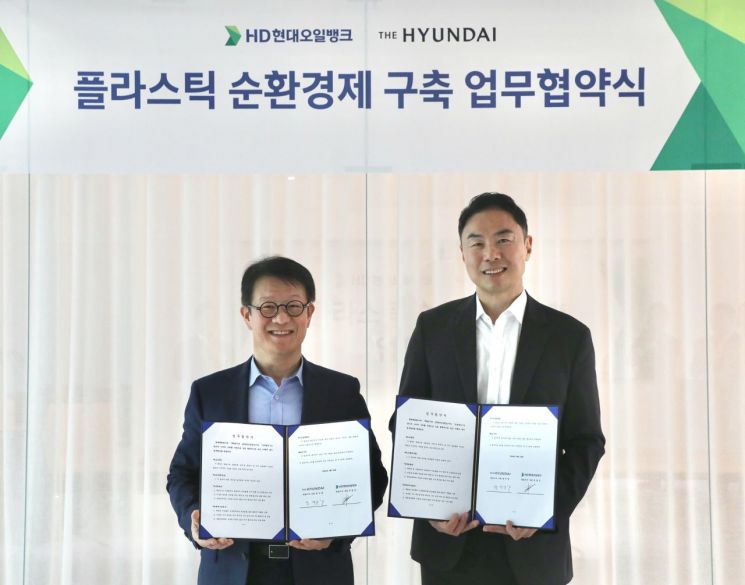 Jung Ji-young, President of Hyundai Department Store (right), and Joo Young-min, President of HD Hyundai Oilbank, are taking a commemorative photo after signing a business agreement to establish a circular economy for plastic vinyl at the HD Hyundai Pangyo Global R&D Center in Seongnam-si, Gyeonggi-do on the 19th.
On the 21st, Hyundai Department Store announced that it signed a 'Business Agreement for Establishing a Circular Economy for Plastic Vinyl' with HD Hyundai Oilbank. In this regard, on the 19th, the agreement ceremony was held at the HD Hyundai Pangyo Global R&D Center in Seongnam, Gyeonggi Province, attended by Hyundai Department Store President Jeong Ji-young, HD Hyundai Oilbank President Joo Young-min, and other officials from both companies.
Through this agreement, both parties agreed to cooperate in introducing the 'Vinyl to Vinyl' process, which recycles vinyl waste generated during department store and outlet operations into waste collection bags.
Typically, clothing, accessories, and food sold at department stores and outlets are covered with vinyl on products and logistics boxes to prevent contamination or product deterioration caused by temperature and humidity changes. This vinyl is made by layering various materials such as plastic, making it practically non-recyclable. Additionally, if food residue is present or stickers are attached, recycling is impossible. As a result, incineration of this vinyl releases greenhouse gases such as carbon dioxide and methane, negatively impacting the environment.
To establish the 'Vinyl to Vinyl' process, Hyundai Department Store collects and compresses packaging vinyl generated at department stores and outlets in 1-ton units and delivers it to HD Hyundai Oilbank. HD Hyundai Oilbank then pyrolyzes the collected vinyl and manufactures it into vinyl waste collection bags, which are provided back to Hyundai Department Store.
Hyundai Department Store will proactively introduce the 'Vinyl to Vinyl' process at five department store locations, including The Hyundai Seoul, Sinchon Branch, and Mokdong Branch, as well as two outlet locations, including Hyundai Premium Outlet Songdo Branch, and plans to expand it sequentially to all stores within the year. They also plan to provide vinyl waste collection bags free of charge to brands operating in each store.
Once the 'Vinyl to Vinyl' process is implemented across all 24 stores nationwide, including 16 department stores and 8 outlets, it is expected to reduce approximately 1,220 tons of carbon dioxide annually from greenhouse gases generated by vinyl waste incineration. This effect is equivalent to planting about 440,000 30-year-old pine trees annually.
Jeong Ji-young, President of Hyundai Department Store, said, "It is significant that we have established a circular economy model in cooperation with HD Hyundai Oilbank by managing the most commonly used vinyl packaging materials in an eco-friendly way." He added, "We will prioritize eco-friendly values and rapidly change existing systems and operational frameworks, while continuing to practice carbon neutrality in daily life that customers can easily experience and participate in, leveraging the characteristics of our business type."
© The Asia Business Daily(www.asiae.co.kr). All rights reserved.
![Clutching a Stolen Dior Bag, Saying "I Hate Being Poor but Real"... The Grotesque Con of a "Human Knockoff" [Slate]](https://cwcontent.asiae.co.kr/asiaresize/183/2026021902243444107_1771435474.jpg)
















