An Active Police Officer's Appeal Posted on Online Community
Approximately 1 Million Intoxicated Person Reports Annually... 4.7% of Total
The police's plea not to report intoxicated individuals lying on the street has become a hot topic on social networking services (SNS) and online communities.

On the 18th, a post titled "The number to call when you see someone lying down who seems drunk on the street" was uploaded to an online community that requires workplace verification for membership. The author, Mr. A, who completed occupational verification with the 'National Police Agency,' began by saying, "Please do not report intoxicated individuals and just pretend you don't see them."
Mr. A explained, "Intoxicated individuals require a joint response, so when you report to 112, both police officers and firefighters are dispatched, and when you report to 119, both firefighters and police officers are dispatched." He added, "Even when dispatched, there is nothing the police or firefighters can do except just stand by." He continued, "I hope that the 119 personnel who can save precious lives and the 112 personnel who can protect victims and subdue criminals will not be unable to respond to urgent scenes because of intoxicated person reports."
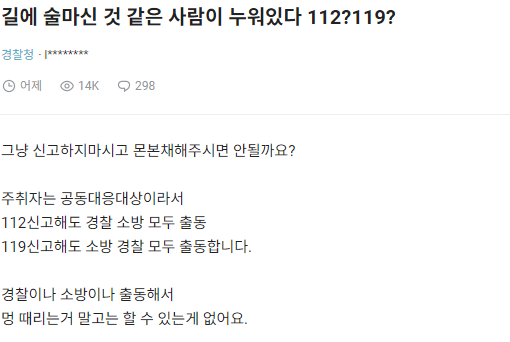 An active police officer is appealing not to report intoxicated individuals.
 [Photo by Online Community]
Mr. A candidly shared, "Honestly, when a report about an intoxicated person comes in, if you try to stimulate and wake them up, they often assault the responders, causing dental injuries and orbital fractures. So it's easier in a way to just stand by and wait until the intoxicated person wakes up."
He also said, "Crime rates at night in Korea are higher than expected. Recently, the scope of crimes and the range of reports have expanded. Sometimes, reports are used as a means to gain an advantage in civil cases." He added, "While watching an intoxicated person and waiting for them to wake up, reports of domestic violence, sexual assault, child abuse, or unknown screams come in via radio, and when the sounds from those scenes are broadcasted, it is very frustrating not to be able to assist my colleagues. Sometimes, when I see colleagues injured at the scene, I even resent the person who reported the intoxicated individual."
Mr. A also said, "This background is probably no different for 119 personnel," and urged, "Please just pretend you don't see intoxicated individuals anymore."
About 1 million intoxicated person reports annually... accounting for 4.7% of all 112 reports

Netizens who read the story responded with comments such as, "I agree 100%. They report but can't even care for the person after waking them up," "I hope a law is enacted to fine people reported for intoxication," and "I think people who drink to the point they can't take care of themselves should just be left alone."
A netizen B, who introduced themselves as an emergency medicine doctor, explained the situation, saying, "Please just leave intoxicated people to sleep. These people are eventually handed over to the police at the emergency room, but as soon as they are handed over, they grab the medical staff by the collar and throw punches. We do get hit, but calming and restraining intoxicated individuals paralyzes the emergency room, and during that time, incoming emergency patients cannot receive treatment."
According to a survey conducted by the National Police Agency last year, about 1 million intoxicated person reports are received annually, accounting for 4.7% of all 112 reports. This averages about 2,700 reports per day. The legal basis for police response to intoxicated individuals is the Police Duty Execution Act, which allows police to take protective measures at the police station if they find a citizen intoxicated and posing a risk to their own or others' life, body, or property. Following a 2021 precedent, the person in need of protection must first be handed over to family, and unconscious intoxicated individuals must receive emergency treatment and be transported to intoxicated person emergency medical centers, as specified in the National Police Agency manual.
■ Let's reduce drinking at company dinners, drinking alone, and drinking with meals... Alcohol management methods
- Alcoholic fatty liver occurs when excessive alcohol intake promotes fat synthesis in the liver and normal energy metabolism is disrupted
- If not properly managed, it can lead to hepatitis, cirrhosis, and eventually liver cancer
- All types of alcoholic beverages are risky; consumption should be reduced
2. Do not exceed 4 shots of soju or 1 can of beer per day; women should drink less
- Risky drinking amounts: 30g per day for men, 20g for women
- Women have much less gastric mucosal alcohol dehydrogenase than men
- Weekly equivalent for men: about 3.5 bottles of 19-degree soju, 10.5 cans of beer, or 3 bottles of wine
- Makgeolli also requires caution due to its high alcohol content of 6-7%
3. Consider alcoholic hepatitis if mild fever, jaundice, or loss of appetite appear after drinking
- Symptoms of alcoholic hepatitis include mild fever, jaundice, loss of appetite, and right upper abdominal pain
- In severe cases, ascites may accompany, making it difficult to distinguish from cirrhosis
- If such symptoms appear after drinking, visit a nearby hospital
© The Asia Business Daily(www.asiae.co.kr). All rights reserved.
![Clutching a Stolen Dior Bag, Saying "I Hate Being Poor but Real"... The Grotesque Con of a "Human Knockoff" [Slate]](https://cwcontent.asiae.co.kr/asiaresize/183/2026021902243444107_1771435474.jpg)


















