Diverging Opinions on Mandatory Rice Purchase Clause
Some Say Committee Still Implies Mandatory Purchase in Practice
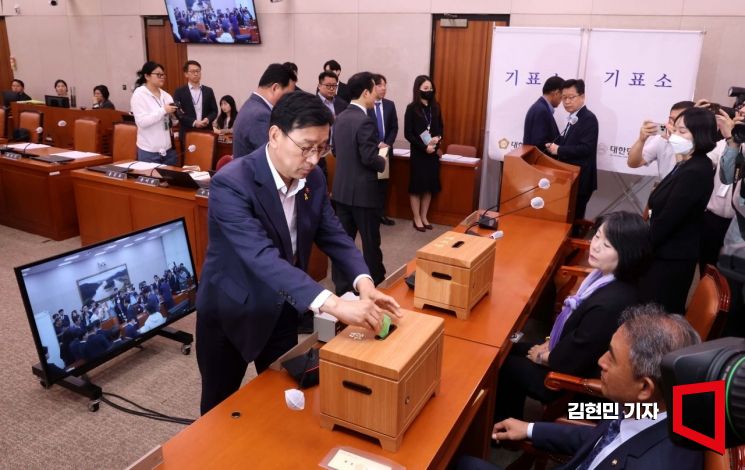 At the plenary meeting of the Agriculture, Forestry, Livestock, Food, and Maritime Affairs Committee held at the National Assembly on the 18th, the proposal to directly refer the 'Grain Management Act Amendment' and the 'Agricultural Products Price Stabilization Act Amendment' to the plenary session of the National Assembly was passed solely by the opposition party. Photo by Kim Hyun-min kimhyun81@
"We have outlined all the reasons for which a veto can be used, so if it is still used, it means the government and ruling party did not properly review the bill" (Yoon Joon-byung, Democratic Party lawmaker)
As the Grain Management Act, on which President Yoon Seok-yeol exercised his 'first veto,' has been re-submitted to the plenary session, the ruling and opposition parties are already sharply clashing over the presidential veto. On the 18th, lawmakers from the Democratic Party's Agriculture, Forestry, Livestock, Food, and Maritime Affairs Committee (AFLFMA Committee) unilaterally passed the 'Request for Plenary Session Submission of the Grain Management Act Amendment Bill.'
Lawmakers from the People Power Party's AFLFMA Committee stated in a position paper, "This Grain Management Act amendment bill revives the clause on the government's compulsory purchase of surplus rice, which was rejected by the National Assembly after the government's reconsideration request in April last year," and pointed out, "The compulsory purchase of surplus rice is a clause that many experts, agricultural organizations, and the government have expressed serious concerns about, as it causes overproduction, rice price decline, increased fiscal burden, and fairness issues, which do not help agricultural development."
Lee Dal-gon, the People Power Party AFLFMA Committee secretary, told Asia Economy in a phone interview, "Opposition lawmakers come from regions in Honam where rice is cultivated, so that is why," expressing the position that the government should exercise the veto. The Ministry of Agriculture, Food and Rural Affairs also stated on the same day, "If surplus rice is compulsorily purchased, it is feared that farmers will be strongly motivated to maintain rice production, exacerbating the oversupply structure," and expressed that it is difficult to agree with the current amendment bill.
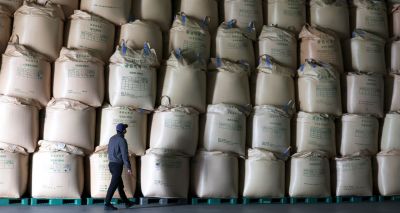
Democratic Party lawmakers argue that it is not a mandatory rice purchase. Yoon Joon-byung, a Democratic Party lawmaker, told Asia Economy in a phone interview, "This amendment bill stipulates that the Grain Supply and Demand Management Committee, chaired by the Vice Minister of the Ministry of Agriculture, Food and Rural Affairs, will decide on market isolation," and added, "It is discretionary isolation, not mandatory isolation." He emphasized that "It is not mandatory isolation, yet without properly examining the regulations, it is being said that mandatory isolation has been revived," and stressed that the government has no grounds to use the veto.
There is also an opinion that even if the Grain Supply and Demand Management Committee is established under the Ministry of Agriculture, Food and Rural Affairs, the government may not be able to oppose mandatory purchase. Professor Kim Sung-hoon of Chungnam National University (Agricultural Economics) said in a phone interview, "If lawmakers say it must be done and farmers go to Yeouido to protest, can it be stopped?" and added, "The biggest concern is that the government signals to the market that it will always take responsibility for rice, which will increase the cultivation area and cause the budget burden to grow like a snowball."
© The Asia Business Daily(www.asiae.co.kr). All rights reserved.
![User Who Sold Erroneously Deposited Bitcoins to Repay Debt and Fund Entertainment... What Did the Supreme Court Decide in 2021? [Legal Issue Check]](https://cwcontent.asiae.co.kr/asiaresize/183/2026020910431234020_1770601391.png)