Seoul City Reports 49.7% Increase in Complaints
Local Governments Granted Expanded Authority
But Legislative Gaps and Staff Shortages Persist
Ko Jaeyoon (38), who lives in Mapo-gu, Seoul, recently experienced an accident where a vehicle collided with an electric scooter parked on the roadside while driving. It was a narrow alley barely wide enough for one car to pass, and the scooter's handlebar touched the vehicle as it made a right turn. Fortunately, the vehicle was not scratched, but Ko was startled and relieved.
Ko said, "When driving, there are many things to pay attention to, but these days, electric scooters carelessly left on the roadside are more of a nuisance than children who might suddenly run out. If my car had gotten scratched, who would be responsible for compensation?"
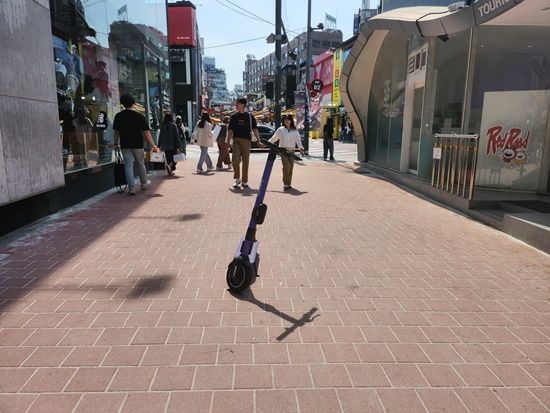 Electric scooters parked near Hongdaeipgu Station in Mapo-gu, Seoul are obstructing pedestrian traffic.
 [Photo by Lee Seohee]
As electric scooters left on the road have become a nuisance, local governments' authority to tow them is gradually being strengthened. However, the voices of citizens complaining about the inconvenience caused by these 'illegally abandoned' scooters continue to grow.
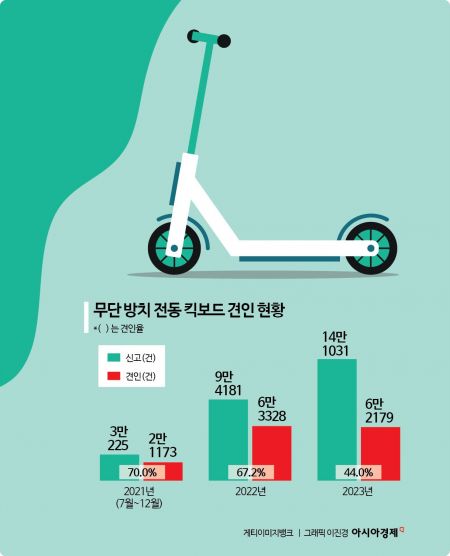
According to Seoul City on the 19th, the number of complaints received through the 'Seoul Electric Scooter Parking Violation Reporting System' last year totaled 141,031, a 49.7% increase compared to 94,181 cases in 2022.
Since the ordinance specifying local governments' authority to tow electric scooters was revised in July 2021, the number of inconvenience reports submitted to Seoul City's reporting system has steadily increased over the past three years. Complaints, which were only 30,225 from July to December 2021, rose significantly to 94,181 in 2022 and 141,031 in 2023.
A representative from Seoul City's Pedestrian and Bicycle Division explained, "As the number of electric scooters deployed and users in Seoul increases, so do the inconvenience reports. When complaints are received by Seoul City, each district autonomously tows the scooters."
Each local government is responding by enacting and revising ordinances regarding illegally abandoned scooters and introducing towing systems. On the 3rd, Seoul City established the '2024 Shared Electric Scooter Management Plan' and added 'protected zones for vulnerable road users' to the existing five immediate towing zones, which include 'roadways and bicycle lanes separated from sidewalks' and 'within 5 meters of subway station entrances and exits.' This aims to significantly strengthen the authority over illegally abandoned scooters. Immediate towing zones refer to areas where local governments can tow scooters without any grace period.
Currently, illegally abandoned scooters are towed jointly by PM companies and local governments. Primarily, personnel affiliated with PM companies patrol regularly to tow illegally parked devices. If the devices are not collected and complaints from citizens are received, towing companies contracted with each district move to the site to collect them. In such cases, a towing fee of 40,000 KRW is paid to the PM company to retrieve the device.
However, the towing rate compared to the number of citizen complaints about illegally parked scooters is significantly low. According to Seoul City, the towing rate, which was 70% in 2021, dropped to 44% last year. Yoo Seonjeong (26), who lives in Gwanak-gu, Seoul, said, "When walking, I often see scooters carelessly left even on roads where cars pass, so I have filed several inconvenience reports. Even hours after reporting, the scooters were not towed, so I wondered when they would be collected."
Experts point out the need for regulatory legislation on PM companies but also suggest filling the legislative gap through increased management personnel and imposing fines. Seoul City's 'PM Supporters,' responsible for educating about illegally abandoned scooters, are deployed with a total of 19 people across four districts?Gangseo, Songpa, Gwanak, and Jungnang?but since they also handle other tasks besides managing illegally parked devices, the manpower is insufficient, and other districts have none at all.
Transportation law expert Jeong Kyungil said, "Currently, PM companies can operate simply by reporting without any special regulations such as licensing. If regulatory legislation for companies is enacted, it could enforce the installation of 'parking zones' and more. It is desirable to fill the gap with legislative efforts along with increasing management personnel and imposing fines."
© The Asia Business Daily(www.asiae.co.kr). All rights reserved.
![Clutching a Stolen Dior Bag, Saying "I Hate Being Poor but Real"... The Grotesque Con of a "Human Knockoff" [Slate]](https://cwcontent.asiae.co.kr/asiaresize/183/2026021902243444107_1771435474.jpg)

















