Takeoff and Landing Training in Suwon, Daegu, and Pohang
The stealth fighter jet F-35B of the U.S. Marine Corps, deployed with the U.S. Forces Korea, conducted training on the Korean Peninsula.
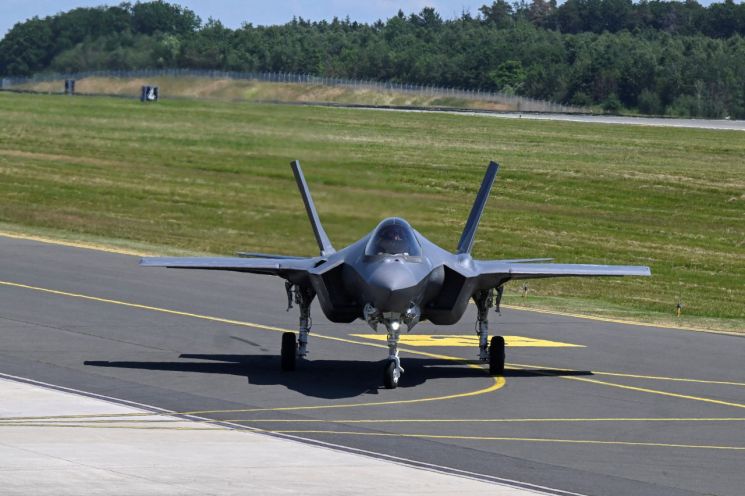
According to the U.S. Department of Defense's Defense Visual Information Distribution Service (DVIDS) on the 18th, the F-35B operated by the U.S. Marine Corps' 121st Fighter Attack Squadron (VMFA-121) landed and trained at Air Force Suwon and Daegu bases, and Navy Pohang base from March 18 to April 2.
At least four F-35Bs deployed from the U.S. military base in Iwakuni, Japan, appear to have been deployed to the Korean Peninsula. Four F-35Bs landed at Suwon base, refueled, and then departed, while at Daegu and Pohang bases, the U.S. Marine Corps' 171st Support Battalion supported the resupply and sortie of the landed F-35Bs during the training. The training was intended to strengthen alliances and cooperation and to familiarize with military operational procedures on the Korean Peninsula. The U.S. Forces Korea explained that it was not in response to provocations such as North Korea's additional military reconnaissance satellite launches.
The F-35B can perform vertical takeoff and landing, unlike the F-35A, which can only be deployed from ground bases. It can take off and land on aircraft carriers and amphibious assault ships. Its top speed is Mach 1.6, and its range is about 2,200 km. Equipped with the Vera radar with a detection range of 500 km, precision-guided bombs such as the Joint Direct Attack Munition (JDAM), and Small Diameter Bombs (SDB) designed to destroy enemy radar sites, it effectively destroys targets. The F-35B first landed in South Korea in 2022 to participate in the Korea-U.S. joint air exercise 'Vigilant Storm.'
© The Asia Business Daily(www.asiae.co.kr). All rights reserved.

















