Comparison of 20 Domestic 'Maeunmat Sauce'
Up to 353 Times Difference in Sugar Content
How much does the spiciness of Korean spicy sauces vary? According to a survey, the spiciness difference between products can be up to 274 times, and the sodium content can be up to 51 times. The Korea Consumer Federation announced on the 18th that it evaluated the quality, safety, and nutrition of a total of 20 spicy sauce products.
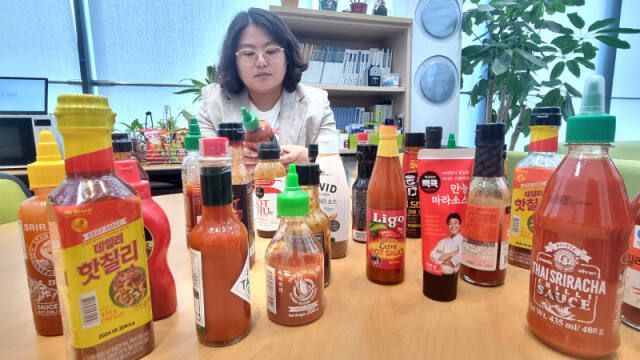 The Korea Consumer Federation announced the results of an experiment comparing 20 "spicy sauce" products on the morning of the 18th at the Fair Trade Commission briefing room in the Government Sejong Complex. The photo shows an employee examining the products. [Image source=Yonhap News]
Spiciness is compared based on the capsaicinoid content. The product with the lowest capsaicinoid content contained 3.2 mg/kg (J-Lec Sriracha Sauce by Cheonha Corporation), while the product with the highest content had 877.2 mg/kg (Teumsae Sauce by Paldo), showing a difference of about 274 times. For the representative Korean spicy sauce, Buldak Sauce (Samyang Foods), the capsaicinoid content was 250.4 mg/kg.
Capsaicinoids are colorless volatile compounds extracted from chili peppers and are known as the ingredients that provide spiciness.
There were also significant differences in sodium and sugar content between products. The sauce with the lowest sodium content per 100g was Bella Hot Seasoned Chicken Sauce manufactured by Bella Food, containing 756.98 mg. On the other hand, the highest was Jindotgae Hot Sauce by Naked Crew, reaching 2909.09 mg.
The sugar content per 100g also varied greatly, ranging from a minimum of 0.1g (Tabasco Pepper Sauce by Ottogi) to a maximum of 35.3g (Daily Hot Chili Sauce by E-Mart), showing a difference of up to 353 times. The World Health Organization (WHO) recommends a daily sugar intake of 50g.
The Consumer Federation advised, "Although the serving size of sauce products is not large, caution is needed not to consume a large amount at once for products with sodium content exceeding 2000 mg per 100g." They added, "There are differences in the degree of spiciness and nutritional content (such as sodium content) among products, so consumers should check these and make wise choices when selecting products."
© The Asia Business Daily(www.asiae.co.kr). All rights reserved.
![Clutching a Stolen Dior Bag, Saying "I Hate Being Poor but Real"... The Grotesque Con of a "Human Knockoff" [Slate]](https://cwcontent.asiae.co.kr/asiaresize/183/2026021902243444107_1771435474.jpg)
















