128 Families for Family Care Youth and 364 Low-Income Crisis Families
50% Payment Based on 85% Median Income Standard and Household Income Difference
Mayor Oh: "Establishing a Representative K-Welfare Model... Nationwide Expansion"
A total of 492 households have been finally selected to participate in the third phase of the 'Safe Income' pilot project, an income security experiment led by Oh Se-hoon. This year, benefits will be concentrated mainly on family caregivers who are youth and low-income households in crisis, who were previously in welfare blind spots.
On the 18th, the Seoul Metropolitan Government announced that the Safe Income support targets for this year are 128 family caregiver youth households and 364 low-income crisis households. From the 26th of this month until March next year, 50% of the difference between 85% of the median income standard and household income will be paid.
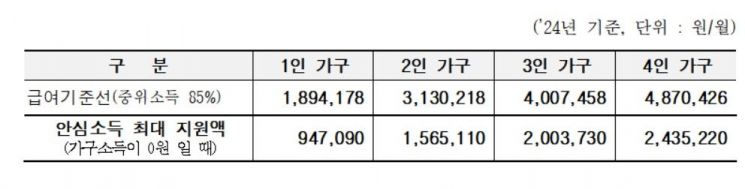
Safe Income is an income security experiment that supplements a certain portion of household income lacking compared to the standard income. It is one of the key projects of Seoul Mayor Oh Se-hoon's commitment to accompany the vulnerable. It is a 'Ha-hu-sang-bak (下厚上薄)' type welfare system that provides more support to those with lower income, aiming to resolve income polarization and welfare blind spots. One of the features is that it eliminates complicated verification procedures such as income conversion of assets, work ability, and presence of dependents, which are problems in the current welfare system, and selects support targets based only on income and asset criteria. In addition, by expanding the guarantee level up to 85% of the median income, it is evaluated as broadly accommodating vulnerable groups in welfare blind spots.
Results from the pilot project over the past one year and six months also showed that participating households' earned income increased and their quality of life improved. Esther Duflo, MIT professor and Nobel laureate in Economics, also stated, "For economically large and developed countries like Korea, selective fiscal support is better than universal basic income," and added, "If I were to design a project, I would have done something similar."
This year, the focus was on discovering and selecting 'family caregiver youth' who have been responsible for their family's livelihood but have not been able to prepare for their own future, and 'low-income crisis households' who have been pushed into sudden crises but are in welfare blind spots due to stringent selection criteria. They will receive 50% of the difference between 85% of the median income standard and household income every month for the next year. However, they cannot receive overlapping cash welfare benefits under the current welfare system such as livelihood and housing benefits, basic pension, Seoul-type basic living security, Seoul-type housing vouchers, youth allowance, and youth monthly rent.
In this regard, Seoul City will hold the 'Safe Income Pilot Project Phase 3 Agreement Ceremony' at the Seoul City Hall Multipurpose Hall this afternoon. About 50 new target households, including Mayor Oh, will attend the ceremony to share cases and exchange opinions. Mayor Oh said, "Safe Income is establishing itself as a genuine K-welfare model where citizens can maintain their dignity and dream of hope," and added, "Since the effectiveness of Safe Income has been proven, we will prepare a reform plan to restructure the current social security system and expand it nationwide, developing it as the next-generation welfare standard."
© The Asia Business Daily(www.asiae.co.kr). All rights reserved.
![User Who Sold Erroneously Deposited Bitcoins to Repay Debt and Fund Entertainment... What Did the Supreme Court Decide in 2021? [Legal Issue Check]](https://cwcontent.asiae.co.kr/asiaresize/183/2026020910431234020_1770601391.png)















